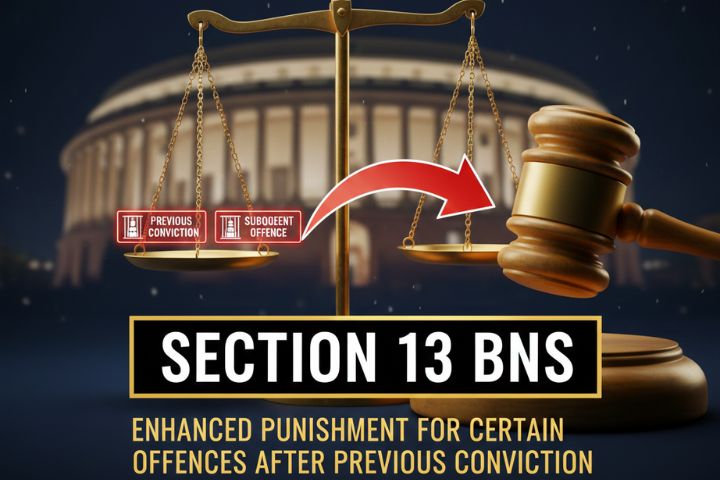
Section 13 Bharatiya Nyaya Sanhita (BNS) – Enhanced Punishment for Certain Offences After Previous Conviction serves as a vital sentencing element which applies to the updated Indian criminal law system. The section empowers judges to impose harsher sentences on repeat offenders who commit new crimes after their first conviction has been established.
The Bharatiya Nyaya Sanhita replaced the Indian Penal Code which was established during colonial times to create modern criminal law for India. The reformed system uses Section 13 of the Bharatiya Nyaya Sanhita to address both recidivism and habitual criminal behavior.
The article studies Section 13 of Bharatiya Nyaya Sanhita BNS Enhanced Punishment for Certain Offences After Previous Conviction through its legal scope and constitutional protections and its comparison to IPC and its real-world effects.
Legislative Intent Behind Section 13 Bharatiya Nyaya Sanhita (BNS)
The foundation of Section 13 Bharatiya Nyaya Sanhita (BNS) lies in deterrence and public protection. Criminal law exists to punish offenders while simultaneously working to stop upcoming criminal activities. The act of an offender committing another illegal act after their first conviction shows that their initial punishment failed to bring about their rehabilitation.
Therefore, legislative intent is justified to enhanced punishment for certain offences after previous conviction.
The law recognizes that repeat offenders demonstrate:
- Greater culpability
- Persistent disregard for the law
- Increased threat to society
By allowing sentencing enhancement, Section 13 Bharatiya Nyaya Sanhita (BNS) reinforces accountability and promotes societal safety.
Legal Requirements for Application
For Section 13 Bharatiya Nyaya Sanhita (BNS) to apply, certain conditions must be satisfied:
Existence of a Prior Conviction
- The accused must have been previously convicted by a competent court of law for a specified offence.
Commission of a Subsequent Offence
- The accused must commit another offence falling within the category eligible for enhanced punishment after previous conviction.
Proof by Prosecution
The prosecution must establish:
- The prior conviction was valid and final
- The conviction has not been overturned
- The accused is the same person previously convicted
Without proper proof, Section 13 Bharatiya Nyaya Sanhita (BNS) cannot be invoked.
Nature of Enhanced Punishment
Under Section 13 Bharatiya Nyaya Sanhita (BNS) – Enhanced Punishment for Certain Offences After Previous Conviction, courts may impose:
- Increased imprisonment term
- Higher fine
- Combination of imprisonment and fine
Importantly, enhanced punishment is not automatic. Courts exercise judicial discretion to ensure fairness and proportionality.
The prior conviction is treated as a sentencing factor — not as a separate offence.
Does It Violate Double Jeopardy?
No.
The constitutional doctrine of double jeopardy prohibits punishing a person twice for the same offence. The Section 13 of Bharatiya Nyaya Sanhita BNS law does not impose additional penalties on the defendant for their previous offense. The court uses the defendant’s previous conviction to determine their punishment for the current crime.
Thus, it remains constitutionally valid.
Constitutional Safeguards
Section 13 Bharatiya Nyaya Sanhita (BNS) operates within constitutional boundaries, including:
Article 20(1)
- Prohibits retrospective criminal penalties. Enhanced punishment applies only if legally prescribed at the time of the second offence.
Article 21
- One should combine various elements of the administrative process concerning justice.
Courts need to provide reasoning at the time of giving enhanced punishments; this makes their actions more transparent and fair.
Sentencing Principles Applied by Courts
When applying Section 13 Bharatiya Nyaya Sanhita (BNS), judges consider:
Proportionality
- Punishment must match the seriousness of the offence.
Deterrence
- Enhanced punishment discourages repeat criminal conduct.
Individual Circumstances
Courts examine:
- Time gap between offences
- Nature and similarity of offences
- Conduct of the accused
- Prospects of rehabilitation
Judicial discretion ensures balanced application rather than mechanical enhancement.
Comparison with the IPC Framework
Under the old IPC regime, Section 75 provided similar provisions for enhanced punishment after previous conviction.
However, Section 13 Bharatiya Nyaya Sanhita (BNS):
- The law language needs updating to its modern form.
- The law improvement process needs to follow general criminal justice reforms.
- The new sentencing system combines with the modified legal code through its implementation.
Thus, it represents continuity with modernization.
Role in Combating Recidivism
Recidivism or repeated criminal behavior is a challenge in India.
Section 13 Bharatiya Nyaya Sanhita (BNS) addresses this issue by:
- Sending a strong message to repeat offenders
- Encouraging reform after first conviction
- Protecting society from habitual criminals
Enhanced punishment for certain offences after previous conviction functions as dual system which both deters potential offenders and protects society from dangerous individuals.
Practical Illustration
The person who developed violent aggression received a judicial sentence which he completed but then proceeded to commit another identical violent crime.
The court receives authority through Section 13 of Bharatiya Nyaya Sanhita (BNS) to apply stronger penalties against particular crimes which have been committed by a defendant with prior felony convictions because they show multiple occasions of breaking the law.
The court needs to impose a more severe punishment because the defendant not only committed past offenses but also exhibits ongoing danger through his repeated criminal activities.
Criticism and Need for Balanced Approach
While Section 13 Bharatiya Nyaya Sanhita (BNS) strengthens deterrence, concerns include:
- The punishment system provides a greater possibility for excessive punishment.
- The punishment system creates a greater possibility to harm vulnerable groups.
- The system now directs less attention towards rehabilitating offenders.
Therefore, enhanced punishment should operate alongside correctional and rehabilitative efforts to achieve balanced justice.
Why Legal Representation is Critical
If you are facing sentencing under Section 13 Bharatiya Nyaya Sanhita (BNS), legal defense becomes extremely important.
An experienced criminal lawyer can:
- Challenge validity of prior conviction
- Verify procedural compliance
- Argue proportionality in sentencing
- Present mitigating circumstances
- Protect constitutional rights
Early legal strategy can significantly impact sentencing outcomes.
Frequently Asked Questions (FAQs)
Q1. What is Section 13 Bharatiya Nyaya Sanhita (BNS)?
It is a provision allowing enhanced punishment for certain offences after previous conviction.
Q2. Is enhanced punishment automatic?
No. Courts exercise judicial discretion.
Q3. Does it violate double jeopardy?
No. It applies to a new offence, not the old one.
Q4. Can prior conviction from years ago be used?
Yes, subject to statutory conditions and judicial assessment.
Conclusion
Section 13 Bharatiya Nyaya Sanhita (BNS) – Enhanced Punishment for Certain Offences After Previous Conviction which applies to defendants who have two or more prior convictions. The law strengthens deterrent effects because it targets repeat offenders and maintains public safety while giving judges discretion to apply constitutional protections.