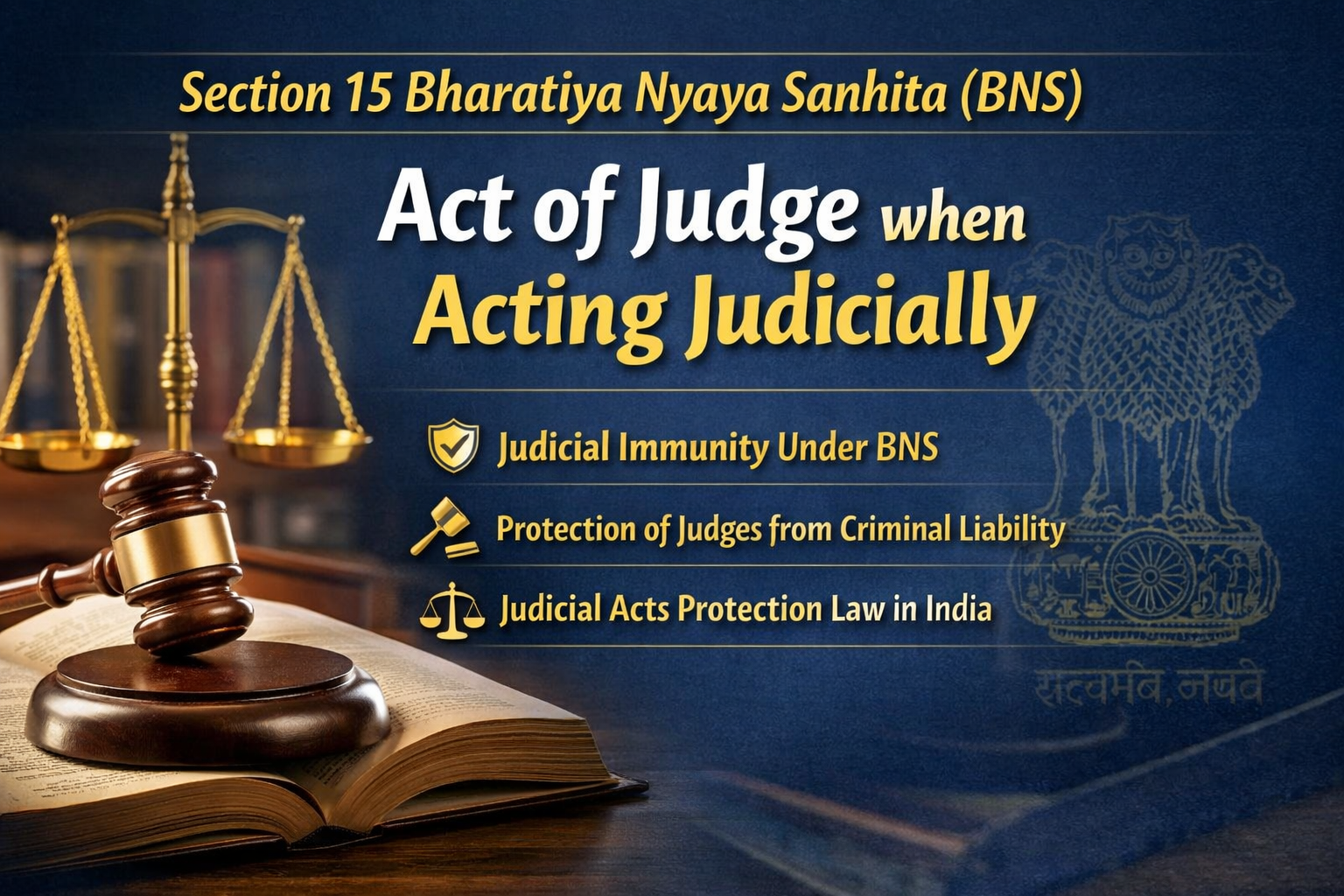
The Bharatiya Nyaya Sanhita 2023 Act has superseded the colonial Indian Penal Code while it transformed multiple aspects of Indian criminal law. The new legislation keeps Section 15 BNS Act of Judge as its most important protection because it defines howAct of Judge when acting judicially
This provision forms the foundation of Judicial immunity under Bharatiya Nyaya Sanhita and ensures that judges are protected from criminal prosecution for acts done while performing their judicial functions. The principle behind the Act of Judge when acting judicially is to preserve judicial independence and maintain public confidence in the justice system.
Meaning of Act of Judge when acting judicially
The phrase Act of Judge when acting judicially refers to actions taken by a judge while exercising lawful judicial authority. Under Section 15 BNS explanation, a judge is not criminally liable for acts performed in the course of official judicial duties, provided such acts are done within jurisdiction.
In simple terms:
- When a judge hears a case
- Evaluates evidence
- Interprets statutory provisions
- Passes an order or judgment
- Issues warrants or sentences
These actions fall under Act of Judge when acting judicially BNS and are protected by law.
This provision establishes clear Judicial protection under Indian criminal law, ensuring that judicial officers are not exposed to harassment through criminal complaints for their decisions.
Purpose of Protection of Judge under BNS
The Protection of Judge under BNS exists for important constitutional and legal reasons. The judicial system requires both independence and impartiality to carry out its functions. The judicial process depends on judges making decisions without fear of criminal charges.
Key Objectives:
- Safeguarding independence of judiciary
- Preventing frivolous criminal complaints
- Maintaining dignity of courts
- Ensuring fearless decision-making
The concept of Immunity of Judge under Indian law ensures that judges can decide cases solely based on facts and law, without external pressure.
Scope of Section 15 BNS Act of Judge
The Section 15 BNS Act of Judge applies when:
- The act is judicial in nature
- The judge acts within lawful jurisdiction
- The act is done in good faith
This reflects the principle of Good faith judicial action under BNS. If a judge passes an order honestly and within authority, protection applies even if the decision is later set aside by a higher court.
The Act of Judge when acting judicially does not mean absolute immunity in all circumstances. Protection exists only for judicial functions, not for personal or illegal conduct.
Criminal liability of Judge under BNS
A common question arises regarding Criminal liability of Judge under BNS. The law does not grant blanket immunity. A judge may be held accountable if:
- The act is done outside jurisdiction
- The act is malicious or corrupt
- The conduct is administrative, not judicial
- There is evidence of bad faith
Therefore, while the Act of Judge when acting judicially BNS protects lawful judicial conduct, it does not shield misconduct.
Difference between judicial act and administrative act
Understanding the Difference between judicial act and administrative act is crucial.
Judicial Act:
- Performed during court proceedings
- Based on evidence and legal reasoning
- Involves adjudication of rights
- Protected under Section 15 BNS Act of Judge
Administrative Act:
- Related to court management
- Staff appointments, transfers, infrastructure decisions
- Not directly part of adjudication
Only judicial acts qualify for protection under Judicial acts protection law in India.
Judicial acts protection law in India
The doctrine of Judge protection for judicial acts is not new. It has long been part of Indian criminal jurisprudence. The principle ensures that judicial decisions are challenged through appeals or revisions, not through criminal prosecution.
The Act of Judge when acting judicially strengthens this doctrine by affirming that mistakes in judgment do not automatically amount to criminal offences.
This provision reinforces Judicial immunity under Bharatiya Nyaya Sanhita and supports separation of powers between judiciary and executive.
Old Section vs New Section
Under the repealed Indian Penal Code, similar protection was provided under Section 77 IPC.
Old Provision:
- Section 77 IPC
- Protected judges acting judicially
- Based on good faith and jurisdiction
New Provision:
- Section 15 BNS Act of Judge
- Continues same principle
- Incorporated under the new criminal framework
The language has been modernized, but the legal philosophy behind Act of Judge when acting judicially remains consistent.
Practical Illustration
Consider a situation where a trial judge convicts an accused based on available evidence. Later, the High Court reverses the decision. The accused cannot initiate criminal proceedings against the trial judge for wrongful conviction.
Why? Because the decision was an Act of Judge when acting judicially, done within jurisdiction and in good faith.
The appropriate remedy is appeal, not prosecution. This reflects the core idea of Immunity of Judge under Indian law.
Importance in the Indian Legal System
The Act of Judge when acting judicially BNS plays a central role in maintaining institutional balance. Without this safeguard:
- Judges may hesitate to pass strict orders
- Powerful litigants could misuse criminal complaints
- Judicial efficiency may suffer
By ensuring Protection of Judge under BNS, the law protects not individual judges but the institution of justice itself.
Key Takeaways
- Act of Judge when acting judicially protects judges from criminal liability for judicial acts.
- Protection applies only when acting within jurisdiction.
- It supports Judicial immunity under Bharatiya Nyaya Sanhita.
- It replaces Section 77 IPC under the new law.
- It differentiates between judicial and administrative functions.
- It prevents misuse of criminal proceedings against judges.
The Section 15 BNS explanation confirms that judicial independence remains a core principle under the new criminal code.
Frequently Asked Questions (FAQ)
1. What does Act of Judge when acting judicially mean?
It means a judge cannot be criminally prosecuted for acts performed while exercising lawful judicial authority.
2. Does Section 15 BNS provide absolute immunity?
No. Protection applies only to judicial acts done within jurisdiction and in good faith.
3. What is the difference between Section 77 IPC and Section 15 BNS?
Section 77 IPC provided similar protection under the old criminal code. Section 15 BNS continues that principle under the new legal framework.
4. Can a judge be prosecuted for corruption?
Yes. If there is corruption or action outside judicial function, protection under Act of Judge when acting judicially BNS does not apply.
5. Why is judicial immunity important?
It preserves independence of the judiciary and ensures decisions are challenged through appeals rather than criminal prosecution.