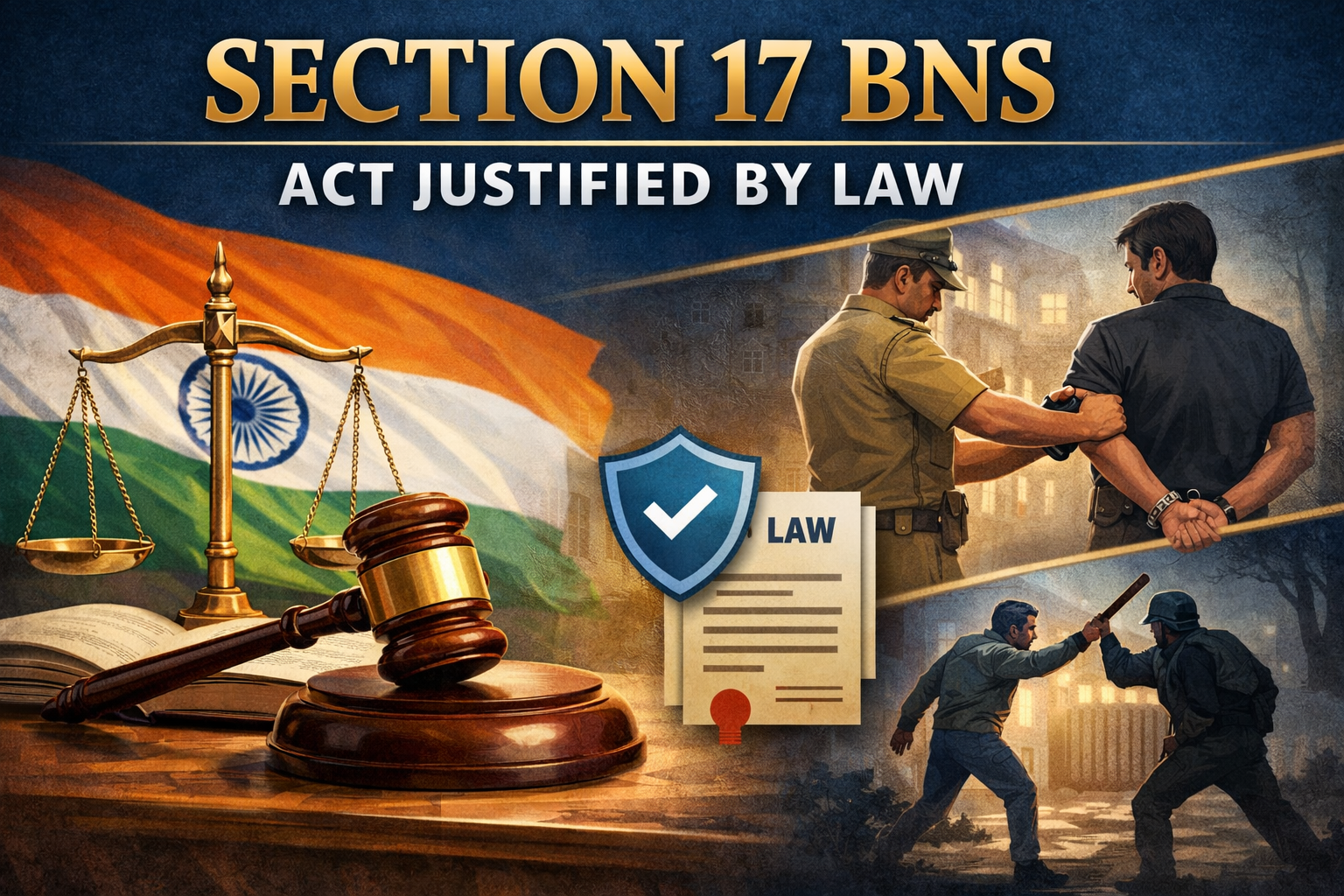
The Bharatiya Nyaya Sanhita, 2023 (BNS), which replaced the Indian Penal Code, 1860 (IPC), contains an important chapter on General Exceptions — provisions that remove criminal liability in specified circumstances. Among these, Section 17 BNS – Act Justified by Law stands as one of the most fundamental protections in Indian criminal jurisprudence. It provides that a person who does an act that is justified by law, or who by reason of a mistake of fact honestly believes that the act is justified by law, shall not be held criminally liable — provided the act is done in good faith
This provision — the Section 17 BNS – Act Justified by Law defence — is rooted in the age-old recognition that criminal law cannot justly punish a person who acts without a guilty mind (mens rea). When a person genuinely and reasonably believes, based on facts (not law), that their act is legally sanctioned, the moral foundation for criminal punishment does not exist. This blog provides a detailed and in-depth analysis of Section 17 BNS – Act Justified by Law, its essential elements, its practical applications, key illustrations, its comparison with the old Section 79 IPC, and the scope and limits of its protection.
What Is Section 17 BNS – Act Justified by Law? Legal Text and Meaning
Section 17 of the Bharatiya Nyaya Sanhita, 2023 which belongs to BNS General Exceptions Chapter II states that no action can be considered an offence when a person performs it who has legal authority to do so or who believes he has legal authority to do so because of his genuine misunderstanding of factual information.
Section 17 BNS – Act Justified by Law thus covers two distinct situations:
- Direct justification: The person’s act is actually and objectively justified by law — for instance, a police officer making a lawful arrest has a direct legal justification for the act of detention.
- Honest belief based on mistake of fact: The act may not in fact be justified by law, but the person, by reason of a mistake of fact — and not a mistake of law — genuinely and in good faith believed that it was. This is the crucial second limb of Section 17 BNS.
The provision is the equivalent to Section 79 IPC under the old Indian Penal Code. As the equivalent to Section 79 IPC, it retains the exact same legal principle, though the language has been modernised to align with the drafting style of the BNS, 2023.
Core Elements of Section 17 BNS – Act Justified by Law
To claim the protection of Section 17 BNS – Act Justified by Law, all of the following essential elements must be present. Courts have consistently held that each element must be independently established.
1. The Act Must Be Done by a Person Justified by Law
Justification under law is the first and foundational element. The person must either have actual legal authority to do the act — such as a police officer authorised to arrest without warrant in certain circumstances — or must have an honest and reasonable belief grounded in a mistake of fact, not a mistake of law, that the act is lawful. Justification under law can arise from statutory provisions, court orders, or specific legal powers conferred by the State.
2. Mistake of Fact, Not Mistake of Law
The distinction between mistake of fact vs. mistake of law is one of the most important in all of criminal law. Section 17 BNS exclusively protects persons who act under a mistake of fact). The law gives no protection for mistakes about what the law says — the maxim ignorantia juris non excusat (ignorance of law is no excuse) applies. However, ignorance of fact vs. ignorance of law — where a person does not know a material fact — is covered under this section. A person who kills another person believing them to be a wild animal in the dark cannot claim a mistake of law, but they may claim a mistake of fact under Section 17 BNS.
3. Good Faith Requirement
The good faith requirement is the central test of Section 17 BNS. Good faith under Indian law means an act done with due care and attention — it is not a mere assertion of honest belief. The person must have had reasonable grounds for belief — the belief must be founded on facts that a reasonable person in that situation would have considered reliable.
4. Absence of Mens Rea
The doctrine of absence of mens rea underpins the entire provision. Criminal liability in India generally requires both a wrongful act (actus reus) and a guilty mind (mens rea). When a person acts under a bona fide act under law or under a genuine mistake of fact, the element of criminal intent — mens rea — is absent. Without absence of mens rea, the state cannot morally or legally justify punishing the person. It is this combination of actus reus without criminal intent and honest belief that Section 17 BNS is specifically designed to address.
Mistake of Fact vs. Mistake of Law – The Critical Distinction Under Section 17 BNS
Understanding the boundary between mistake of fact vs. mistake of law is essential when applying Section 17 BNS – Act Justified by Law. Courts have grappled with this distinction in many cases, and the following principles have been established:
- Mistake of fact: Occurs when a person is mistaken about the existence or nature of a factual circumstance. Example — a person kills someone believing that person to be a burglar breaking into their home at night. The belief about who the person was is a factual mistake. If this belief was in good faith based on reasonable grounds for belief, Section 17 BNS protection applies.
- Mistake of law: Occurs when a person is mistaken about what the law says or permits. Example — a person believes that a particular act is legally permitted, when in fact it is not. The law does not excuse this — ignorance of fact vs. ignorance of law is a fundamental distinction, and only the former is protected by Section 17 BNS.
- Knowledge vs. belief in criminal law: Section 17 BNS uses the word ‘believes’ — meaning the person need not have actual knowledge of all the facts, but must have a genuine, honest and reasonable belief based on the facts available to them at the time of acting. The standard of knowledge vs. belief in criminal law is therefore subjective (was the belief genuine?) as well as objective (was there a reasonable basis for it?).
Section 17 BNS and Public Officers – Special Relevance
Section 17 BNS and public officers have a particularly important relationship. Police officers and revenue officials and forest officials together with other public servants face emergency situations which require them to make instant decisions based on incomplete information while they need to determine whether their actions will be legal or illegal.
- Section 17 BNS and public officers: A police officer who arrests a person believing them to be the wanted accused — based on a genuine mistake of fact such as a resemblance in description — is protected under Section 17 BNS. The protection applies because the officer held a sincere belief that he acted upon valid evidence.
- Acting in good faith under authority: A forest officer who seizes timber believing it to be illegally cut — acting on a genuine mistake of fact about the ownership or permit — is acting in good faith under authority and would be protected under this section.
- Colour of law defence: Section 17 BNS also encompasses the colour of law defence — where a public officer acts under an apparent legal authority that turns out not to exist, but where the officer honestly and reasonably believed the authority was real. The colour of law defence is available only when the belief was genuine and grounded in fact, not in a misunderstanding of the law.
Private Defence and Mistake of Fact Under Section 17 BNS
Private defence and mistake of fact is one of the most practically relevant applications of Section 17 BNS. A person exercising the right of private defence may, in the heat of the moment, act under a genuine mistake of fact about the nature or severity of the threat they face.
Example: A person sees someone approaching them at night with a stick. Believing they are about to be seriously assaulted, they strike back with force, seriously injuring the other person — who turns out to be a night watchman making rounds. Here, the belief in the need for private defence and mistake of fact is based on a genuine misreading of the factual situation. If the belief was honest and reasonable in the circumstances, Section 17 BNS – Act Justified by Law would protect the person from criminal liability.
It is important to note the distinction between voluntary act vs. act under belief: a person who deliberately and wilfully attacks another cannot claim Section 17 BNS protection. The protection applies only to voluntary act vs. act under belief — where the act, although voluntary, was performed under an honest and good-faith belief that it was justified by law.
Scope and Limits of Section 17 BNS – Act Justified by Law
The scope and limits of Section 17 BNS are carefully defined by the legislature and further refined by judicial decisions. Understanding these boundaries is critical to correctly applying the provision.
What Section 17 BNS Protects
- The law permits actions done justification under law because the law explicitly permits those actions.
- Protection is not available where the person acts under a mistake of law or without exercising due care and attention.
- Acts of Section 17 BNS and public officers who exercise statutory powers under a mistaken but reasonable belief about the facts.
- Acts of private individuals exercising private defence and mistake of fact — where the belief in the need for defence was genuine and based on facts.
What Section 17 BNS Does NOT Protect
- Acts based on a mistake of law — mistake of fact vs. mistake of law is a hard boundary, and the latter never attracts protection under Section 17 BNS.
- The good faith requirement exists as an essential requirement that cannot be changed.
- The person must demonstrate that he possessed absolutely no valid reasons to think the situation existed in order to meet this requirement.
- The defendant must demonstrate that he understood the illegal nature of his actions and that he acted with this knowledge because he did not possess the required mental state.
Judicial Interpretation of Mistake of Fact
The judicial interpretation of mistake of fact under Section 17 BNS (and its predecessor Section 79 IPC) has consistently held that the test is both subjective and objective. Subjectively, the belief must be genuine and honest. Objectively, there must have been reasonable grounds for belief — a completely baseless or fanciful belief does not attract the protection from criminal prosecution afforded by this section. Courts have also emphasised that the bona fide act under law standard requires due care, not mere assertion of belief.
Section 79 IPC to Section 17 BNS – Old Law vs. New Law: A Detailed Comparison
The Bharatiya Nyaya Sanhita, 2023 repealed the Indian Penal Code, 1860 in its entirety. Section 79 IPC — which governed acts done by a person justified by law or by mistake of fact believing themselves justified — has been carried forward as Section 17 BNS. The detailed comparison table below shows precisely what changed, what remained the same, and how the transition from old to new law affects practitioners and citizens.
| Parameter | Section 79 IPC (Old Law) | Section 17 BNS (New Law) |
| Governing Act | Indian Penal Code | Bharatiya Nyaya Sanhita |
| Section Number | Section 79 IPC | Section 17 BNS |
| Chapter | Chapter IV – General Exceptions | Chapter II – General Exceptions (Renumbered) |
| Core Principle | Act justified by law, or by mistake of fact believing justified | Identical principle retained — no substantive change |
| Good Faith Requirement | Mandatory — due care and attention required | Mandatory — bona fide act under law; same standard |
| Mistake of Fact | Covered — must be mistake of fact, not law | Covered — identical treatment; mistake of fact only |
| Mistake of Law | Not covered — ignorantia juris non excusat | Not covered — same legal position retained |
| Absence of Mens Rea | Central to protection — no guilty mind, no crime | Same — absence of mens rea remains foundational |
| Public Officers | Applicable to public officers acting under lawful authority | Equally applicable — Section 17 BNS and public officers |
| Private Persons | Applicable to private persons acting under belief | No change in scope — equally applicable |
| Private Defence | Covers private defence involving mistake of fact | Same — private defence situations included |
| Colour of Law Defence | Recognised in jurisprudence under Section 79 IPC | Preserved under Section 17 BNS |
| Reasonable Belief Standard | Subjective + objective test — genuine belief + reasonable grounds | Same dual test — honest and reasonable belief required |
| Drafting Language | Victorian-era English; archaic style | Modernised, plain-language drafting |
| Judicial Precedent | 160+ years of case law developed | Section 79 IPC precedents remain persuasive |
| Effect of Repeal | Repealed by BNS, 2023 | Replaces Section 79 IPC; identical protective intent |
| Related Provisions | Read with Sections 52 (Good Faith) & 76 IPC | Read with BNS definition of Good Faith & Section 16 BNS |
The comparison makes clear that Section 17 BNS is the direct and faithful equivalent to Section 79 IPC. No substantive change has been made in the legal protection offered. The transition from old law to new law is a renumbering and language modernisation — not a change in principle. Legal practitioners can confidently rely on all judicial precedents decided under Section 79 IPC when arguing or adjudicating cases under Section 17 BNS.
Key Takeaways from the Old-to-New Transition
- The mistake of fact vs. mistake of law distinction is fully preserved — only mistake of fact attracts protection.
- The good faith requirement and reasonable grounds for belief standard remain identical under both old and new law.
- All Section 17 BNS and public officers protections from the IPC era carry forward without dilution.
- The colour of law defence and private defence and mistake of fact doctrines remain equally available under Section 17 BNS.
- The BNS General Exceptions Chapter II renumbers — but does not restrict — the protections formerly found in Chapter IV of the IPC.
Conclusion
Section 17 BNS – Act Justified by Law is a cornerstone of India’s criminal law framework. By protecting persons who act under a genuine mistake of fact — and not a mistake of law — the provision ensures that criminal liability is reserved for those who act with a guilty mind, not those who act honestly under an honest misapprehension of facts. The principles of absence of mens rea, good faith requirement, honest and reasonable belief, and bona fide act under law converge in this section to create a balanced and fair legal protection.