The Bharatiya Nyaya Sanhita (BNS) of 2023 has replaced the Indian Penal Code of 1860 and brought fundamental changes to the Indian legal system. The new legislation maintains multiple legal principles which were established under the IPC. One such important legal principle is addressed in Section 19 Bharatiya Nyaya Sanhita – Act likely to cause harm.
The rule recognizes that in certain situations a person needs to perform dangerous actions which require approval because they exist to protect against a greater threat. Criminal law does not treat such actions as offences when they are performed honestly and without criminal intention.. This concept forms part of the Bharatiya Nyaya Sanhita general exceptions, which protect individuals who act without criminal intent in emergency situations.
The principle behind Section 19 Bharatiya Nyaya Sanhita – Act likely to cause harm reflects the idea that the law must consider human judgment in difficult circumstances. If a person acts in good faith to prevent serious harm, the law provides protection from criminal liability.
Understanding Section 19 Bharatiya Nyaya Sanhita – Act Likely to Cause Harm
The legal meaning of Section 19 Bharatiya Nyaya Sanhita – Act likely to cause harm states that an act which may cause harmful effects does not qualify as an offense when performed with good faith and without criminal intent to protect another person or their property from harm.
The law permits persons to defend themselves through legal means which do not require immediate police assistance. The provision acknowledges that some situations demand urgent decisions because a person must select between two dangerous options. The law permits people to take necessary actions which help them avoid more severe threats.
This concept is closely connected with the Doctrine of necessity in criminal law, which permits an individual to execute an unlawful action when the action becomes essential for stopping more significant damage.
In simpler terms, Section 19 of the India Penal Code protects people who take decent action in emergencies to save life or property.
Key Conditions Under Section 19 Bharatiya Nyaya Sanhita – Act Likely to Cause Harm
For protection under Section 19 Bharatiya Nyaya Sanhita – Act likely to cause harm, several conditions must be satisfied. Courts carefully evaluate these elements before granting the defence.
1. The Act May Cause Harm
The first requirement is that the act performed may potentially cause harm. However, the person performing the act is aware that the harm is unavoidable in the circumstances.
The concept of Act likely to cause harm BNS describes a situation where an individual understands the dangerous situation yet takes action to stop more severe consequences from happening.
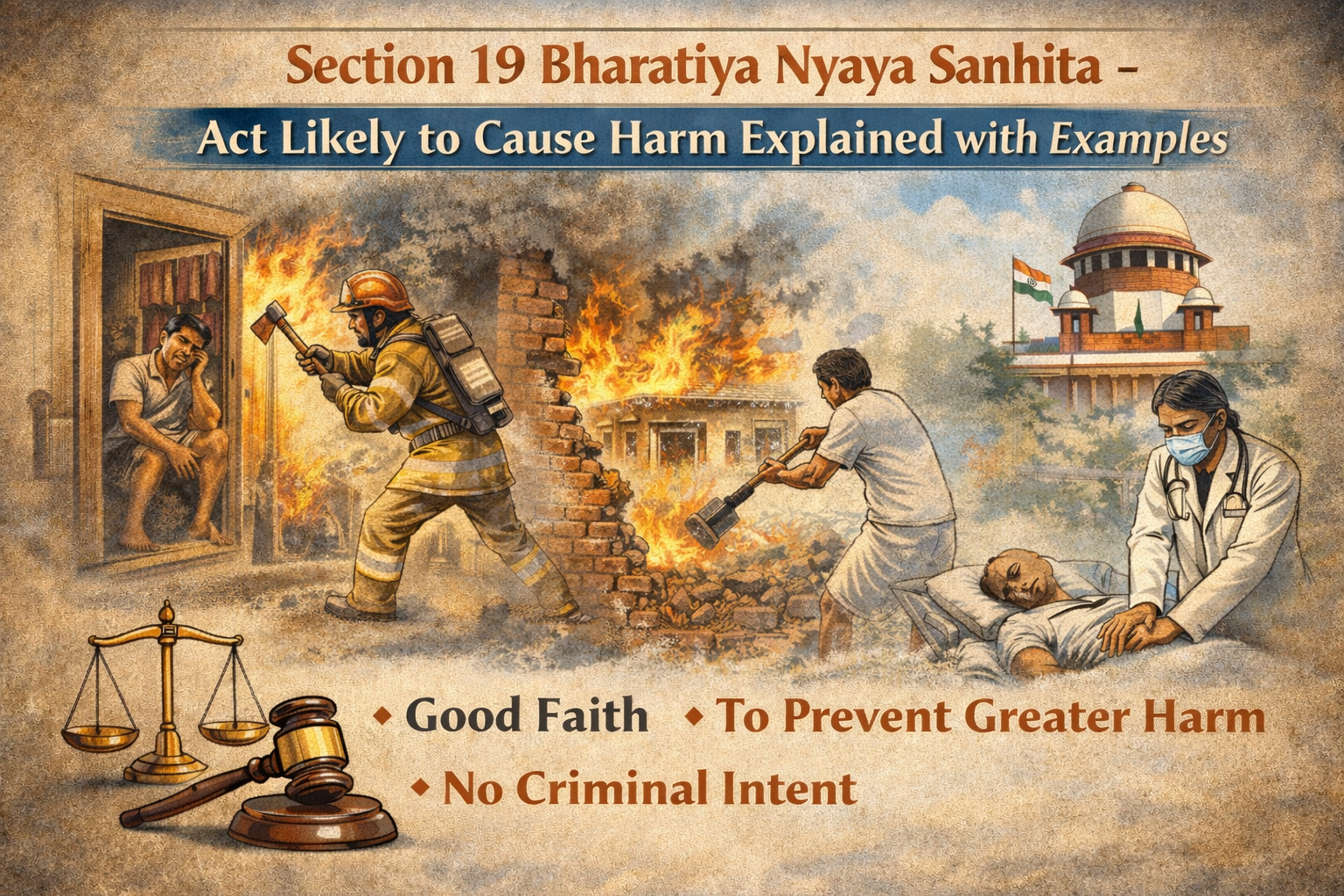
The fire department breaks down doors to rescue people who are trapped inside burning buildings. The fire department breaks down doors because their mission requires them to protect lives.
2. Absence of Criminal Intention
Another important condition of Section 19 Bharatiya Nyaya Sanhita – Act likely to cause harm is the absence of criminal intention.
The person must not intend to cause harm for wrongful purposes. Instead, the action must be taken with the purpose of preventing greater damage.
This reflects the concept of Criminal liability without intent BNS, which means that liability should not arise when there is no guilty intention.
3. The Act Must Be Done in Good Faith
The law requires that the act must be performed honestly and with the belief that it is necessary to prevent harm.
This element is known as Act done in good faith to prevent harm.
Courts examine whether the person genuinely believed that the action was necessary under the circumstances. If the act was done dishonestly or recklessly, the defence may not apply.
4. Purpose of Preventing Greater Harm
One of the most important aspects of Section 19 Bharatiya Nyaya Sanhita – Act likely to cause harm is that the act must be done to prevent a greater danger.
This is described as Act done to prevent greater harm law, which allows limited harm when it prevents serious injury or loss.
For example:
- The firefighters needed to break down the wall to control the fire from reaching adjacent buildings.
- The team needs to remove the hazardous object which poses a risk of serious harm to people present.
In such cases, the person acts to avoid a larger disaster.
5. Presence of an Emergency Situation
The defence under Section 19 Bharatiya Nyaya Sanhita – Act likely to cause harm explained generally arises in situations involving urgency or danger.
Such situations are referred to as Protection for actions taken in emergency.
In emergencies, individuals may have to make quick decisions to protect life or property, and the law acknowledges these circumstances.
Role of Section 19 Bharatiya Nyaya Sanhita – Act Likely to Cause Harm in Criminal Law
The principle established under Section 19 Bharatiya Nyaya Sanhita – Act likely to cause harm plays an important role in maintaining fairness within the criminal justice system.
Without this provision, individuals acting responsibly during emergencies could face criminal prosecution.
This rule is closely connected with the Criminal law necessity defence India, which allows actions that may technically cause harm but are necessary to avoid greater danger.
Importance of the Provision
- Protects individuals acting during emergencies
- Prevents unjust punishment when the intention is to prevent harm
- Recognizes human judgment in difficult situations
- Supports fairness within criminal law
The provision therefore acts as an important Legal defence under Section 19 BNS.
Practical Examples of Section 19 Bharatiya Nyaya Sanhita – Act Likely to Cause Harm
Understanding real-life situations helps clarify how the provision works.
Example 1: Breaking a Door to Save a Person
If a person breaks the door of a house to rescue someone trapped inside during a fire, the act causes property damage but saves a life.
Such an act may fall under Acts done to avoid greater danger.
Example 2: Destroying Property to Stop a Fire
A person demolishes part of a building wall to prevent a spreading fire from destroying several houses.
The act causes limited damage but prevents a much larger disaster.
Example 3: Emergency Medical Assistance
In certain emergencies, a doctor may perform a procedure that carries risk to save a patient’s life.
Such actions may qualify as Good faith act to prevent harm under the law.
Old Law Comparison – Section 81 IPC
Before the introduction of the Bharatiya Nyaya Sanhita, a similar provision existed under the Indian Penal Code, 1860.
Section 81 IPC – Old Provision
Section 81 IPC stated that an act likely to cause harm but done without criminal intention and in good faith to prevent other harm would not be considered an offence.
Similarity with Section 19 BNS
The principle under Section 81 IPC has been carried forward into Section 19 Bharatiya Nyaya Sanhita – Act likely to cause harm.
The legal doctrine remains the same, though the provision now appears under the new criminal law framework.
Courts may continue relying on earlier judicial interpretations of Section 81 IPC while interpreting the new provision.
Judicial Approach to Necessity and Harm Prevention
Courts in India evaluate cases involving Section 19 Bharatiya Nyaya Sanhita – Act likely to cause harm by examining several factors:
- Whether the act was performed in good faith
- Whether the harm prevented was greater than the harm caused
- Whether the situation involved urgency or emergency
- Whether the accused acted honestly and reasonably
These factors help determine whether the act qualifies as a legitimate Criminal intent and harm prevention law defence.
Conclusion
The principle explained under Section 19 Bharatiya Nyaya Sanhita – Act likely to cause harm ensures that criminal law remains fair and practical when dealing with emergency situations. The provision acknowledges that individuals sometimes need to take actions that may cause limited harm in order to prevent serious danger.
As part of the General exceptions under BNS, the section protects individuals who act honestly and in good faith to safeguard life or property. The rule also reflects the broader concept of necessity recognized in criminal law across many legal systems.