India’s criminal law system establishes that children below a certain age lack the ability to grasp their actions and their results. The legal system provides protection to extremely young children because they lack the capacity to face criminal charges. One such important provision is Section 20 BNS – Act of a Child Under Seven Years of Age under the Bharatiya Nyaya Sanhita.
This provision falls within the General exceptions under Bharatiya Nyaya Sanhita, which identify circumstances where a person cannot be held criminally liable. The BNS Section 20 legal provision states that any act done by a child under seven years of age cannot be treated as an offence because the child is legally presumed incapable of forming criminal intent.
This rule is based strictly in the traditional Indian law known as `Doli incapax`, which states that a child of very young age lacks the mental capacity to commit a crime. Therefore, the law grants Child immunity from criminal offence India for children below seven years.
Section 20 BNS – Act of a Child Under Seven Years of Age Explained
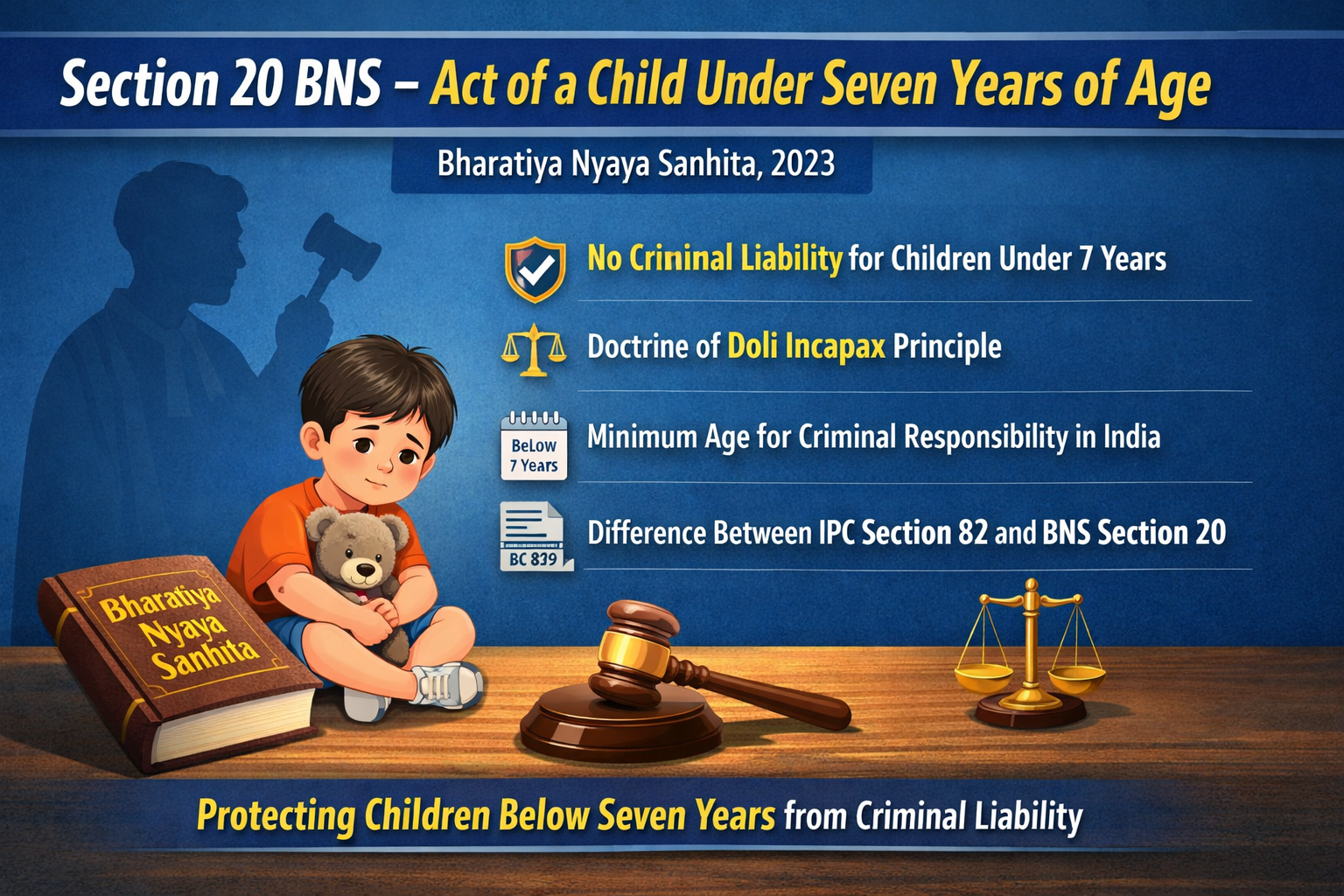
The Section 20 BNS – Act of a Child Under Seven Years of Age clearly states that nothing is considered an offence if it is committed by a child who has not completed seven years of age. In simple terms, the law assumes that such a child does not possess the understanding required to differentiate between right and wrong in a criminal sense.
Key Points of the Provision
- Absolute immunity for children below seven years
The Child below seven years criminal liability India rule states that a child under seven cannot be prosecuted for any criminal act. This protection is absolute and applies regardless of the seriousness of the act. - Part of the general exceptions
The provision forms an important part of the General exceptions under Bharatiya Nyaya Sanhita, which include situations where criminal liability does not arise. - Based on mental incapacity
The law presumes that children under seven lack the mental maturity required for criminal responsibility. Therefore, the Criminal liability of minors under BNS does not apply to children in this age group.
This rule forms the basis of the Section 20 BNS explanation and clarifies why the law does not punish very young children.
Concept of Doli Incapax in Criminal Law
The Doctrine of doli incapax in BNS plays a major role in determining the Age of criminal responsibility in India.
Meaning of Doli Incapax
- Legal presumption of incapacity
The term Doli incapax principle in Indian law means “incapable of committing a crime.” It recognizes that young children cannot form criminal intent. - Protection of children
Through this doctrine, the law ensures Child protection under Bharatiya Nyaya Sanhita by preventing unnecessary criminal prosecution of young children. - Connection with criminal responsibility
The doctrine directly relates to the Minimum age for criminal responsibility in India, which determines the age at which a person can be held legally responsible for crimes.
This doctrine is the foundation behind Section 20 BNS – Act of a Child Under Seven Years of Age.
Age of Criminal Responsibility in India
Understanding the Age of criminal responsibility in India is essential to interpret Section 20 BNS – Act of a Child Under Seven Years of Age.
Key Aspects
- Children below seven years
According to Section 20 BNS – Act of a Child Under Seven Years of Age, children below seven years cannot be held criminally responsible for any act. - Children between seven and twelve years
For this age group, the court examines whether the child had enough maturity to understand the consequences of their act. - Children above twelve years
Children above this age can be held responsible depending on the circumstances and provisions under Juvenile justice and criminal responsibility laws.
These rules establish the Minimum age for criminal responsibility in India.
Examples of Acts Covered Under Section 20 BNS
To better understand the Act of a child under seven years BNS, consider the following examples:
- Example 1
If a six-year-old child accidentally damages someone’s property, the act cannot be treated as a criminal offence under Section 20 BNS – Act of a Child Under Seven Years of Age. - Example 2
If a child below seven picks up an object belonging to another person without understanding ownership rights, it cannot amount to theft in criminal law. - Example 3
If a young child causes minor harm while playing, the act does not create Criminal liability of minors under BNS.
These examples highlight the importance of Child immunity from criminal offence India.
Difference Between IPC Section 82 and BNS Section 20
Before the introduction of Bharatiya Nyaya Sanhita, the same principle existed in the Indian Penal Code under Section 82.
Key Differences
- Provision under IPC
Section 82 of the IPC stated that nothing is an offence if done by a child under seven years of age. - Provision under BNS
The same concept is now included as Section 20 BNS – Act of a Child Under Seven Years of Age. - Purpose remains the same
Both provisions aim to maintain Child protection under Bharatiya Nyaya Sanhita and recognize the Doctrine of doli incapax in BNS.
The Difference between IPC Section 82 and BNS Section 20 mainly relates to the new codification under BNS, while the legal principle remains unchanged.
Importance of Section 20 BNS in Child Protection
The Section 20 Bharatiya Nyaya Sanhita explained provision plays an important role in protecting children from the harsh consequences of criminal law.
Key Importance
- Protection of young children
The rule ensures Child immunity from criminal offence India, recognizing the vulnerability of children. - Balanced criminal justice system
It maintains fairness in the system by preventing punishment for individuals who cannot understand criminal behaviour. - Support for juvenile justice principles
The provision aligns with Juvenile justice and criminal responsibility laws, which prioritize rehabilitation over punishment for minors.
Through these protections, Section 20 BNS – Act of a Child Under Seven Years of Age reinforces the idea that criminal law must consider the mental development of children.
Conclusion
The Section 20 BNS – Act of a Child Under Seven Years of Age is an essential provision in modern Indian criminal law. It ensures that children below seven years cannot be held criminally liable because they lack the maturity to understand the consequences of their actions.
The Doli incapax principle establishes a fundamental requirement which Indian law needs to determine specific age limits for criminal responsibility. The provision enhances child protection through Bharatiya Nyaya Sanhita while maintaining equitable treatment in the criminal justice system.