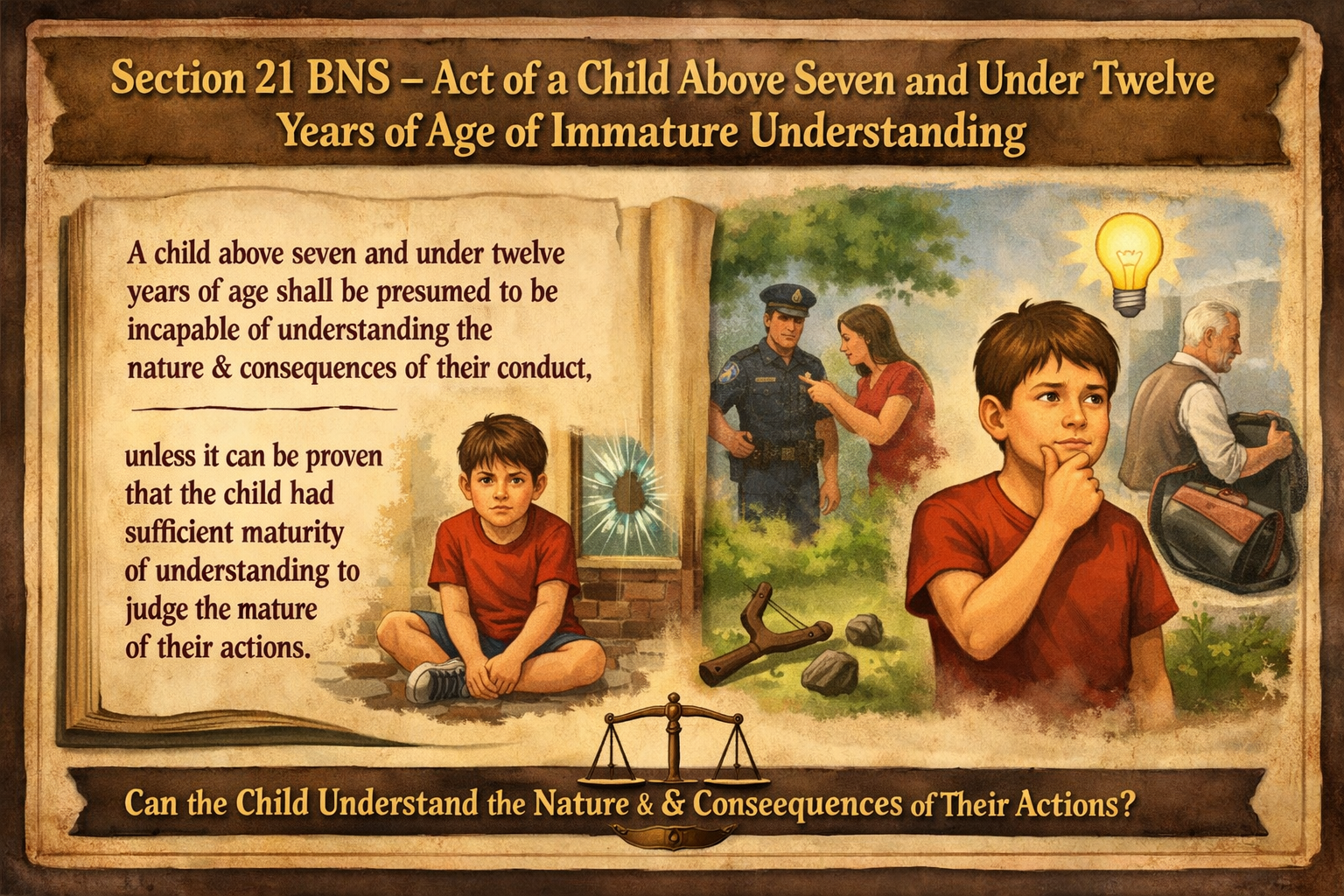
The Bharatiya Nyaya Sanhita 2023 Act replaced all existing colonial criminal laws which used the Indian Penal Code from 1860 as their legal foundation. The BNS Section 21 BNS Act of a Child Above Seven and Under Twelve Years of Age of Immature Understanding provides one of its key sections which defines how minors are legally accountable for their actions.
The provision defines the circumstances in which children aged seven to twelve we held criminally responsible because they lack the necessary maturity to recognize their actions and their potential outcomes.
The law recognizes that children below a certain age lack the ability to comprehend their actions and their consequences. The legal system acknowledges that not all actions performed by children in this age range should result in criminal responsibility.
The main objective of Section 21 BNS Act of Child Above Seven and Under Twelve aims to establish fair legal proceedings for minor defendants who lack sufficient mental capacity to participate.
Meaning of Section 21 BNS
The provision under Section 21 BNS Act of Child Above Seven and Under Twelve defines that a child between seven and twelve years of age does not commit a criminal offense when he performs an act which he cannot understand because he lacks sufficient mental development.
The law essentially says that children of this age may not always be in a position from where they can judge whether his actions are right or wrong.
The Bharatiya Nyaya Sanhita establishes general exceptions which include this provision to declare that certain actions do not qualify as criminal offenses despite their classification as adult offenses.
The rule described in Section 21 BNS Act of Child Above Seven and Under Twelve is closely linked to doli incapax which stands as a legal principle that assumes children lack the ability to commit crimes until they reach adulthood.
Section 21 BNS Act of Child Above Seven and Under Twelve – Key Elements
To understand Section 21 BNS Act of Child Above Seven and Under Twelve, it is important to examine the key elements that determine whether the child can be held criminally responsible.
1. Age Requirement
One of the first conditions under Section 21 BNS Act of Child Above Seven and Under Twelve is the age of the child.
Explanation
- The child must be of an age greater than 7 years.
- The child must be of an age less than 12 years.
Similarly, when the child falls within this age bracket, the court is required to assess whether the child is capable of exercising his will in relation to the act.
This is associated with the Age of criminal responsibility in India, but a law that appreciates that maturity in children develops gradually.
2. Immature Understanding
Another important factor under Section 21 BNS Act of Child Above Seven and Under Twelve is whether the child had the mental ability to understand the consequences of the act.
This concept is often referred to as Immature understanding law BNS.
Explanation
The court examines whether the child:
- Understood the nature of the act
- Knew that the act was wrong or illegal
- Was capable of understanding its consequences
If the child lacks such understanding, the act may not be treated as a criminal offence.
3. Mental Capacity of the Child
The law also examines the mental maturity of the child in determining Child criminal liability under BNS.
Explanation
The court may consider several factors, such as:
- The child’s education level
- Behavior and awareness
- Circumstances in which the act was committed
- Guidance from parents or guardians
If the child shows insufficient maturity, the protection under Section 21 BNS Act of Child Above Seven and Under Twelve may apply.
4. Nature of the Act
The seriousness of the act may also influence the court’s decision.
Explanation
For minor acts, courts are more likely to accept that the child did not understand the consequences. However, if the act appears planned or deliberate, the court may examine the child’s mental capacity more carefully.
This principle forms part of the broader Child offence law under BNS.
Importance of Section 22 Bharatiya Nyaya Sanhita Explained
The rule provided in Section 22 Bharatiya Nyaya Sanhita explained plays a crucial role in balancing justice and child protection.
Protecting Children from Unfair Punishment
Children are still developing their cognitive abilities and their emotional skills. The established legal system applies complete accountability to them which results in unjust penalties because it fails to recognize their developmental status.
The provision under Section 21 BNS Act of Child Above Seven and Under Twelve prevents such situations.
Recognizing Developmental Differences
Every child develops at a different pace. Some children may understand the consequences of their actions earlier, while others may take longer.
The law recognizes this variation by allowing courts to examine the maturity level of each child individually.
Encouraging Reform Rather Than Punishment
Another important objective of the Child offence law under BNS is to focus on rehabilitation rather than punishment.
Instead of criminal punishment, children may receive counseling, supervision, or guidance to help them understand their actions.
Case Law Example
A well-known case explaining the principle behind Section 21 BNS Act of Child Above Seven and Under Twelve is Krishna Bhagwan v. State of Bihar.
Case Background
In this case, the accused child was within the age group where the court had to determine whether the child possessed sufficient maturity to understand the act.
Court’s Observation
The court stated that simply proving the age of the child is not enough. The prosecution must also establish that the child had sufficient maturity of understanding to judge the nature and consequences of the act.
Legal Principle
This case highlights that Child criminal liability under BNS cannot automatically apply to children between seven and twelve years of age unless their mental maturity is proven.
Old Law Comparison
Before the introduction of the Bharatiya Nyaya Sanhita, the same principle existed under Section 83 of the Indian Penal Code, 1860.
Section 83 IPC
Section 83 IPC stated that an act committed by a child above seven and under twelve years of age is not an offence if the child has not attained sufficient maturity to understand the consequences.
Similarity with Section 21 BNS
The rule under Section 21 BNS Act of Child Above Seven and Under Twelve continues the same principle that existed in Section 83 IPC.
Structural Change
Although the wording and structure have been reorganized in the new criminal law framework, the core legal principle remains the same.
Practical Example
To better understand Act of child above seven and under twelve BNS, consider the following example.
Example
Suppose a ten-year-old child takes a bicycle from outside a shop without permission because the child believes it is acceptable to borrow it temporarily.
Legal Interpretation
If the court finds that the child did not understand that taking the bicycle without permission was a criminal act, the protection under Section 21 BNS Act of Child Above Seven and Under Twelve may apply.
However, if evidence shows the child knew the act was wrong and attempted to hide it, the court may consider criminal responsibility.
Role of Courts in Determining Liability
Courts play an important role in interpreting Section 22 Bharatiya Nyaya Sanhita explained.
Judges examine several aspects before deciding whether the child can be held responsible.
Factors considered by courts
- Age of the child
- Mental maturity
- Nature of the act
- Circumstances of the incident
- Evidence showing the child’s understanding
This careful examination ensures fairness when applying Immature understanding law BNS.
Conclusion
The provision under Section 21 BNS – Act of a Child Above Seven and Under Twelve Years of Age of Immature Understanding is an important part of India’s criminal law framework.
In principle, Section 21 BNS Act Recognizes the Child Above Seven and Under Twelve on the basis that there is no guarantee that without restraint the consequences of actions taken by a child within the age of seven and twelve years would be a mindless mischief.
By incorporating this protection, the Bharatiya Nyaya Sanhita ensures that the criminal justice system treats children with fairness and sensitivity.