The Bharatiya Nyaya Sanhita, 2023 introduced a modern framework for criminal law in India by replacing the colonial-era Indian Penal Code, 1860. The new law established new arrangements for its legal provisions while maintaining essential elements of criminal law. People who have mental health disorders that prevent them from understanding their actions receive legal protection as one of these fundamental principles.
A key provision dealing with this situation is Section 22 BNS – Act of a Person of Unsound Mind. This provision explains when a person suffering from mental incapacity cannot be held criminally responsible for their actions. The law requires that defendants must possess a guilty mind before they can face criminal charges. When a person is incapable of understanding their conduct because of mental illness, holding them fully responsible may lead to injustice.
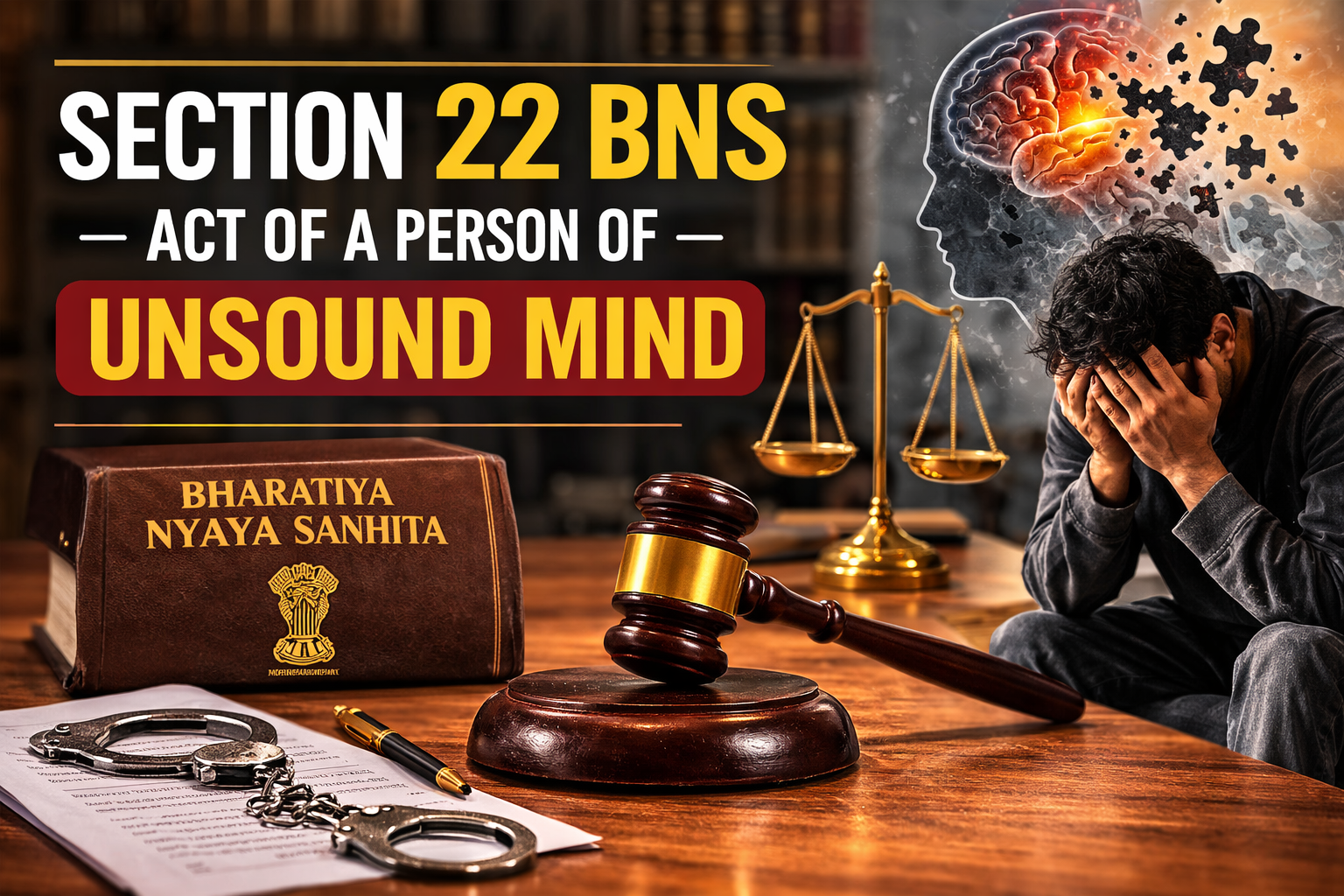
Section 22 BNS – Act of a Person of Unsound Mind establishes legal protection for people who cannot recognize their actions and their results because of mental incapacity to create a fair system for criminal justice.
Meaning of Section 22 BNS – Act of a Person of Unsound Mind
The Section 22 Bharatiya Nyaya Sanhita explanation states that an act committed by a person who is of unsound mind is not considered a criminal offence if, at the time of committing the act, the person was incapable of understanding the nature of the act or that it was wrong or illegal.
The Insanity defence in Indian criminal law uses this principle as its fundamental rule. The rule states that individuals with severe mental illnesses are not responsible for their criminal actions when their mental state prevents them from understanding their behavior.
The Act of a person of unsound mind BNS therefore focuses on the mental capacity of the accused at the time the act was committed. The court needs to evaluate whether the accused possessed adequate mental capacity to comprehend both the nature of their actions and the resulting consequences.
According to Section 22 BNS explained of the Brain Not Sick philosophy, the person who has lost the awareness at any time is not “guilty.”
Key Elements of Section 22 BNS – Act of a Person of Unsound Mind
To understand Section 22 BNS legal provision, it is necessary to look at important elements that courts consider when applying this rule.
1. Presence of Unsound Mind
The first requirement under Section 22 BNS – Act of a Person of Unsound Mind is that the accused must suffer from a condition that affects their mental capacity.
Explanation
A person who experiences an unsound mind can face multiple mental disorders that create a major impact on their ability to think. The courts use medical proof and expert witness statements to assess whether the defendant had a mental health disorder at the time of the offense.
The Unsound mind meaning in criminal law defines a mental condition that disables a person from understanding their actions while also unable to determine what is right or wrong.
However, every mental illness does not automatically qualify as unsoundness of mind under criminal law. The illness must be serious enough to affect the person’s ability to understand the act.
2. Lack of Understanding of the Nature of the Act
Another important consideration under section 22 BNS -Act of a Person of Unsound Mind- will be assessing the accused’s understanding of the nature of the act he committed.
Explanation
According to the law, if a mental illness prevents a person from knowing the nature of his act, the act may not be considered a crime.
A person with severe mental disorder who believes they need to defend themselves against an imaginary threat will display behavior that does not show their intention to commit a crime.
This is an aspect encompassed in the defence of Mental incapacity defence in criminal law law: the loss of mental capacity is held to deprive the perpetrator of an element of intent in the crimes.
3. Inability to Understand That the Act Was Wrong or Illegal
Under Section 22 BNS explained, the court must also determine whether the accused understood that the act was legally wrong.
Explanation
A person may physically perform an act but may not realize that it is morally or legally wrong due to mental illness.
For instance, a person suffering from severe delusions may believe that their actions are justified or necessary. In such situations, the law may excuse the person because they lacked the mental ability to judge the legality of their actions.
This principle reflects the Unsound mind defence under BNS, which protects individuals whose mental condition prevents them from understanding legal or moral consequences.
4. Timing of the Mental Condition
The most vital element for implementing Section 22 BNS – Act of a Person of Unsound Mind requires assessment of the defendant’s mental state at the moment of the offense.
Explanation
A person can only take defense insofar as there has been an unsoundness of mind during the time the offense was committed, no matter the history of mental illness.
The court goes through careful analyses of medical reports, witness testimonies, and the context in an attempt to assess the prevailing mental condition of the accused at the time.
This evaluation helps determine the Criminal liability of unsound mind person in criminal cases.
Importance of Section 22 BNS in Criminal Law
Section 22 BNS serves a fairly specific function in the pursuit of justice within the paradigm of criminal law unto itself.
Protection Against Unjust Punishment
People who have serious mental health disorders lose their ability to understand what they are doing and to control their behavior. The practice of punishing these individuals without assessing their mental health condition becomes an unjust treatment.
The Act of a person of unsound mind BNS therefore protects individuals who are not capable of forming criminal intent.
Recognition of Mental Health in Law
The law acknowledges that mental illness can significantly affect human behavior. By recognizing this fact, Section 22 BNS – Act of a Person of Unsound Mind ensures that courts consider psychological conditions while determining guilt.
This approach reflects the broader principle of Insanity defence in Indian criminal law.
Balance Between Justice and Compassion
The provision also ensures that the justice system maintains a balance between protecting society and treating mentally ill individuals fairly.
Instead of punishment, courts may direct treatment, medical supervision, or institutional care for such individuals.
Comparison with the Old Law
Before the introduction of the Bharatiya Nyaya Sanhita, 2023, the same principle existed under Section 84 of the Indian Penal Code.
Section 84 IPC – Unsound Mind Defence
Section 84 IPC stated that an act committed by a person who, due to unsoundness of mind, was incapable of knowing the nature of the act or that it was wrong or contrary to law would not be considered an offence.
Similarities with Section 22 BNS
The Section 22 Bharatiya Nyaya Sanhita explanation retains the same fundamental principle found in Section 84 IPC. Both provisions recognize that criminal liability requires the presence of a guilty mind.
Structural Change in New Criminal Law
Although the numbering and structure have changed under the new criminal law framework, the core legal idea behind the Unsound mind defence under BNS remains the same as the earlier provision.
Practical Example
To understand Section 22 BNS – Act of a Person of Unsound Mind, consider the following situation.
Example
A person suffering from severe schizophrenia believes that a neighbor is attempting to harm them due to hallucinations. Acting under this false belief, the person attacks the neighbor.
Legal Interpretation
If medical evidence shows that the accused was incapable of understanding the nature of the act or that it was wrong due to mental illness, the defence under Section 22 BNS – Act of a Person of Unsound Mind may apply.
In such a case, the court may conclude that the accused lacked criminal intent and therefore cannot be held fully responsible for the act.
Role of Courts in Determining Unsound Mind
Courts play a crucial role when applying Section 22 BNS explained. Judges examine several factors before accepting the defence of unsound mind.
Important factors include:
- Medical evidence and psychiatric reports
- Behavior of the accused before and after the incident
- Statements of witnesses and family members
- History of mental illness
- Circumstances surrounding the act
Through this careful examination, courts determine the Criminal liability of unsound mind person and decide whether the defence should apply.
Conclusion
Section 22 BNS – Act of a Person of Unsound Mind is an essential provision in modern Indian criminal law. It reflects the principle that criminal responsibility requires the presence of mental awareness and intent.
By recognizing the Unsound mind defence under BNS, the law ensures that individuals who are incapable of understanding their actions due to mental illness are not unfairly punished.
The provision also continues the legal principle that previously existed under Section 84 IPC, maintaining continuity within the Indian legal system.