The Bharatiya Nyaya Sanhita 2023 (BNS) introduced updated provisions governing criminal liability and general exceptions in Indian criminal law. Section 23 establishes an important legal protection which covers cases when a person performs an act under the influence of alcohol but did not willingly drink the alcoholic beverage.
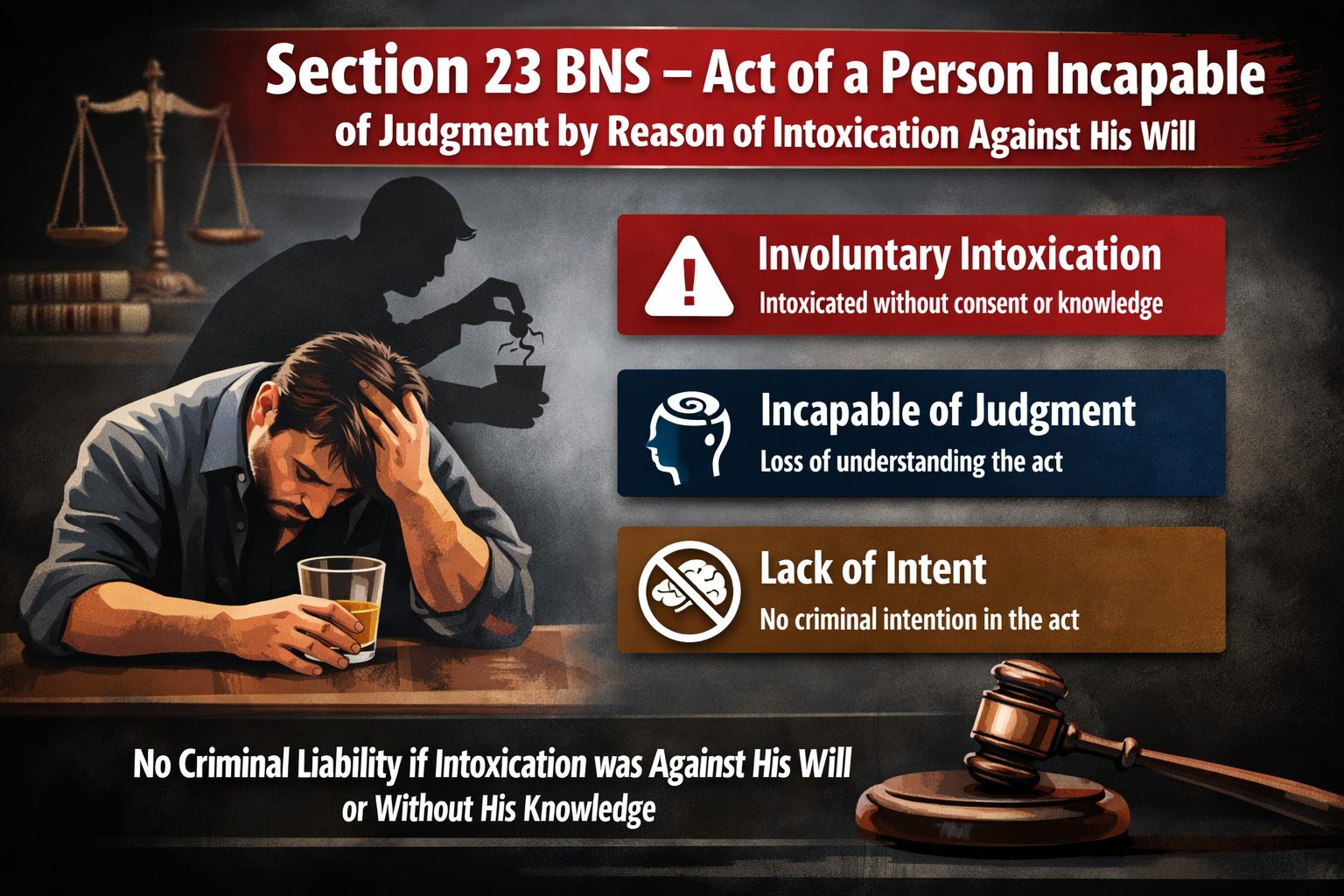
The legal system requires criminals to prove their guilt through deliberate intent or proof of knowledge about their actions. The law considers a person unable to make decisions because their intoxication prevents them from understanding their actions and their consequences which occurred without their consent or knowledge.
The complete legal explanation of Section 23 BNS Act of Person Incapable of Judgment Due to Intoxication contains its legal definition, applicable conditions, judicial interpretation, and comparison with earlier Indian Penal Code laws.
Meaning of Section 23 BNS Act of Person Incapable of Judgment Due to Intoxication
Section 23 BNS Act of Person Incapable of Judgment Due to Intoxication establishes that a person who lacks mental capacityto understand their actions and the consequences of those actions should not be held criminally responsible for their actions.
The legal system needs both a guilty mind (mens rea) and a guilty act to establish criminal responsibility. The required mental capacity cannot be established when a person experiences forced or unknown intoxication.
Key Legal Idea
The essence of Section 23 Bharatiya Nyaya Sanhita is that involuntary intoxication may remove criminal responsibility if it destroys the ability to understand the act.
This concept forms an important part of General exceptions under Bharatiya Nyaya Sanhita, where the law recognizes circumstances in which a person should not be punished for an act that would otherwise be criminal.
Legal Conditions Under Section 23 BNS
For Section 23 BNS Act of Person Incapable of Judgment Due to Intoxication to apply, certain conditions must be satisfied. Courts carefully examine these factors before granting the protection.
1. Intoxication Must Be Involuntary
The first requirement is that the intoxication must have occurred without the person’s consent.
This means:
- The intoxicating substance was administered by someone else
- The person did not willingly consume alcohol or drugs
- The intoxication occurred without knowledge
This principle forms the basis of the Involuntary intoxication defence in criminal law India.
Example:
- A drink is secretly spiked with drugs at a party.
- The person becomes intoxicated unknowingly and commits an act without understanding its consequences.
In such cases, Intoxication as defence in criminal law India may apply.
2. Incapability of Understanding the Nature of the Act
The second condition requires that the intoxication must be severe enough to make the person incapable of judgment.
The court must determine whether the accused:
- Could understand the nature of the act, or
- Could realize that the act was wrong or illegal
If both abilities are lost due to involuntary intoxication, the defence may succeed.
This is closely linked to the concept of Person incapable of judgment intoxication law.
3. Lack of Criminal Intention or Knowledge
Criminal offences generally require a mental element. Under Section 23 BNS explained, the accused must show that intoxication destroyed the capacity to form intention.
Courts evaluate whether there was:
- Absence of intent
- Absence of knowledge
- Loss of control over mental faculties
This principle reflects Lack of intention due to intoxication law and affects Criminal responsibility under intoxication BNS.
Act Done Under Intoxication Without Consent
A key element of Section 23 BNS Act of Person Incapable of Judgment Due to Intoxication is that the intoxicating substance must have been consumed without knowledge or against the will of the person.
Situations where this may happen include:
- Someone secretly mixing intoxicants in food or drinks
- Medical administration of drugs without informing the person
- Being forced to consume alcohol or drugs
Such circumstances are categorized as Act committed under intoxication without knowledge, and the law recognizes them as a valid defence in certain cases.
Criminal Liability and Intoxication BNS
The law distinguishes between voluntary intoxication and involuntary intoxication.
Voluntary Intoxication
If a person willingly consumes alcohol or drugs, the law usually does not allow intoxication as a defence.
For example:
- Drinking alcohol intentionally
- Taking drugs voluntarily
- Being aware of the intoxicating nature of the substance
In such cases, Criminal liability and intoxication BNS continues to apply.
Involuntary Intoxication
When intoxication is forced or unknown, the person may lack the mental ability to understand the act.
In these situations, When intoxication becomes legal defence in India depends on whether the accused lost the capacity to understand the act.
Section 23 BNS vs Section 85 IPC
The new provision under the Bharatiya Nyaya Sanhita is largely based on the earlier rule contained in the Indian Penal Code, 1860.
Old Law
- Section 85 IPC – Act of a person incapable of judgment by reason of intoxication caused against his will
New Law
- Section 23 BNS – Act of a person incapable of judgment by reason of intoxication against his will
Key Similarities
- Both recognize involuntary intoxication as a defence
- Both require lack of knowledge or intention
- Both demand proof that intoxication was without consent
Structural Change
The main difference is that Section 23 BNS vs Section 85 IPC reflects the restructuring of criminal law under the new codes introduced in 2023.
The legal principle itself remains largely unchanged.
Judicial Approach Toward Intoxication Defence
Courts in India examine intoxication claims very carefully because misuse of the defence could allow offenders to escape liability.
Judges normally analyze:
- Evidence regarding how intoxication occurred
- The degree of intoxication
- Behaviour of the accused before and after the act
- Whether the accused understood the consequences
Under Section 23 BNS legal explanation, the burden of proof generally lies on the accused to show that intoxication was involuntary.
Examples Illustrating Section 23 BNS
Example 1: Drink Spiking
A person attends a party and unknowingly consumes a drink mixed with a strong intoxicant. Due to severe intoxication, the person damages property without understanding the act.
This situation may fall under Section 23 BNS Act of Person Incapable of Judgment Due to Intoxication.
Example 2: Forced Intoxication
An individual is forced by others to consume alcohol and becomes mentally incapable of understanding actions. During that state, an act occurs without intention.
This may qualify for Involuntary intoxication defence in criminal law India.
Importance of Section 23 BNS in Criminal Law
The provision plays a significant role in balancing justice and fairness.
Key importance includes:
- Protects individuals from punishment for acts committed without mental awareness
- Recognizes that criminal liability requires intention or knowledge
- Prevents misuse of forced intoxication to frame innocent persons
The rule ensures fairness within the framework of General exceptions under Bharatiya Nyaya Sanhita.
Relevant Case Laws on Section 23 BNS Act of Person Incapable of Judgment Due to Intoxication
The defence of intoxication in Indian criminal law has been interpreted by courts in several important judgments. Even after the introduction of the Bharatiya Nyaya Sanhita, 2023, courts still rely on earlier precedents decided under Section 85 of the Indian Penal Code (IPC) because Section 23 BNS contains almost the same legal principle.
These case laws help in understanding how courts determine criminal liability and intoxication BNS and when intoxication can become a valid defence.
1. Basdev v. State of Pepsu (1956)
Facts of the Case
In this case, the accused attended a wedding ceremony and consumed alcohol. During the event, he fired a pistol at a young boy, which resulted in the boy’s death. The accused claimed that he was heavily intoxicated and therefore incapable of forming criminal intention.
Issue Before the Court
The court had to decide whether intoxication could exempt the accused from criminal liability.
Judgment
The Supreme Court held that voluntary intoxication cannot generally be used as a defence in criminal cases. The Court explained that a person who voluntarily drinks alcohol is responsible for the consequences of his actions.
However, the Court clarified that intoxication may become a defence if it is involuntary and renders the person incapable of understanding the nature of the act.
Legal Principle
This judgment established that intoxication becomes a valid defence only when the accused:
- Did not voluntarily consume the intoxicant, and
- Became incapable of understanding the act or its consequences.
This principle directly supports Section 23 BNS Act of Person Incapable of Judgment Due to Intoxication.
2. Director of Public Prosecutions v. Beard (1920)
Facts
The accused raped a girl and during the incident caused her death. He argued that he was so intoxicated that he was incapable of forming the intent required for the crime.
Court’s Observation
The House of Lords held that intoxication may affect the ability of a person to form specific intent required for certain crimes.
Legal Significance
Although this is an English case, it has strongly influenced Indian courts in cases involving Intoxication as defence in criminal law India.
The judgment established that intoxication can be relevant when determining whether the accused had the necessary mental state for committing a crime.
3. State of Maharashtra v. Mohd. Yakub (1980)
Facts of the Case
The accused claimed that he was intoxicated at the time of the offence and therefore lacked criminal intention.
Court’s Analysis
The Supreme Court observed that intoxication must be proven to have completely impaired the mental capacity of the accused.
Mere drunkenness or partial intoxication is not sufficient to remove criminal responsibility.
Legal Principle
The Court emphasized that:
- The defence applies only when intoxication causes complete incapacity of judgment
- The accused must prove that he could not understand the nature of the act
This interpretation remains relevant in understanding Section 23 BNS explained.
4. State of Rajasthan v. Shera Ram (2012)
Facts
The accused argued that he committed the offence while under the influence of alcohol and therefore should not be held responsible.
Court’s Decision
The Supreme Court rejected the defence and held that voluntary intoxication does not excuse criminal conduct.
Key Observation
The Court explained that intoxication may reduce the ability to think clearly, but if the person voluntarily consumed alcohol, the defence cannot normally be accepted.
Legal Importance
This case clarified the limits of Criminal responsibility under intoxication BNS and reinforced the idea that only involuntary intoxication may serve as a defence.
Conclusion
Section 23 BNS Act of Person Incapable of Judgment Due to Intoxication provides an important defence in Indian criminal law which covers cases of intoxication that occur without a person having given their explicit consent or awareness of the situation. The provision establishes that criminal responsibility exists when a person possesses both intent and comprehension of their actions.
Section 23 Bharatiya Nyaya Sanhita defines criminal responsibility for people who develop alcohol addiction through involuntary intoxication because they lose their capacity to understand their criminal actions. The courts examine factual evidence before they allow defendants to use this defense because they want to prevent its improper application.
The transition from Section 85 IPC to Section 23 BNS reflects the modernization of criminal statutes while preserving established legal principles. The provision functions as a vital protection for cases involving intoxication-based criminal acts which require proof of intentionality or awareness before criminal penalties can be applied.