The Bharatiya Nyaya Sanhita 2023 introduces clear provisions regarding criminal liability when an accused is intoxicated. Section 24 BNS specifically deals with situations where an offence committed under intoxication law requires a particular intention or knowledge. This provision plays a critical role in determining whether a person under intoxication can be held criminally liable.
Criminal law requires mens rea as a fundamental requirement for establishing guilt. The legal system faces challenges in determining criminal responsibility because intoxication affects a person’s ability to understand their actions according to Indian law.
Understanding the Concept of Offence Committed Under Intoxication Law
The principle behind offence committed under intoxication law is that intoxication does not automatically excuse criminal conduct. The courts conduct a thorough evaluation of the defendant’s mental state at the time of the crime to determine whether he possessed the necessary criminal intent.
Key Aspects:
- Mens Rea Requirement:
The law focuses on whether the accused had the necessary mental element despite intoxication. The rule establishes direct connections between intoxication and mens rea requirements. - Voluntary vs Involuntary Intoxication:
The legal implications are very different if the intoxicants have been abused rather than consented. - Strict Judicial Scrutiny:
Before judges reach their decisions about liability, they evaluate all available evidence together with the behavior displayed by the parties involved and the contextual factors of the case.
Thus, an offence committed under intoxication law is not automatically excused; instead, it is judged on the presence or absence of intent.
Effect of Intoxication on Criminal Intent
The effect of intoxication on criminal intent is central to Section 24 BNS. Intoxication causes people to lose their ability to make decisions because it impairs their judgment and decreases their awareness.
Important Considerations:
- Cognitive Impairment:
Alcohol or drug use can impair future thinking.. - Temporary Loss of Control:
Inebriation can lessen one’s self-control but not necessarily extinguish one’s intent. - Judicial Approach:
Courts look for the intention to kill (in the case of particular intent) and do not realize the contrary, if the person is intoxicated.
Even in cases of offence committed under intoxication law, the court may still find intention if the act shows planning or awareness.
Difference Between Voluntary and Involuntary Intoxication
Understanding the difference between voluntary and involuntary intoxication is essential for applying Section 24 BNS.
1. Voluntary Intoxication
- Occurs when a person willingly consumes alcohol or drugs.
- No complete defence is available.
- The accused is presumed to have knowledge of consequences.
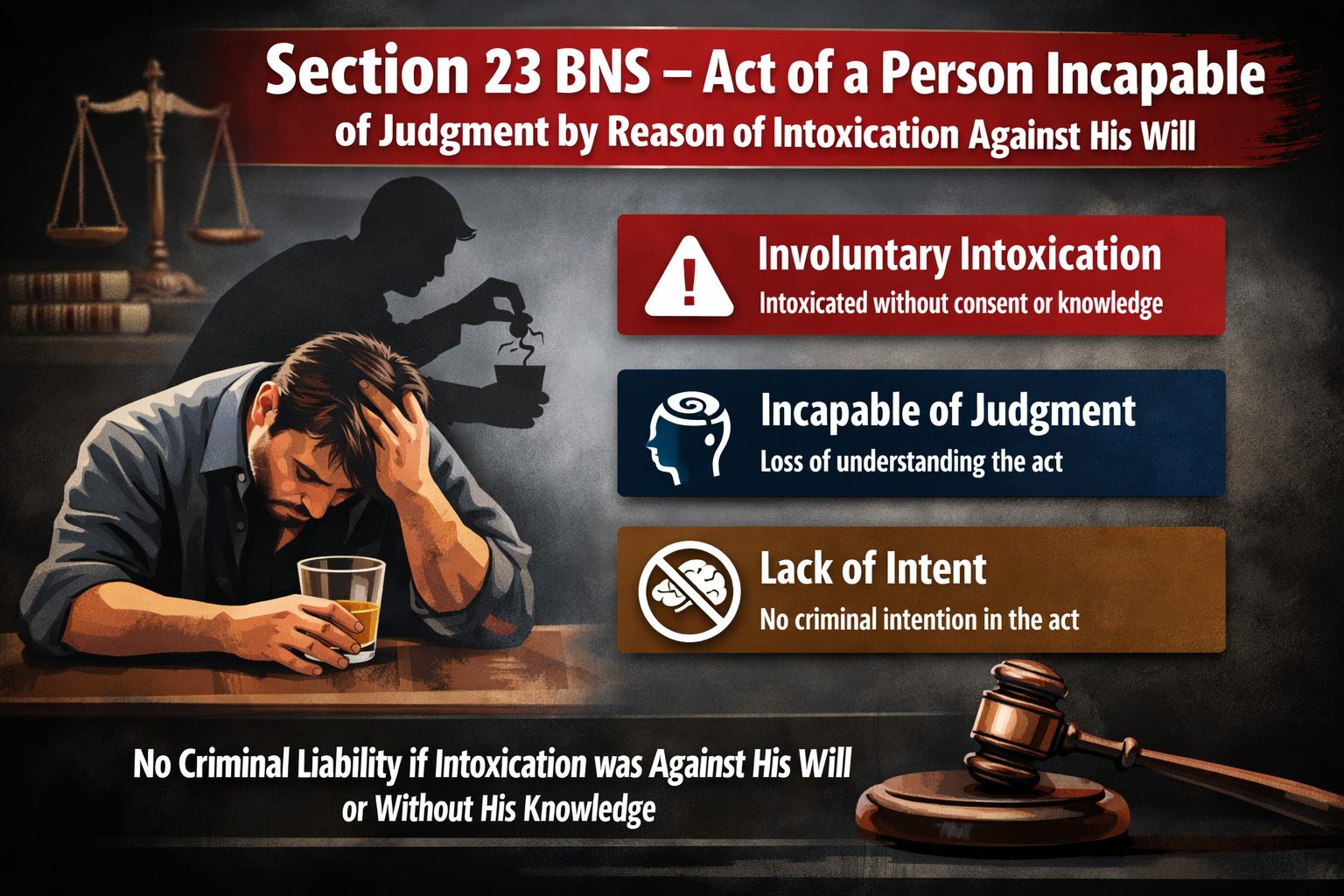
2. Involuntary Intoxication
- Occurs without the person’s consent or knowledge.
- May serve as a valid defence if it prevents formation of intent.
- Courts treat such cases with greater leniency.
In cases of offence committed under intoxication law, involuntary intoxication may reduce or eliminate criminal liability, while voluntary intoxication usually does not.
Intoxication as Defence in Criminal Law
The concept of intoxication as defence in criminal law is limited and carefully regulated.
When It Can Be Used:
- When intoxication is involuntary.
- When it completely destroys the ability to form intent.
When It Cannot Be Used:
- When intoxication is self-induced.
- When the offence requires only general intent.
Thus, offence committed under intoxication law rarely results in complete acquittal unless strict conditions are met.
Knowledge and Intention in Criminal Law India
In Indian criminal jurisprudence, knowledge and intention in criminal law India are fundamental elements.
Key Distinctions:
- Intention:
A deliberate aim to achieve a specific result. - Knowledge:
Awareness that an act is likely to cause a particular consequence.
Under Section 24 BNS, even if a person is intoxicated, courts may attribute knowledge if a reasonable person in similar circumstances would have foreseen the consequences. This ensures accountability in offence committed under intoxication law cases.
Exceptions to Criminal Liability Intoxication
The law recognizes certain exceptions to criminal liability intoxication.
Recognized Exceptions:
- Involuntary intoxication
- Lack of intent due to intoxication
- Absence of knowledge of consequences
However, these exceptions are applied narrowly. Courts ensure that the defence is not misused in offence committed under intoxication law cases.
Burden of Proof in Intoxication Cases
The burden of proof intoxication cases lies primarily on the accused.
Legal Position:
- The accused must prove intoxication.
- The accused must show lack of intent or knowledge.
- Courts rely on medical evidence, witness statements, and conduct.
In an offence committed under intoxication law, merely claiming intoxication is not sufficient; it must be substantiated with evidence.
Legal Consequences of Drunken Offence India
The legal consequences of drunken offence India depend on the nature of the offence and the level of intoxication.
Possible Outcomes:
- Full Criminal Liability:
In cases of voluntary intoxication. - Reduced Liability:
If intent cannot be established. - Complete Defence:
Only in rare cases of involuntary intoxication.
Courts ensure that individuals cannot escape punishment solely because the offence was an offence committed under intoxication law.
Criminal Responsibility Under Influence of Alcohol
The concept of criminal responsibility under influence of alcohol emphasizes accountability.
Judicial Approach:
- Intoxication is not an excuse for reckless behaviour.
- Individuals are expected to foresee consequences.
- Public safety is given priority.
Thus, even under intoxication, liability may arise if the person acted knowingly in an offence committed under intoxication law.
Defence of Intoxication Under BNS
The defence of intoxication under BNS is structured but limited.
Key Principles:
- Only involuntary intoxication is a strong defence.
- Voluntary intoxication does not excuse criminal acts.
- Courts examine the degree of intoxication.
This ensures that the law balances fairness with accountability in offence committed under intoxication law cases.
Old Law vs New Law: Section 85 & 86 IPC vs Section 24 BNS
Before the introduction of BNS, intoxication-related offences were governed by the Indian Penal Code, 1860.
Earlier Provisions:
- Section 85 IPC:
Act of a person incapable of judgment due to involuntary intoxication. - Section 86 IPC:
Offences requiring intent or knowledge committed under intoxication.
Changes Under BNS:
- Consolidation and simplification under Section 24.
- Clearer interpretation of intent and knowledge.
- Alignment with modern legal principles.
The transition strengthens the framework governing offence committed under intoxication law.
Conclusion
The law establishes its own process through Section 24 BNS which determines liability for intoxicated individuals. The legal system treats each case of intoxication as a particular situation which requires evaluation of the defendant’s mental state and their awareness and the specific facts of the case.
An offence committed under intoxication law is judged on strict legal principles, which guarantee justice execution while blocking the possibility of intoxication being used as an excuse for criminal behavior. The law establishes a balance between individual rights and societal protection through its approach to voluntary and involuntary intoxication, which defines intoxication and mens rea as legal concepts.