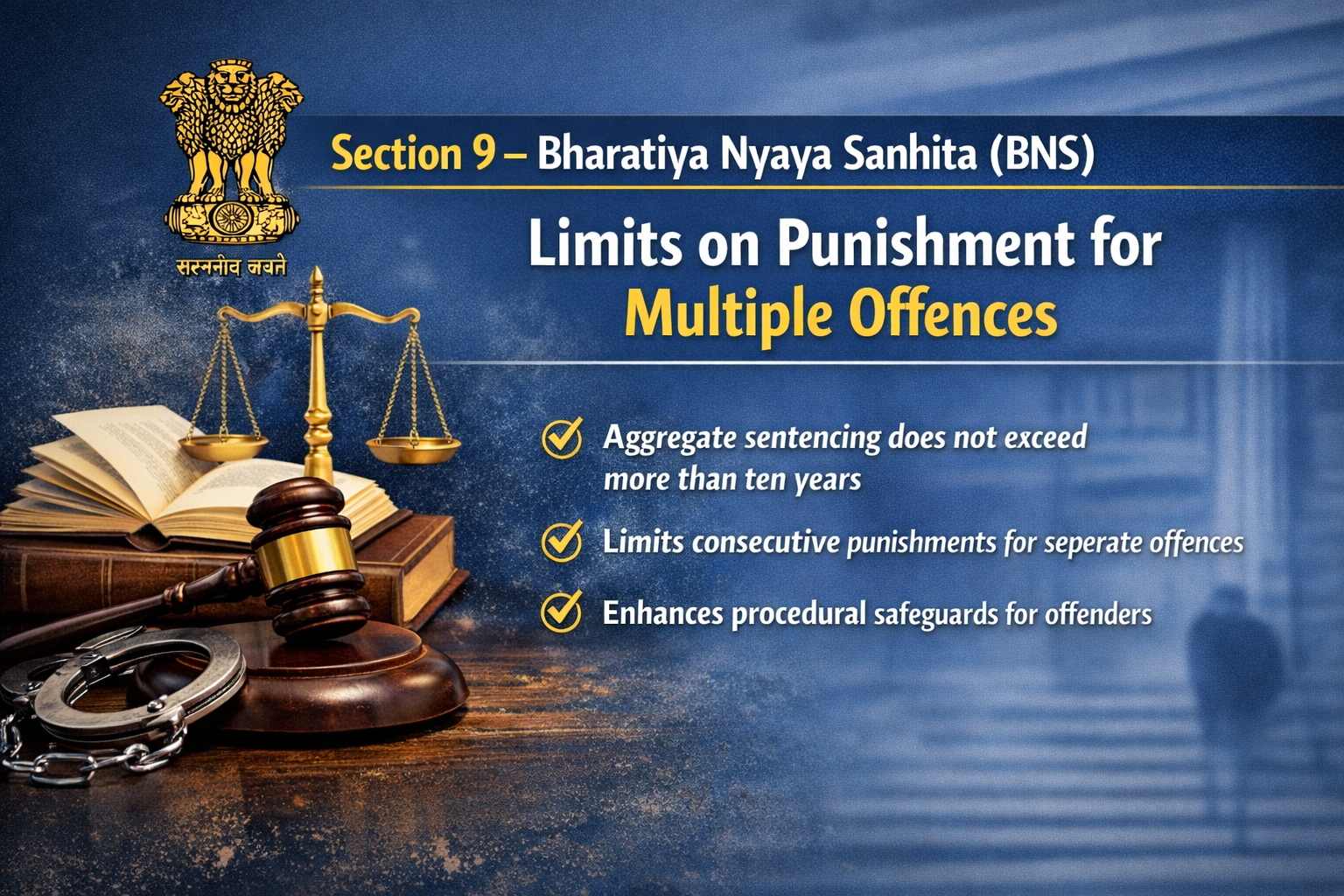
The Indian legal system has experienced its greatest transformation through the introduction of Bharatiya Nyaya Sanhita (BNS), which started operating on July 1, 2024. The judicial process maintains its essential fairness through all core provisions, but Section 9 of Bharatiya Nyaya Sanhita serves as the primary protection for defendants.This section prevents the arbitrary stacking of penalties for a single criminal transaction, upholding the spirit of justice.
The Indian Penal Code (IPC) Section 71 established the principle which operated during the previous regime. The Substitution of IPC Section 71 with Section 9 BNS ensures that the fundamental doctrine of proportionality in sentencing is preserved in the new era of Bharatiya Nyaya Sanhita 2023 punishments.
Understanding the Legal Core of Section 9 Bharatiya Nyaya Sanhita
Section 9 Bharatiya Nyaya Sanhita is designed to address situations where a person’s actions might technically trigger multiple criminal definitions. Without this section, a single act could lead to an absurdly long prison sentence. It provides the Legal protection against double punishment India requires to maintain a corrective rather than oppressive justice system.
1. Offences Made Up of Parts
The first part of Section 9 BNS states that if an offence is composed of multiple parts which each qualify as separate offences the offender should face punishment for only one of those offences.
- Detailed Explanation: Consider a situation where an individual strikes another person multiple times with a rod. Each individual blow technically constitutes “voluntarily causing hurt.” However, the law views the entire sequence as one “beating.” If a judge were to sentence the person for every single blow, a simple physical altercation could result in decades of imprisonment. Section 9 BNS mandates that the offender is punished only for the total act of hurt, not for each strike.
2. Acts Falling Under Multiple Definitions
There are instances where a single act satisfies the criteria of two or more separate legal definitions. In these cases, Section 9 Bharatiya Nyaya Sanhita limits the severity of the penalty.
- Detailed Explanation: An act might simultaneously be defined as “criminal trespass” and “mischief.” Under the Sentencing limits in BNS, the court cannot award a punishment more severe than what it could give for any one of these offences. This ensures that the accused is not unfairly penalized twice for the same set of facts.
3. Combined Acts Creating a New Offence
When several acts, which are offences individually, combine to form a different, often more serious offence, the total punishment is restricted.
- Detailed Explanation: If an offender commits acts that individually qualify as “assault” and “wrongful restraint,” but together they constitute “robbery,” the court will sentence the person based on the combined offence. Section 9 BNS ensures the punishment does not exceed the maximum limit prescribed for the most serious component or the combined crime itself.
Section 9 Bharatiya Nyaya Sanhita: Sentencing and Judicial Discretion
When a trial concludes in a conviction for multiple charges, the judge must decide how the sentences will be served. This is where Consecutive vs Concurrent sentences BNS (Crucial for high court appeals) becomes a significant point of contention.
- Concurrent Sentences: All sentences run at the same time. If a person is sentenced to 3 years for one charge and 5 years for another, they spend a total of 5 years in prison.
- Consecutive Sentences: One sentence starts after the previous one ends. This can lead to very long terms, and Section 9 Bharatiya Nyaya Sanhita acts as the primary check on this power.
- Appeal Strategy: In the High Courts of Rajasthan or Gujarat, if a lower court fails to apply the limits set by Section 9 Bharatiya Nyaya Sanhita, it creates a strong ground for appeal. Lawyers often argue that the sentences should have been concurrent to stay within the Sentencing limits in BNS.
Key Differences: Substitution of IPC Section 71
While the text of Section 9 Bharatiya Nyaya Sanhita is largely similar to its predecessor, it is now part of the more organized BNS Chapter II Sections.
- Structural Placement: The IPC had punishments scattered across various chapters. The BNS has consolidated the general principles of punishment in Chapter II, making it easier for the Criminal Procedure under BNSS and BNS to be applied uniformly.
- Modern Context: While the “beating with a stick” illustration remains, the modern interpretation of Section 9 Bharatiya Nyaya Sanhita now extends to digital crimes and complex financial frauds where a single “hack” or “transaction” might violate multiple sections of the law.
Case Study: Proportionality in Practice
To understand the weight of Section 9 Bharatiya Nyaya Sanhita, we look at how Indian courts have historically handled the concept of a “Single Transaction.”
The Principle of “Same Transaction”
In many landmark judgments, the Supreme Court has held that if several offences are committed in the same transaction, the sentences should generally run concurrently. For example, if an individual is caught with a forged document and then uses that document to cheat someone, these are two offences. However, using Section 9 BNS, the defense can argue that the punishment should be limited because the forgery was merely a part of the act of cheating.
Impact on Criminal Procedure under BNSS and BNS
The Bharatiya Nagarik Suraksha Sanhita (BNSS), which replaces the CrPC, works in tandem with the BNS. When a magistrate or judge frames charges for multiple offences, they must keep the provisions of Section 9 Bharatiya Nyaya Sanhita in mind.
- Aggregate Punishment: Under the new Criminal Procedure under BNSS and BNS, there are specific limits on the aggregate punishment a magistrate can inflict.
- Fair Trial Rights: By strictly adhering to Section 9 BNS, the state ensures that the trial process is not used to vindictively “pile on” charges to keep an individual incarcerated beyond the gravity of their crime.
Conclusion
Section 9 Bharatiya Nyaya Sanhita is a cornerstone of the new criminal law regime. It ensures that Bharatiya Nyaya Sanhita 2023 punishments remain fair, logical, and proportionate. By providing Legal protection against double punishment India, it prevents the judicial system from becoming a tool for excessive retribution.
For anyone navigating a criminal case, understanding the Sentencing limits in BNS and the nuances of Consecutive vs Concurrent sentences BNS (Crucial for high court appeals) can be the difference between a fair sentence and an oppressive one. As we move forward with the BNS Chapter II Sections, the importance of Section 9 BNS will only grow in ensuring that the “Nyaya” (Justice) in the Sanhita’s name is truly delivered.