
The Bharatiya Nagarik Suraksha Sanhita, 2023 (BNSS) has come in place of the Criminal Procedure Code (CrPC) with the intention of making the criminal justice system of India more modern. One of its major structural provisions is Section 11 BNSS – Special Judicial Magistrates which is a very important factor in improving judicial administration, and also in dealing with categories of cases very efficiently.
The present paper describes Section 11 BNSS Special Judicial Magistrates in a comprehensive way, discussing its definition, the procedure of appointment, the authority, the area of jurisdiction, the importance, and also the differences between it and regular Judicial Magistrates.
Understanding Section 11 BNSS – Special Judicial Magistrates
Section 11 BNSS empowers the State Government, in consultation with the High Court, to appoint Special Judicial Magistrates for particular areas or specific classes of cases.
The purpose of introducing Special Judicial Magistrates under BNSS is to:
- Reduce the burden on regular courts
- Speed up disposal of minor and specialised cases
- Improve administrative efficiency in the justice system
Unlike regular Magistrates, Special Judicial Magistrates are appointed for limited purposes and defined jurisdictions.
Legal Text Overview of Section 11 BNSS
Under Section 11 of the Bharatiya Nagarik Suraksha Sanhita, the State Government may:
- Appoint Special Judicial Magistrates
- Specify their local jurisdiction
- Define the nature of cases they can handle
- Make appointments for a definite or extendable period.
The High Court will be consulted beforehand in making such appointments, thereby guaranteeing the independence of the judiciary and the balance of the constitution.
Who Can Be Appointed as a Special Judicial Magistrate?
Under Section 11 BNSS Special Judicial Magistrates, appointments are generally made from among:
- Persons holding or having held judicial office
- Experienced legal professionals
- Retired judicial officers
- Individuals with legal expertise who are approved by the High Court are considered to be qualified.
The qualification criteria are designed to guarantee that Special Judicial Magistrates have the required legal knowledge and experience to carry out judicial duties powerfully and professionally.
Jurisdiction of Special Judicial Magistrates Under Section 11 BNSS
One of the defining features of Section 11 BNSS is that Special Judicial Magistrates have limited jurisdiction.
Their jurisdiction may be limited by:
- Area (district, city, or specific zone)
- Nature of cases (summary cases, minor offences, administrative matters)
- Specific functions assigned by the State Government
They do not enjoy the same wide jurisdiction as regular Judicial Magistrates unless specifically authorised.
Powers of Special Judicial Magistrates Under BNSS
The powers of Section 11 BNSS Special Judicial Magistrates depend on the notification issued by the State Government and approval of the High Court.
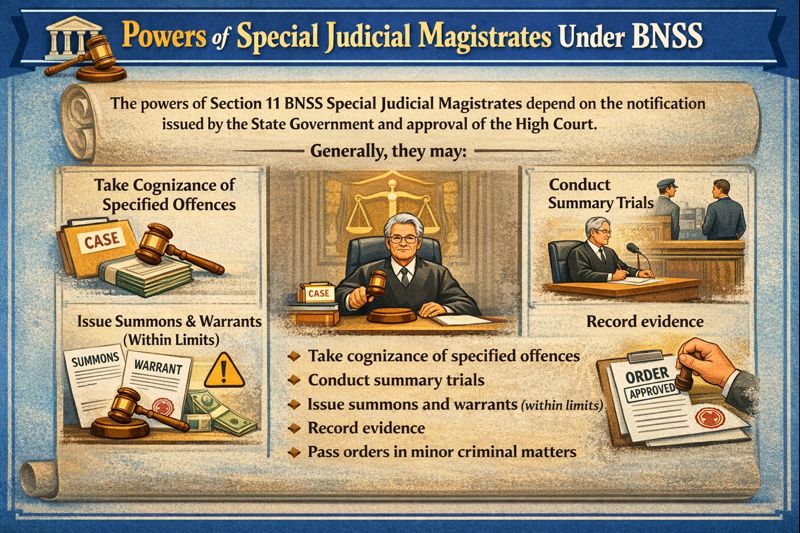
Generally, they may:
- Take cognizance of specified offences
- Conduct summary trials
- Issue summons and warrants (within limits)
- Record evidence
- Pass orders in minor criminal matters
However, serious offences involving severe punishment are usually excluded from their jurisdiction.
Objective Behind Section 11 BNSS – Special Judicial Magistrates
The introduction of Special Judicial Magistrates under BNSS serves multiple objectives:
1. Speedy Justice
- By assigning minor or specialised cases to Special Judicial Magistrates, regular courts can focus on serious criminal trials.
2. Reduced Case Backlog
- A special judicial magistrate may be provided where time taken to clear legal process is considerably long, more so in urban areas with high case load.
3. Administrative Efficiency
- These are appointed very often when they need to deal with violations of regulation, or any municipal or administrative offenses so that instant solutions could be sought.
4. Access to Justice
- Localised jurisdiction allows citizens to approach courts closer to their place of residence.
Difference Between Judicial Magistrate and Special Judicial Magistrate
To fathom the concept of the special judicial magistrates in the BNSS Section 11, one needs to have comprehensive knowledge of the difference in their responsibilities.
| Basis | Judicial Magistrate | Special Judicial Magistrate |
| Appointment | Regular judicial service | Appointed under Section 11 BNSS |
| Jurisdiction | Broad and general | Limited and specific |
| Tenure | Permanent | Fixed or temporary |
| Powers | Full powers under BNSS | Restricted by notification |
| Purpose | General criminal trials | Speedy disposal of specific cases |
Importance of High Court Consultation in Section 11 BNSS
A crucial safeguard in Section 11 BNSS is mandatory consultation with the High Court before appointment.
This ensures:
- Judicial independence
- Transparency in appointments
- Competence of appointees
- Prevention of executive overreach
The High Court may also issue guidelines regarding the functioning of Special Judicial Magistrates.
Types of Cases Handled by Special Judicial Magistrates
Though the exact nature varies by state notification, Section 11 BNSS Special Judicial Magistrates often handle:
- Minor criminal offences
- Summary trials
- Regulatory violations
- Municipal and local law offences
- Administrative non-compliance cases
- Lesser punishments cases
They usually do not come into the folds of major crimes like murder, rape, or major economic offences.
Term and Removal of Special Judicial Magistrates
Under Section 11 BNSS, Special Judicial Magistrates:
- Are appointed for a specific period
- May have their term extended
- Can be removed or replaced as per law and High Court recommendations
Their functioning is subject to judicial discipline and oversight.
How Section 11 BNSS Improves the Criminal Justice System
The provision relating to Section 11 BNSS Special Judicial Magistrates contributes significantly to judicial reform by:
- Decongesting trial courts
- Encouraging decentralised justice
- Improving case management
- Enhancing public trust in legal institutions
- Ensuring quicker resolution of low-complexity cases
This aligns with the broader goals of BNSS to make justice faster, citizen-friendly, and accountable.
Relationship Between Section 11 BNSS and Other Magistrate Provisions
Section 11 BNSS works alongside:
- Section 6 BNSS (Classes of Criminal Courts)
- Section 7 BNSS (Territorial divisions)
- Section 9 BNSS (Courts of Judicial Magistrates)
Together, these sections define the structure of subordinate criminal courts in India.
Challenges and Safeguards
While Section 11 BNSS Special Judicial Magistrates offer efficiency, safeguards are essential to prevent misuse:
- Clear limitation of powers
- Proper training
- Judicial supervision
- Transparent appointment process
The BNSS framework addresses these concerns through High Court oversight.
Conclusion: Why Section 11 BNSS Matters
Section 11 BNSS – Special Judicial Magistrates is a realistic reform that targets judicial efficiency improvement without the loss of fairness or independence. By allowing the appointment of specialized magistrates for specific limited purposes, the BNSS is sure that there will be no delays in justice due to the overload of procedures.
Citizens, lawyers, and legal institutions must know about Section 11 BNSS Special Judicial Magistrates because it has a direct impact on the minor and specialized criminal cases under India’s new criminal procedure law.
Section 11 is the part of BNSS that makes Indian justice fast, reachable, and effective while still being in line with the rule of law.