

The Bharatiya Nagarik Suraksha Sanhita, 2023 (BNSS) is a groundbreaking law as far as criminal procedure in India is concerned, which will knock down the…provisions of the current Criminal Procedure Code (CrPC). The BNSS contains among its major provisions Section 13, which concerns the subordination of Judicial Magistrates. The judicial discipline, administrative efficiency, and a clear hierarchy in the criminal court system, will be sustained through this section.
The comprehension of Section 13 BNSS is necessary for judges, lawyers, law students, and citizens who want to know the workings of the criminal courts under the new BNSS regime.
Understanding Section 13 BNSS
Section 13 BNSS has laid down the clear principle of judicial hierarchy in which Judicial Magistrates are under the Chief Judicial Magistrate (CJM) and are controlled by the High Court as a whole. The concept of hierarchy, in this case, does not compromise the independence of the judiciary; on the contrary, it assures a proper arrangement of supervision and administration.
The hierarchy of Judicial Magistrates under BNSS is mainly for the purpose of administration, which does not affect the judicial decision-making process.
Meaning of Subordination of Judicial Magistrates
Judicial Magistrate subordination is a term that denotes a hierarchical structure in the criminal courts, where:
- Judicial Magistrates are subject to the administrative control of the Chief Judicial Magistrate.
- The CJM has the power to distribute work, oversee court activities, and standardize procedures.
- Judicial independence in ruling on cases is guaranteed all the way through.
As a result, subordination under BNSS creates an orderly situation that does not interfere with justice.
Legal Structure Under Section 13 BNSS
1. Role of the Chief Judicial Magistrate
Under BNSS Section 13 subordination, the Chief Judicial Magistrate acts as the administrative head of all Judicial Magistrates within a district. The CJM is responsible for:
- Distributing cases among Magistrates
- Supervising court administration
- Ensuring compliance with procedural laws
This centralized supervision helps maintain efficiency and accountability.
2. High Court’s Supervisory Control
While Judicial Magistrates are subordinate to the CJM, ultimate control lies with the High Court. This dual structure ensures:
- Protection of judicial independence
- Prevention of misuse of administrative authority
- Uniform interpretation of criminal procedure
Judicial Magistrates subordination BNSS operates within constitutional boundaries.
Why Section 13 BNSS Is Important
Maintains Judicial Discipline
- A well-defined hierarchy under Section 13 BNSS prevents chaos in court administration. It ensures that Magistrates follow standardized procedures.
Ensures Efficient Case Management
- Through Judicial Magistrates subordination, the CJM can redistribute workload, reducing delays and pendency of cases.
Promotes Accountability
- Subordination ensures that Magistrates remain accountable for administrative lapses without affecting judicial autonomy.
Section 13 BNSS vs CrPC: Key Differences
Although the concept existed earlier, Section 13 BNSS refines and modernizes the framework.
| Aspect | CrPC | BNSS |
| Terminology | Traditional | Modern & clear |
| Administrative Control | Implicit | Explicit |
| Judicial Independence | Preserved | Clearly emphasized |
| Accountability | Limited clarity | Structured |
The subordination of Judicial Magistrates under BNSS is more transparent and systematic.
Judicial Independence and Subordination
A common concern is whether Judicial Magistrate subordination affects judicial independence. The answer is no.
- Subordination is administrative, not judicial.
- Magistrates are free to decide cases without interference.
- Higher authorities cannot dictate judgments.
Courts have repeatedly held that administrative supervision does not violate judicial independence.
Practical Application of Section 13 BNSS
Example Scenario
If a Judicial Magistrate faces an excessive workload, the Chief Judicial Magistrate, under BNSS Section 13 subordination, may reassign cases to other Magistrates. However, the CJM cannot influence how a Magistrate decides a case.
Impact on Criminal Justice System
For Lawyers
Understanding Section 13 BNSS explained helps lawyers know:
- Administrative hierarchy
- Appropriate authority for grievances
- Court management processes
For Magistrates
Judicial officers benefit from structured supervision and guidance, improving efficiency.
For Citizens
Citizens gain confidence in a transparent and accountable court system.
Relationship Between Section 12 and Section 13 BNSS
While Section 12 BNSS deals with local jurisdiction, Section 13 BNSS addresses hierarchical control. Together, they create a complete framework governing the functioning of Judicial Magistrates.
Judicial Interpretation of Subordination
Indian courts have consistently ruled that subordination under BNSS or CrPC is necessary for administrative efficiency. Any misuse of authority by superior officers can be challenged before the High Court.
Future Significance of Section 13 BNSS
As BNSS fully replaces CrPC, Section 13 BNSS will play a critical role in:
- Streamlining criminal court administration
- Reducing case backlog
- Strengthening public trust in the judiciary
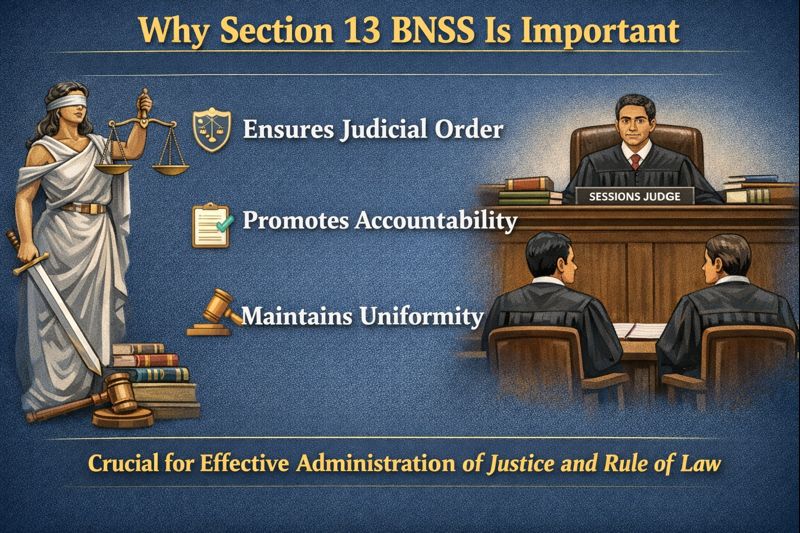
The clear definition of Judicial Magistrates subordination BNSS aligns with modern governance principles.
Conclusion
Section 13 – Bharatiya Nagarik Suraksha Sanhita (BNSS) – Subordination of Judicial Magistrates is a major provision that provides the basis for order, efficiency, and accountability in the criminal courts of India. By clearly marking the line of command and at the same time protecting the independence of the judiciary, Section 13 BNSS creates a situation where control and autonomy coexist.
For those who are interested in grasping the new criminal procedure law in India, Section 13 Bharatiya Nagarik Suraksha Sanhita gives a very important clue about the administration of justice in the BNSS setup.