
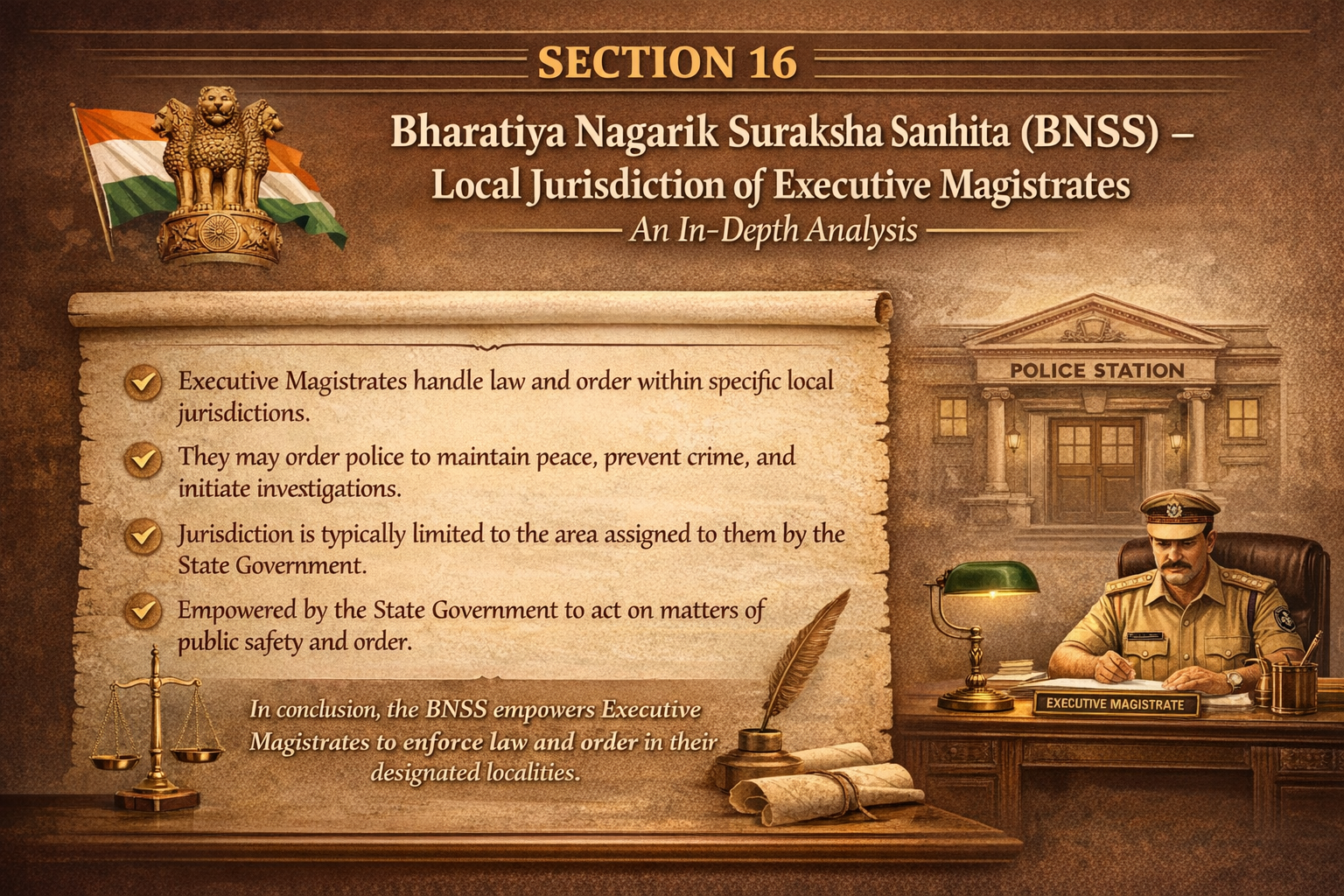
The Bharatiya Nagarik Suraksha Sanhita, 2023 (BNSS) represents a landmark reform in India’s criminal procedural law. As part of the trio of new criminal laws replacing the Criminal Procedure Code (CrPC), BNSS seeks to modernize procedural aspects of criminal justice, enhance clarity, and strengthen administrative functions in maintaining public order. Among its core provisions, Section 16 pertains to the local jurisdiction of Executive Magistrates — a foundational concept that clarifies where and how Executive Magistrates can exercise their powers.
This article explains Section 16 in depth, exploring its purpose, legal scope, practical implications, interplay with related provisions, and its significance in the broader criminal justice framework under BNSS. It also includes illustrative examples and frequently asked questions to help readers fully grasp this essential legal provision.
1. Introduction to Section 16 BNSS
Section 16 of the BNSS is titled “Local Jurisdiction of Executive Magistrates.” It forms part of Chapter II (Constitution of Criminal Courts and Offices) and defines the geographic and administrative limits within which Executive Magistrates may exercise their powers conferred by BNSS. The provision giv
es both structure and flexibility to the administrative framework for executive authority — balancing centralized control with localized enforcement. It does this by empowering the District Magistrate (DM) to define specific local limits and by recognizing that, absent such definitions, Executive Magistrates possess jurisdiction throughout the district.
2. Text of Section 16 BNSS
Section 16 of the BNSS states:
(1) Subject to the control of the State Government, the District Magistrate may, from time to time, define the local limits of the areas within which the Executive Magistrates may exercise all or any of the powers with which they may be invested under this Sanhita.
(2) Except as otherwise provided by such definition, the jurisdiction and powers of every such Magistrate shall extend throughout the district.
At its core, this section sets out two key principles:
- The District Magistrate has authority to limit or define the local jurisdiction of Executive Magistrates.
- If no such limits are defined, Executive Magistrates’ powers automatically extend across the entire district.
3. Legal Purpose of Local Jurisdiction Provisions
The concept of local jurisdiction ensures that Executive Magistrates’ authority is properly calibrated to administrative needs and local conditions. It mirrors similar provisions in the CrPC — specifically Section 22 of the old CrPC, which regulated local limits for executive authority.
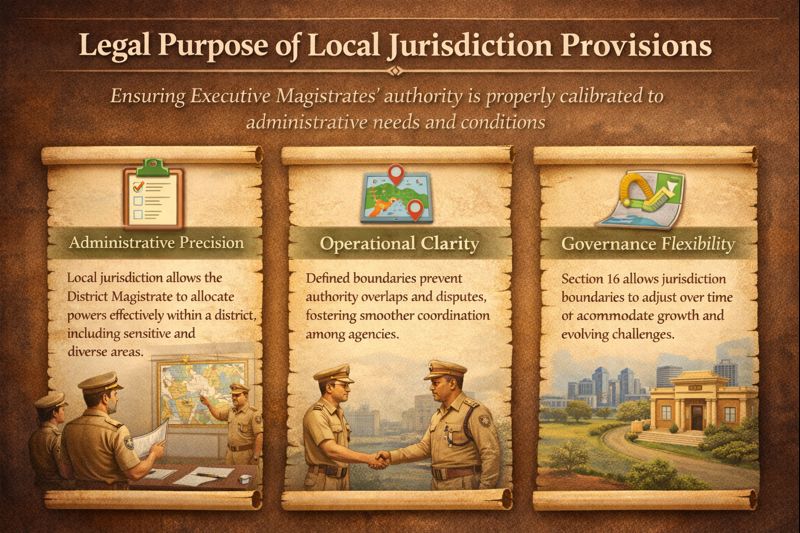
The purposes of this provision include:
a. Administrative Precision
Local jurisdiction allows the District Magistrate to allocate powers effectively within a district. For example, certain sensitive areas, urban neighborhoods, or remote rural zones might require tailored administrative oversight.
b. Operational Clarity
By defining clear boundaries, the law prevents overlaps of authority, confusion, and potential disputes among officers. This contributes to smoother coordination among agencies.
c. Governance Flexibility
Section 16 allows jurisdictional boundaries to be adjusted over time, providing flexibility to adapt to changing circumstances such as population growth, civil projects, or emerging law‑and‑order challenges.
4. Role of the District Magistrate
Under Section 16, the District Magistrate acts as the primary authority for defining the local jurisdiction of Executive Magistrates. This authority is always subject to the control of the State Government, meaning the State Government can guide, modify, or override jurisdictional decisions.
The DM’s role involves:
- Assessing local needs within the district.
- Defining geographic boundaries where specific magistrates exercise certain powers.
- Revising jurisdictional limits based on administrative demand.
By empowering the DM to define jurisdiction, BNSS ensures that local administrative expertise informs enforcement boundaries, rather than a one‑size‑fits‑all approach.
5. Default Jurisdiction — Powers Throughout the District
Clause (2) of Section 16 establishes a default rule: unless the District Magistrate specifies otherwise, the jurisdiction and powers of every Executive Magistrate extend over the entire district.
This default rule serves several important functions:
- It prevents gaps in jurisdiction where no local limits are defined.
- It allows Executive Magistrates to act with full authority in any part of the district unless restrictions are set.
- It facilitates broad administrative responsiveness across the district.
In practice, the default provision ensures continuity and avoids administrative paralysis in the absence of specific local limits.
6. Interaction With Related Provisions
Section 16 functions in conjunction with other BNSS provisions governing Executive Magistrates:
a. Section 14 – Executive Magistrates
Section 14 empowers the State Government to appoint Executive Magistrates and designate the District Magistrate. Section 16 builds on this structure by specifying the territorial reach of their authority.
b. Section 17 – Subordination of Executive Magistrates
Section 17 outlines the hierarchy and subordination among Executive Magistrates, emphasizing that all are subordinate to the District Magistrate and sometimes to the Sub‑Divisional Magistrate where applicable — reinforcing the control framework that interacts with jurisdictional definitions.
Together, these provisions create a coherent structure for executive authority — from appointment to jurisdiction and hierarchy.
7. Practical Implications of Local Jurisdiction
Understanding Section 16 in practice helps to appreciate its real‑world significance:
a. Distinct Urban and Rural Zones
A district may include both urban centers and rural areas with distinct administrative requirements. The DM may assign separate Executive Magistrates specifically to urban police stations and rural blocks to ensure tailored governance.
b. Temporary or Seasonal Jurisdictional Adjustments
During large festivals, elections, or unusual civic events, the DM may reallocate jurisdiction temporarily to enhance oversight or assign specialized magistrates to specific zones.
c. Clarity in Law Enforcement Response
When multiple officers operate in overlapping areas, clearly defined jurisdiction avoids conflicting orders and distributed responsibility, thus improving law enforcement efficiency.
8. Why Section 16 Matters in Modern India
In today’s rapidly evolving administrative environment, ensuring public order and governance requires adaptable legal tools. Section 16 contributes to this by:
- Providing administrative agility — jurisdiction can be changed to suit local conditions.
- Supporting effective enforcement — magistrates know exactly where they can exercise authority.
- Enhancing legal clarity — clear jurisdiction reduces litigation arising from improper exercise of authority.
These factors make Section 16 a critical component of India’s modern criminal justice machinery under BNSS.
9. Comparative Perspective: BNSS vs CrPC
The concept of jurisdiction of Executive Magistrates is not novel; it existed in the CrPC under Section 22. However, BNSS recontextualizes the law into a clearer and modern format while retaining the substantive principles.
Key similarities include:
- Both laws allow the District Magistrate to define local limits.
- Both grant default districts‑wide jurisdiction absent specific limits.
The BNSS framing emphasizes administrative flexibility and aligns with contemporary governance needs.
10. Challenges and Considerations
While Section 16 is straightforward, certain practical challenges can arise:
- Resource constraints: Some districts may lack enough trained Executive Magistrates to warrant fine‑tuned jurisdictional boundaries.
- Dynamic urban growth: Rapidly growing cities may require frequent reconfigurations of local limits.
- Coordination hurdles: Coordination between police and civil magistracy may sometimes be tested when local limits are frequently altered.
Despite these challenges, the provision’s flexibility remains a significant strength.
11. Conclusion
In essence, Section 16 – Local Jurisdiction of Executive Magistrates – is a cornerstone provision under the Bharatiya Nagarik Suraksha Sanhita. It provides the legal architecture for defining where Executive Magistrates can exercise authority, ensuring both clarity and administrative efficiency. By empowering the District Magistrate to define local limits — while maintaining default district‑wide powers — the law embeds flexibility, responsiveness, and accountability into India’s executive legal framework.