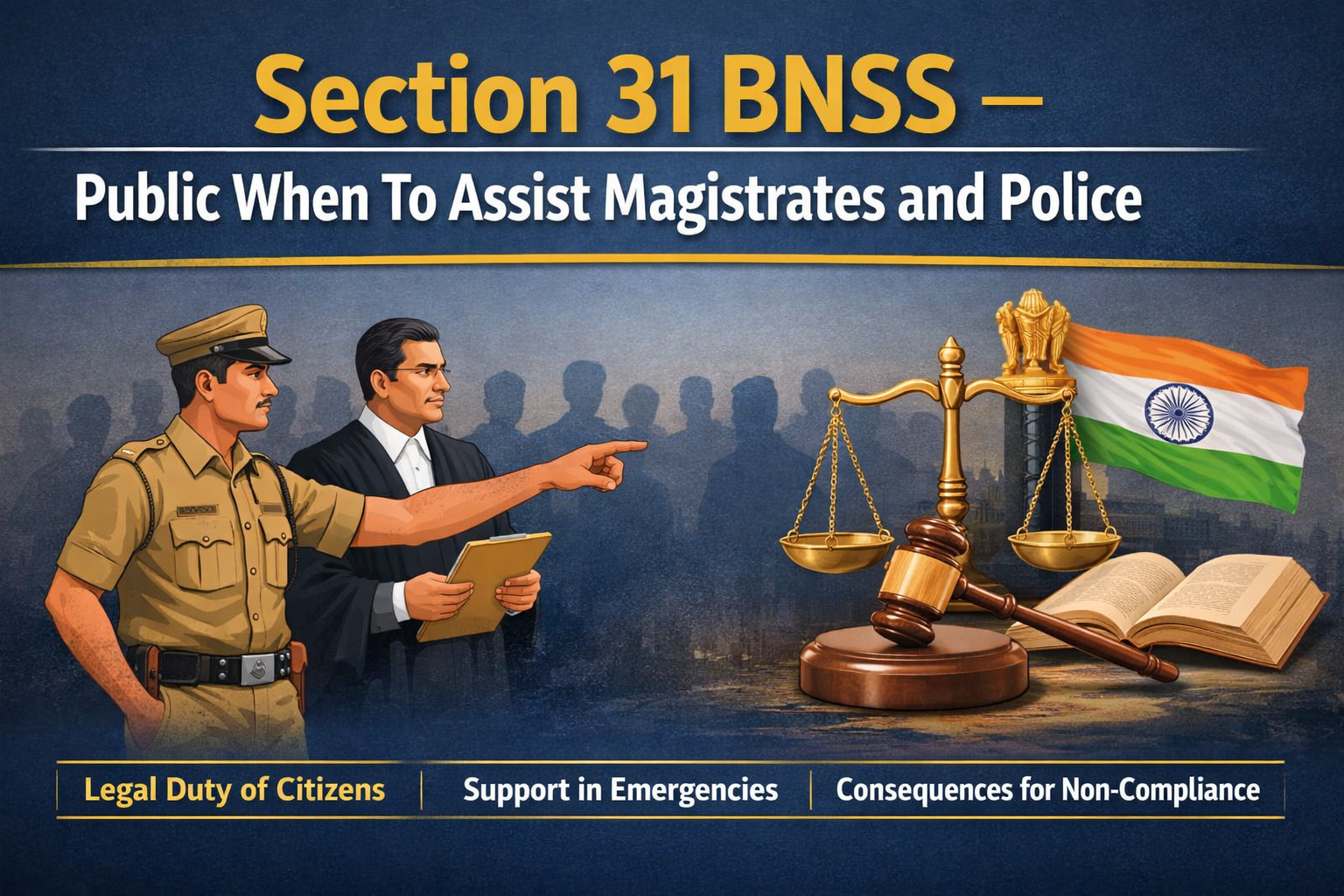
The Indian criminal justice system functions through multiple organizations beyond police and court systems. Citizens also play an important role in maintaining law and order. The Bharatiya Nagarik Suraksha Sanhita, 2023 (BNSS) recognizes this responsibility and includes provisions that require public cooperation with authorities when necessary.
One such important provision is Section 31 BNSS – Public When To Assist Magistrates and Police. This section legally obligates citizens to assist magistrates or police officers in certain situations where public support becomes necessary to maintain peace, prevent crime, or carry out lawful actions.
The Section 31 Bharatiya Nagarik Suraksha Sanhita explanation establishes that public involvement functions as a vital component which supports the maintenance of social order. The provision reflects the idea that crime prevention and enforcement of law is a shared responsibility between the state and the public.
In this article, we will explain the BNSS Section 31 BNSS explained, its purpose, situations where assistance is required, and the legal consequences of refusing to help authorities.
Meaning of Section 31 BNSS – Public When To Assist Magistrates and Police
The Section 31 BNSS – Public When To Assist Magistrates and Police states that every person who is reasonably capable must assist a Magistrate or police officer when called upon to do so in specific situations provided by law.
This provision creates a Legal duty of citizens to help police in India when required. It does not mean that citizens must always assist authorities, but they are required to cooperate when the law specifically calls for such help.
The Bharatiya Nagarik Suraksha Sanhita Section 31 legal provision ensures that law enforcement authorities can seek public support in urgent circumstances where additional help is necessary.
Old Law vs New Law – Section 31 BNSS
The concept of public assistance to authorities existed even in earlier criminal procedure law.
| Old Law | New Law |
| Section 37 of Code of Criminal Procedure (CrPC), 1973 | Section 31 BNSS |
| Public to assist magistrates and police when required | Public when to assist magistrates and police |
| Applied under CrPC procedural framework | Now incorporated under BNSS 2023 |
The BNSS law public cooperation with police continues the principle found in the earlier law but places it within the framework of modern criminal procedure reforms.
Purpose of Section 31 BNSS
The Section 31 BNSS – Public When To Assist Magistrates and Police was introduced to ensure that authorities receive immediate support when dealing with serious situations that threaten public order or safety.
Key objectives of the law include:
- Maintaining public safety and order
- Assisting law enforcement during emergencies
- Preventing criminals from escaping
- Supporting lawful arrest or detention
- Protecting communities from violence or crime
The Role of citizens in maintaining law and order BNSS becomes especially important during situations where authorities alone cannot manage the situation without assistance.
Situations When Public Must Assist Police Under BNSS
The When public must assist police under BNSS provision applies only in certain specific circumstances where the assistance is necessary for lawful enforcement.
Below are some situations where help may be required.
1. Preventing the Commission of an Offence
If a police officer or magistrate is attempting to prevent a crime from occurring, they may request assistance from nearby citizens.
For example:
- Preventing a violent fight or mob attack
- Stopping theft or robbery in progress
- Assisting police in controlling unlawful gatherings
In such cases, the Public duty to assist magistrate and police becomes essential for preventing the offence from escalating.
2. Arresting a Person Who Has Committed an Offence
Another situation covered under Section 31 BNSS – Public When To Assist Magistrates and Police is when authorities require help to arrest a person who has committed an offence.
This may include situations such as:
- A suspect attempting to flee from the police
- A criminal resisting arrest
- A person involved in serious violent activity
Here, the Public assistance to magistrates and police law ensures that the accused cannot escape simply because authorities lack immediate support.
3. Preventing Escape of a Person in Custody
If a person who is lawfully detained attempts to escape, the police or magistrate may seek help from members of the public.
Examples include:
- A prisoner attempting to escape custody
- A detained suspect trying to flee from the police station or while being transported
Under the Citizen responsibility under BNSS, individuals may be asked to help prevent the escape until authorities regain control.
4. Protecting Public Property or Government Authority
Sometimes assistance may also be required to protect public property or government institutions from damage or illegal actions.
For example:
- Preventing vandalism during protests
- Assisting authorities during riots or violent gatherings
- Helping secure public areas during emergencies
In such situations, Magistrate powers and public assistance law India ensures that public support strengthens the authority of law enforcement.
Limits to Public Assistance Under BNSS
Although the law creates a duty, the Section 31 Bharatiya Nagarik Suraksha Sanhita explanation also recognizes that assistance must be reasonable.
Citizens are not expected to place themselves in serious danger.
Important limits include:
- Assistance should be requested by a lawful authority
- The person must be reasonably capable of helping
- The request must be related to lawful police action
This ensures that the BNSS law public cooperation with police remains fair and practical.
Failure to Assist Police – Legal Consequences
Refusing to help authorities when legally required may lead to legal consequences.
The Failure to assist police legal consequences India may include penalties under criminal law for disobedience of lawful directions.
Possible consequences include:
- Legal proceedings for refusing lawful assistance
- Penalties under criminal law provisions
- Liability for obstructing public duty
However, such consequences generally apply only when the refusal is intentional and unjustified.
Importance of Citizen Cooperation in Criminal Justice
The Section 31 BNSS – Public When To Assist Magistrates and Police highlights the important role that citizens play in supporting the justice system.
Law enforcement agencies often face situations where immediate help from the public becomes necessary.
The Role of citizens in maintaining law and order BNSS can be seen in situations such as:
- Reporting crimes
- Assisting during emergencies
- Helping authorities control dangerous situations
Public cooperation strengthens the ability of authorities to maintain safety and enforce the law effectively.
Practical Examples of Public Assistance
To better understand the BNSS Section 31 BNSS explained, consider the following real-life scenarios.
Example 1:
A thief snatches a purse and attempts to escape. A police officer chasing the suspect asks nearby people to block the path. Citizens helping the officer would fall under Section 31 BNSS – Public When To Assist Magistrates and Police.
Example 2:
During a violent altercation in a crowded market, police request help to control the crowd and stop the fight. Citizens assisting in maintaining order fulfill their Public duty to assist magistrate and police.
Example 3:
A detained person tries to escape while being transported by police. Authorities may request help from people nearby to prevent the escape under the Public assistance to magistrates and police law.
Conclusion
The Section 31 BNSS – Public When To Assist Magistrates and Police is an important provision that highlights the partnership between citizens and law enforcement in maintaining public safety.
The Section 31 Bharatiya Nagarik Suraksha Sanhita explanation clarifies that citizens are not merely observers of the legal system but active participants when required by law. The legal provision establishes a duty for Indian citizens to assist police forces which enhances law enforcement agencies’ capability to track down criminals.
The Citizen responsibility under BNSS encourages cooperation between the public and authorities while ensuring that such assistance remains reasonable and lawful.