
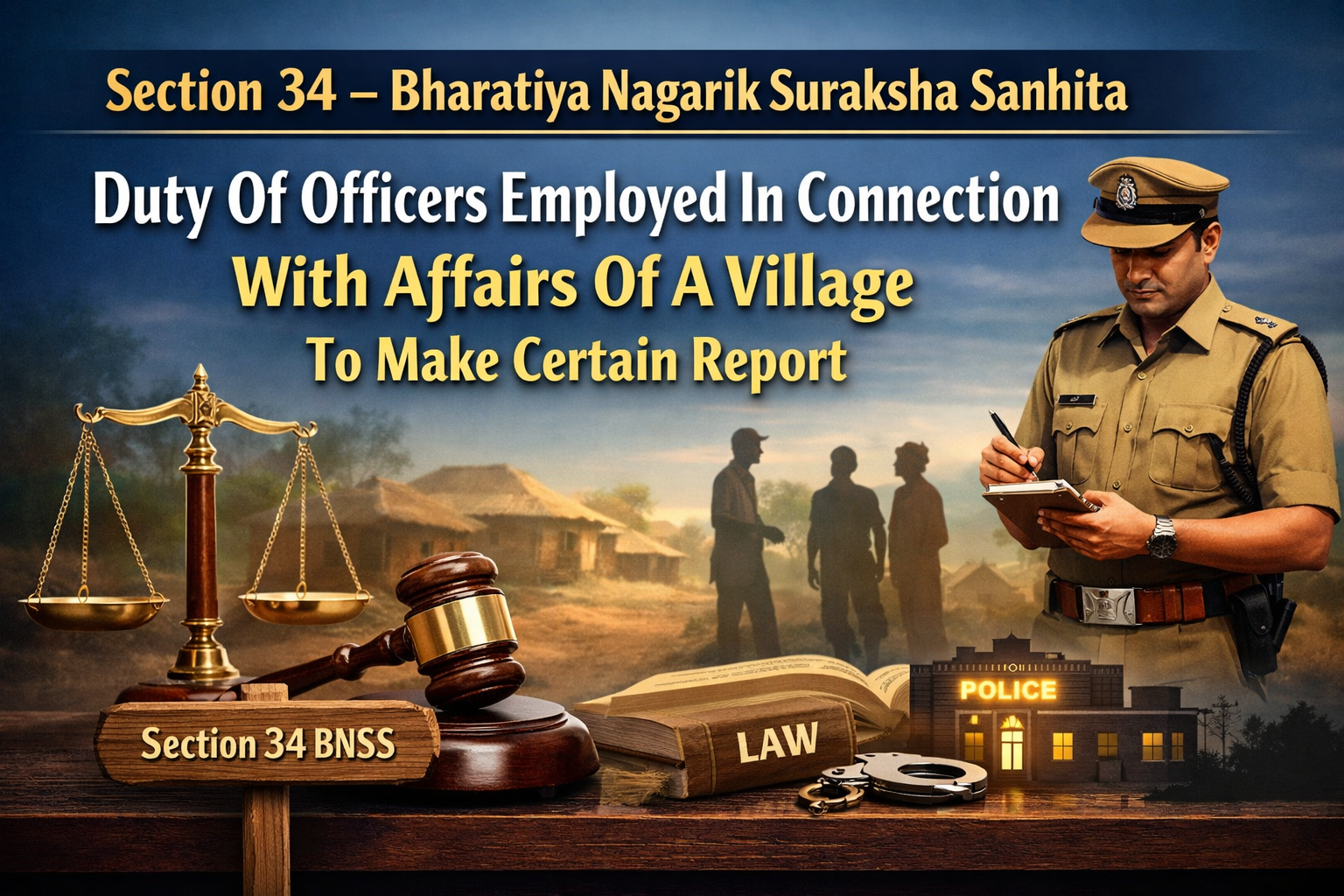
The Bharatiya Nagarik Suraksha Sanhita (BNSS) of 2023 established new rules which enhance criminal investigation procedures and improve methods for reporting criminal activities. The law mandates village officers through Section 34 of Bharatiya Nagarik Suraksha Sanhita to report particular crimes and suspicious events that take place in their designated areas to law enforcement authorities.
The purpose of this law exists to protect rural communities from unreported criminal activities which would otherwise remain hidden. Local administrative officers who include village headmen and watchmen and revenue officials serve as the primary sources of information about crimes that occur in villages. The law requires these individuals to report such information to the police or Magistrate because they stand as the primary witnesses to criminal activities.
This article provides a Section 34 BNSS explained guide, including the duties of village officers, the type of information they must report, and the legal consequences if they fail to perform their obligations.
Meaning of section 34 BNSS Village Officers’ Duty to Report
The provision known as section 34 BNSS Village Officers’ Duty to Report establishes that certain village officials must immediately provide information to the nearest Magistrate or police officer about serious offences, suspicious deaths, or activities that threaten public safety.
Under BNSS 2023 Section 34 provisions, officers employed in connection with village administration must report information if they become aware of:
- Commission of serious crimes
- Presence of suspicious persons or offenders
- Unnatural or suspicious deaths
- Plans or preparations to commit offences
- Movements of proclaimed offenders
The purpose of section 34 BNSS Village Officers’ Duty to Report is to create a structured communication channel between village administration and law enforcement agencies. This ensures that crimes are reported quickly and investigated without delay.
Who Must Report Offences Under Section 34 BNSS
The village officer reporting crime law India applies to individuals who hold official responsibilities within village administration. These officers play a crucial role in maintaining order and providing information about criminal activity.
1. Village Headmen
The village headman duty to report crime BNSS requires the head of the village administration to inform authorities about any serious offence committed within the village.
Village headmen usually supervise local administration and maintain communication with government authorities. Because of this position, the law expects them to act immediately when they receive information about crimes.
2. Village Watchmen or Chowkidars
Village watchmen are responsible for monitoring the safety of the village. The police information duty of village officers specifically includes these watchmen because they regularly patrol the village and often become aware of suspicious activities before others.
Their reporting role helps police respond quickly to potential criminal threats.
3. Revenue Officers and Local Administrative Staff
Some officers working in land records or local administration may also come across information related to crimes. The legal responsibility of village servants BNSS applies to these officials if their duties connect them with village affairs.
If such officers receive information about offences, they must communicate it to the authorities without delay.
Types of Information That Must Be Reported
The information of crime to police BNSS requirement under this provision covers several categories of criminal activity. Village officers must report information related to the following situations.
1. Commission of Serious Offences
Village officials must report offences such as murder, robbery, kidnapping, or other serious crimes. The legal duty of village officials to report offences ensures that police authorities receive early information about such incidents.
Prompt reporting allows law enforcement to begin investigation immediately.
2. Suspicious Deaths
If a person dies under suspicious circumstances, village officers must notify the authorities. This is an essential part of the criminal law reporting duties in villages India because early reporting helps prevent destruction of evidence.
Suspicious deaths may include cases involving violence, poisoning, or unknown causes.
3. Presence of Criminals or Proclaimed Offenders
Village officials must report if a known criminal or proclaimed offender enters the village. The reporting obligation of village officers BNSS ensures that the police remain informed about the movements of offenders.
This helps prevent criminals from hiding in rural areas.
4. Preparations for Criminal Activity
If officers receive information that a group of individuals is planning to commit an offence, they must inform the authorities. Under section 34 BNSS Village Officers’ Duty to Report, failure to report such information could allow crimes to occur.
Early reporting helps the police prevent offences before they happen.
Legal Responsibility of Village Officers Under BNSS
The legal obligations of village officers in India have become more structured with the introduction of BNSS. The Bharatiya Nagarik Suraksha Sanhita village reporting law ensures that local authorities actively participate in maintaining law and order.
Key responsibilities include:
- Reporting criminal activities immediately
- Informing the nearest police station or Magistrate
- Cooperating with law enforcement during investigations
- Providing accurate information about suspects or incidents
The Section 34 BNSS legal explanation makes it clear that this duty is mandatory, not optional. Officers cannot ignore criminal activity occurring within their jurisdiction.
Failure to Report Crime by Village Officer
The failure to report crime by village officer law may lead to legal consequences. If an officer deliberately hides information about a crime or fails to report it without reasonable cause, authorities may take action against that officer.
Failure to report offences can:
- Delay criminal investigations
- Allow offenders to escape
- Destroy crucial evidence
- Threaten public safety
Therefore, section 34 BNSS Village Officers’ Duty to Report places strict responsibility on officials connected with village administration.
Section 34 BNSS vs Section 40 CrPC
The provision under BNSS replaced a similar rule that existed under the earlier criminal procedure law.
| Aspect | Old Law | New Law |
| Governing Law | Code of Criminal Procedure, 1973 | Bharatiya Nagarik Suraksha Sanhita, 2023 |
| Section | Section 40 CrPC | Section 34 BNSS |
| Subject | Duty of village officers to report offences | Duty of officers employed in village affairs to report offences |
The Section 34 BNSS vs Section 40 CrPC comparison shows that the concept remains similar, but the new law aligns the provision with the updated criminal procedure framework.
The objective remains the same: ensure that rural administration assists the criminal justice system by reporting offences promptly.
Importance of Section 34 in Village Administration
The village administration and criminal reporting law under BNSS recognizes that village officers are often the first source of information about crimes. Rural areas may not always have immediate police presence, so local officials play an essential role in maintaining law and order.
The duty of village officers under BNSS strengthens the criminal justice system by ensuring that:
- Crimes are reported quickly
- Police receive reliable local information
- Criminals cannot hide in villages
- Rural communities remain safe
By requiring village officers to report crimes, section 34 bnss Village Officers’ Duty to Report helps bridge the gap between village administration and law enforcement agencies.
Relevant Case Laws & Interpretations (2025–2026)
Judicial interpretations play an important role in understanding the practical scope of Section 34 Bharatiya Nagarik Suraksha Sanhita. Courts have clarified how the section 34 BNSS Village Officers’ Duty to Report should be applied in real situations. Several rulings delivered during 2025–2026 have strengthened the legal duty of village officials to report offences and clarified how this provision operates in rural administration.
Below are some important cases that explain the application of BNSS 2023 Section 34 provisions.
1. Nitesh Rastogi v. State of U.P. (February 2026)
Background of the Case
This case became one of the most significant judicial interpretations related to section 34 bnss Village Officers’ Duty to Report. The dispute arose when a village officer failed to report the presence of a person known for receiving stolen property within the village jurisdiction.
The accused officer argued that he lacked formal police training and therefore did not fully understand his obligation to inform authorities.
Court’s Decision
The court rejected this argument and held that the duty of village officers under BNSS is not dependent on police training. The court described the responsibility under Section 34 BNSS explained as an “active duty of citizenship.”
The ruling clarified several important legal principles:
- Village officers must report criminal activity based on the information available to them.
- Lack of professional investigation training cannot excuse failure to report offences.
- The reporting obligation of village officers BNSS exists because they are the first point of contact with local information.
The court also emphasized that the village officer reporting crime law India relies heavily on local awareness. Village officials often know the social environment of their communities better than external agencies.
Legal Interpretation
This judgment strengthened the legal responsibility of village servants BNSS and confirmed that the police information duty of village officers is a mandatory obligation rather than a discretionary action.
The court clearly stated that when village officers fail to report known offenders, they weaken the functioning of the criminal justice system.
2. State of Punjab v. Panchayat Member (2025)
Background of the Case
In this case, a Panchayat member was accused of failing to report the movement of a suspected drug trafficker who passed through the village lands.
Authorities argued that the officer knew about the presence of the trafficker but deliberately failed to inform the police.
The issue before the court was whether the officer had a legal duty under section 34 bnss Village Officers’ Duty to Report to inform authorities about the movement of such an individual.
Court’s Decision
The court examined the Bharatiya Nagarik Suraksha Sanhita village reporting law and concluded that the Panchayat member had a clear legal obligation to report the information.
A key aspect of this ruling involved the definition of a proclaimed offender. Under the earlier criminal procedure system, reporting obligations were often linked to specific offences. However, the BNSS 2023 Section 34 provisions introduced a punishment-based approach.
Since drug trafficking offences can carry a punishment exceeding ten years, the court ruled that the village officer was legally required to report the movement of the suspect.
Legal Interpretation
This case clarified several aspects of Section 34 BNSS legal explanation:
- The duty to report now depends on the seriousness of the offence.
- Offences carrying heavy punishments create a stronger reporting obligation.
- Village officers must actively monitor suspicious activities affecting public safety.
The decision demonstrated that the criminal law reporting duties in villages India have become stricter under BNSS.
3. Public Safety & District Magistrate’s Orders (2026 Context)
Background
Another important development related to section 34 bnss Village Officers’ Duty to Report emerged through administrative orders issued by District Magistrates in several border states during 2026.
These orders required village officers to report the use of unidentified drones or suspicious aerial devices in rural areas near international borders.
Authorities believed that such devices could be used for illegal surveillance, smuggling, or other criminal activities.
Legal Authority
The orders were issued under the powers provided in Section 34 Bharatiya Nagarik Suraksha Sanhita, particularly the clause that allows the District Magistrate to require village officers to report information necessary for maintaining public order.
Some individuals challenged these directions, arguing that they imposed additional responsibilities on local officers.
Court’s Observation
Courts upheld the District Magistrate’s authority and ruled that such orders fall within the scope of village administration and criminal reporting law.
The judiciary recognized that the information of crime to police BNSS requirements must adapt to modern security challenges.
Therefore, village officers can be required to report:
- Suspicious drone activity
- Unusual surveillance devices
- Unknown individuals operating technological equipment in rural areas
Legal Interpretation
This development shows how the legal obligations of village officers in India continue to evolve under BNSS. The courts confirmed that the section 34 BNSS Village Officers’ Duty to Report is flexible enough to address emerging security threats.
The decisions also emphasized that village officers serve as an essential link between rural communities and the law enforcement system.
Conclusion
The Section 34 Bharatiya Nagarik Suraksha Sanhita plays a crucial role in strengthening the reporting system for crimes in rural India. The provision ensures that village officers act responsibly when they receive information about criminal activities.
Through section 34 BNSS Village Officers’ Duty to Report, the law establishes a clear reporting mechanism between village administration and police authorities. The provision also reinforces the legal responsibility of village servants BNSS to support the criminal justice system.