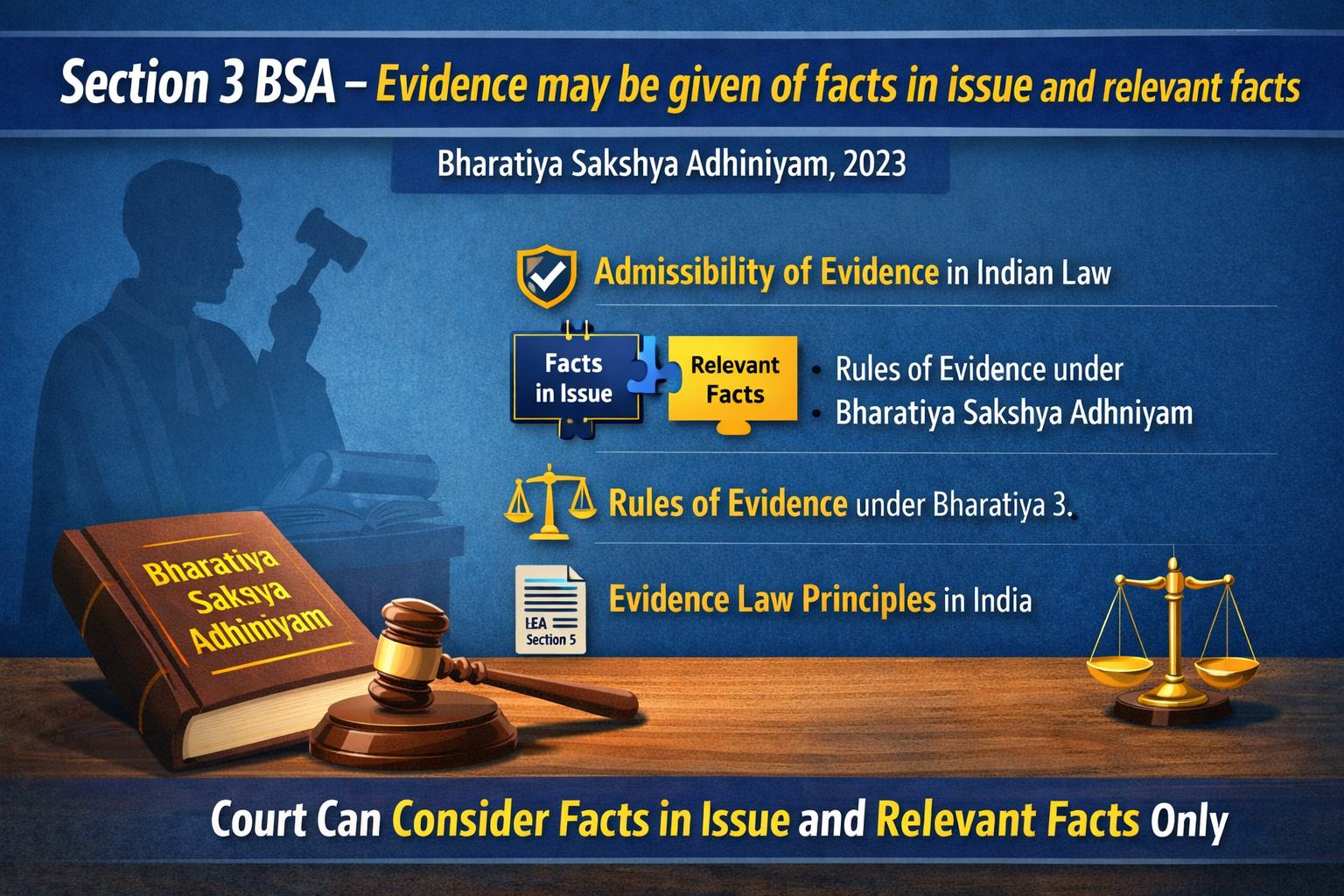
The law of evidence determines what information a court can consider when deciding a case. In India, this area of law is governed by the Bharatiya Sakshya Adhiniyam, which replaced the colonial-era Indian Evidence Act. One of the most fundamental provisions of this legislation is Section 3 BSA – Evidence may be given of facts in issue and relevant facts.
This rule forms the foundation of evidence law because it defines what information can be presented before a court. According to Section 3 BSA – Evidence may be given of facts in issue and relevant facts, only those facts that are directly in dispute or closely connected with the dispute can be proved in court. Any unrelated information is generally not considered admissible.
Understanding Section 3 Bharatiya Sakshya Adhiniyam explained is essential for lawyers, law students, and individuals who wish to understand how courts determine truth through legally admissible evidence.
Section 3 BSA – Evidence may be given of facts in issue and relevant facts Explained
The core principle of Section 3 BSA – Evidence may be given of facts in issue and relevant facts is that courts can consider evidence only if it relates to the dispute being examined. In other words, evidence must either prove a fact in issue or show a relevant fact connected to the matter.
Key Elements of the Provision
- Evidence limited to relevant matters
The court requires evidence that establishes direct ties to the case being examined. The rule protects judicial decisions from being affected by evidence that does not matter to the case. - Foundation of evidence law
The Bharatiya Sakshya Adhiniyam Section 3 legal provision establishes the primary rule which governs evidence admission in Indian judicial proceedings. The system guarantees that courts examine only evidence which provides actual assistance in establishing the truth of the matters before them.. - Connection with the dispute
The Bharatiya Sakshya Adhiniyam establishes evidence standards which require proof to show a direct connection between evidence and the particular legal matter that the court must resolve.
These features are unlock valuable aspects Section 3 BSA explanation providing detailed guidance for the court in determining whether or not to admit evidence.
Meaning of Facts in Issue in Evidence Law
A central concept within Section 3 BSA – Evidence may be given of facts in issue and relevant facts is the idea of facts in issue.
Key Aspects of Facts in Issue
- Definition
The term Indian evidence law facts in issue meaning refers to the facts that are directly disputed between the parties in a case. - Importance in legal proceedings
These facts determine the rights or liabilities of the parties involved. Therefore, evidence must be presented to prove or disprove these facts. - Direct connection with the case
In Facts in issue and relevant facts in evidence law, facts in issue represent the core matter the court must resolve.
For example, in a theft case, whether the accused actually took the property would be a fact in issue.
Meaning of Relevant Facts in Evidence Law
Another crucial concept in Section 3 BSA – Evidence may be given of facts in issue and relevant facts is the idea of relevant facts.
Important Characteristics of Relevant Facts
- Facts connected to the main issue
Relevant facts are not the main issue themselves but have a connection that helps prove or disprove the issue. - Logical relationship
The Relevancy of facts under Bharatiya Sakshya Adhiniyam requires that these facts must logically relate to the facts in issue. - Supporting role in evidence
Under Evidence related to facts in issue India, relevant facts assist the court in forming a complete understanding of the case.
For instance, in a murder case, the presence of the accused near the crime scene may be considered a relevant fact.
Difference Between Facts in Issue and Relevant Facts
Understanding the Difference between facts in issue and relevant facts is essential to properly interpret Section 3 BSA – Evidence may be given of facts in issue and relevant facts.
Key Differences
- Nature of the facts
Facts in issue are the main disputed facts in a case, while relevant facts are supporting facts connected to those issues. - Role in determining liability
Facts in issue directly determine the outcome of the case, whereas relevant facts help establish or explain those issues. - Position in evidence law
In Facts in issue and relevant facts in evidence law, relevant facts serve as indirect proof that supports the main issue.
This distinction is fundamental in applying the Rules of Evidence under Bharatiya Sakshya Adhiniyam.
Admissibility of Evidence in Indian Law
The concept of Admissibility of evidence in Indian law is closely linked to Section 3 BSA – Evidence may be given of facts in issue and relevant facts.
Important Rules
- Evidence must be relevant
Under the Court admissible evidence under BSA, only relevant information can be presented before the court. - Irrelevant facts are excluded
The law prevents irrelevant or unrelated facts from influencing judicial decisions. - Application in court proceedings
These rules form the basis of Evidence law principles in India and ensure fairness in legal trials.
Therefore, What evidence can be given in court BSA depends largely on whether the evidence relates to facts in issue or relevant facts.
Practical Examples of Section 3 BSA
To understand Section 3 BSA – Evidence may be given of facts in issue and relevant facts, the following examples can be considered.
Example 1
In a murder case, whether the accused caused the death of the victim is a fact in issue. Evidence such as eyewitness testimony or forensic reports may be presented.
Example 2
If the accused was seen near the location shortly before the incident, this may be considered Evidence related to facts in issue India, as it supports the prosecution’s argument.
Example 3
Communication between the accused and the victim before the incident may also be treated as a relevant fact.
These examples demonstrate how Section 3 Bharatiya Sakshya Adhiniyam explained works in real legal situations.
Old Law: Position Under the Indian Evidence Act
Before the enactment of the Bharatiya Sakshya Adhiniyam, the same rule existed under the Indian Evidence Act.
Key Points of the Old Provision
- Section 5 of the Indian Evidence Act
Under the earlier law, Section 5 provided that evidence may be given only of facts in issue and relevant facts. - Similar legal principle
The principle remains largely the same in the new law. - Modern codification
The Bharatiya Sakshya Adhiniyam Section 3 legal provision continues the same rule while reorganizing the structure of evidence law.
Thus, the transition from the old law to the new law maintains the fundamental Evidence law principles in India.
Importance of Section 3 BSA in the Justice System
The Section 3 BSA – Evidence may be given of facts in issue and relevant facts plays a crucial role in ensuring fairness and clarity in court proceedings.
Major Importance
- Prevents irrelevant evidence
Courts avoid wasting time on unnecessary information that does not help resolve the dispute. - Ensures fair trials
By focusing only on relevant evidence, the rule maintains fairness in judicial proceedings. - Improves judicial efficiency
udges can concentrate on the facts that truly matter in the case.
Through these principles, the Rules of Evidence under Bharatiya Sakshya Adhiniyam strengthen the reliability of the justice system.
Conclusion
The Section 3 BSA – Evidence allows presentation of evidence which includes both contested facts and pertinent facts. The section defines which information can be used by courts to make their case determinations.
By distinguishing between Facts in issue and relevant facts in evidence law, the provision ensures that courts rely only on legally admissible and meaningful evidence. The rule also continues the long-standing principles previously found in the Indian Evidence Act.