The Bharatiya Sakshya Adhiniyam, 2023 (BSA) replaced the Indian Evidence Act, 1872 and introduced a modern framework for the law of evidence in India. The new law establishes its first major requirement through Section 4 BSA which explains how to assess the relevance of facts that belong to the same event. The rule establishes which facts judicial authorities will accept as relevant evidence during the court proceedings.
The purpose of Section 4 BSA is to ensure that courts examine all connected events that form part of a single occurrence or transaction. Often, a legal dispute involves several related facts that happen at different times or places but still form one continuous event. The law recognizes that such facts are important for understanding the complete picture of a case.
Understanding Section 4 BSA
The provision under Section 4 BSA states that facts which form part of the same transaction are considered relevant, even if they occurred at different times or locations. The court can consider these facts as evidence if they are connected with the main event.
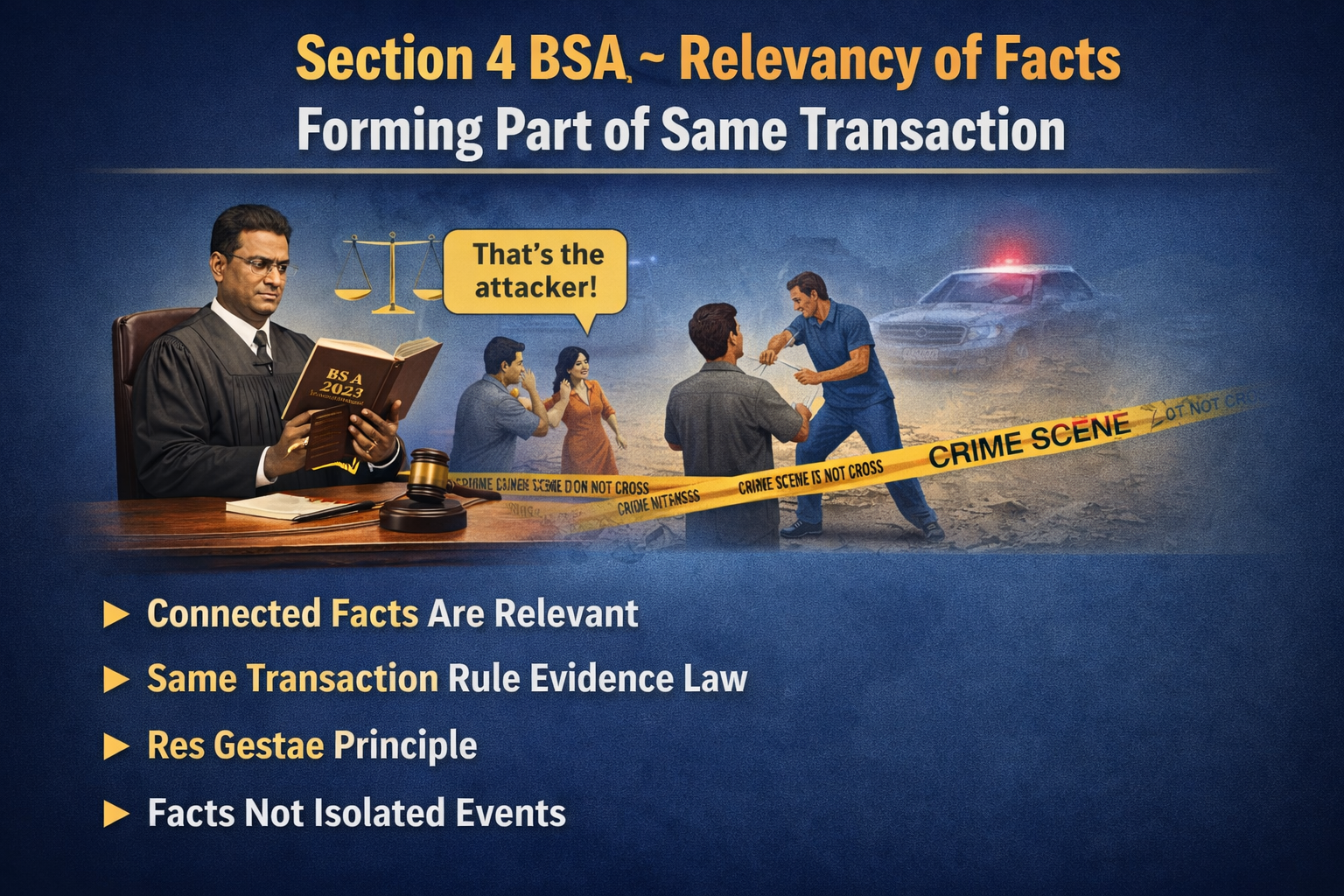
The rule explained in Bharatiya Sakshya Adhiniyam Section 4 is based on the legal principle known as res gestae, which means “things done.” According to this doctrine, statements or acts that occur as part of the same transaction are admissible because they help explain the complete event.
In simple terms, Section 4 BSA meaning refers to the idea that when several facts together form a continuous story or occurrence, each of those facts may be relevant in court.
Meaning of Relevancy of Facts Forming Part of Same Transaction
The concept of Relevancy of facts forming part of same transaction ensures that courts do not examine incidents in isolation. Instead, the law requires the court to consider the entire chain of events.
Key Idea
If multiple actions occur as part of one continuous incident, they are treated as connected facts.
Explanation
For example, if a crime occurs and several statements, actions, or reactions immediately follow, those events may help explain what happened. Under Section 4 BSA, such connected facts can be presented before the court as evidence.
Section 4 BSA Explanation – Key Elements
To understand the Section 4 BSA explanation, it is important to examine the key elements that determine whether facts form part of the same transaction.
1. Continuity of Events
One important factor in Section 4 BSA is whether the events form a continuous sequence.
Explanation
When multiple events happen one after another and are closely connected, they may be considered part of the same transaction. The Same transaction rule evidence law allows the court to analyze these events together rather than separately.
2. Proximity in Time and Place
Another important element of Facts forming part of same transaction evidence is the closeness in time and location.
Explanation
If several events occur within a short period and in nearby places, they may be treated as part of a single transaction. However, physical proximity is not always necessary if the events are clearly related.
3. Connection Between the Facts
Under Bharatiya Sakshya Adhiniyam Section 4, the facts must have a logical connection with the main event.
Explanation
The events should contribute to explaining the main occurrence. If a fact helps clarify the motive, conduct, or circumstances of the case, it may fall under Section 4 BSA.
4. Spontaneous Statements or Actions
Another important aspect of the Res gestae principle in evidence law is that statements made spontaneously during an event may be relevant.
Explanation
When a person makes a statement immediately during or after an incident, such statements may be considered trustworthy because they are made without time for fabrication.
Same Transaction Rule Evidence Law
The Same transaction rule evidence law is a fundamental principle behind Section 4 BSA. This rule allows courts to examine all related events as a single narrative.
Purpose of the Rule
The main objective of the rule is to provide a complete understanding of the incident.
Explanation
If courts only examine isolated facts, they may miss the broader context. The Relevancy of facts forming part of same transaction ensures that every connected event that forms part of the occurrence is considered.
Practical Examples of Section 4 BSA
Understanding Section 4 BSA meaning becomes easier with practical examples.
Example 1 – Statement During an Assault
Suppose a person is attacked on the street and immediately shouts the name of the attacker while running away.
Explanation
The victim’s statement made during the incident may be admissible as evidence under Section 4 BSA, because it forms part of the same transaction.
Example 2 – Chain of Events in a Theft Case
If a theft occurs and the accused is seen fleeing the scene while witnesses shout or react to the incident, these events are connected.
Explanation
All such events may be treated as Facts forming part of same transaction evidence under the rule established by Section 4 BSA.
Example 3 – Statements Made Immediately After an Incident
A person who witnesses an accident may immediately describe what happened to others present at the scene.
Explanation
Such statements may be considered under the Res gestae principle in evidence law, which is recognized in Bharatiya Sakshya Adhiniyam Section 4.
Importance of Section 4 BSA in Evidence Law
The role of Section 4 BSA is significant in the administration of justice because it helps courts evaluate evidence in a realistic manner.
Helps Courts Understand the Complete Event
By considering connected facts, courts can examine the full sequence of events.
Explanation
The Section 4 BSA explanation ensures that judges do not ignore relevant circumstances surrounding an incident.
Prevents Artificial Separation of Facts
Without the Same transaction rule evidence law, important facts could be excluded simply because they occurred slightly earlier or later.
Explanation
Relevancy of facts forming part of same transaction prevents such artificial separation and promotes fairness in legal proceedings.
Supports Truthful Evidence
Spontaneous statements made during an incident are often more reliable.
Explanation
The Res gestae principle in evidence law recognizes that such statements are less likely to be fabricated.
Old Law Comparison – Indian Evidence Act
Before the introduction of the Bharatiya Sakshya Adhiniyam, similar provisions existed in the Indian Evidence Act, 1872.
Earlier Provision
Section 6 of the Indian Evidence Act dealt with the same concept of facts forming part of the same transaction.
Key Similarity
Both laws recognize the res gestae principle and allow connected facts to be admitted as evidence.
Structural Update
The Bharatiya Sakshya Adhiniyam Section 4 continues the same legal principle but reorganizes the structure of evidence law under the new legislation introduced in 2023.
Conclusion
The provision under Section 4 BSA plays an essential role in the law of evidence by recognizing the Relevancy of facts forming part of same transaction. It ensures that courts consider all related events that together form a complete occurrence.
Through the Section 4 BSA explanation, it becomes clear that the law aims to present a full and accurate picture of an incident rather than examining isolated facts. The rule derived from the Res gestae principle in evidence law allows courts to admit spontaneous statements and connected events that help reveal the truth.