The Bharatiya Sakshya Adhiniyam 2023 BSA replaced the Indian Evidence Act of 1872 which existed during the colonial period and established new standards for proof and evidence assessment in Indian legal proceedings. The principal section of the Section 6 Bharatiya Sakshya Adhiniyam establishes standards for behavioral evidence assessment which allows motive evidence together with evidence of preparation and conduct to be used in both criminal and civil court cases.
The courts need to use circumstantial evidence in criminal cases because direct evidence does not exist in many trials. The courts use circumstantial evidence to interpret how defendants behave and what they intend to do. The concept explained in Section 6 BSA Motive Preparation and Conduct helps courts determine whether a person had a reason to commit an offence, whether they made preparations before committing it, and how they behaved before or after the alleged act.
This article Section 6 BSA explained through its detailed guide which demonstrates the meaning of motive and preparation and conduct and their application during criminal trials and the legal impact according to BSA 2023 Section 6 provisions.
Meaning of Section 6 BSA Motive Preparation and Conduct
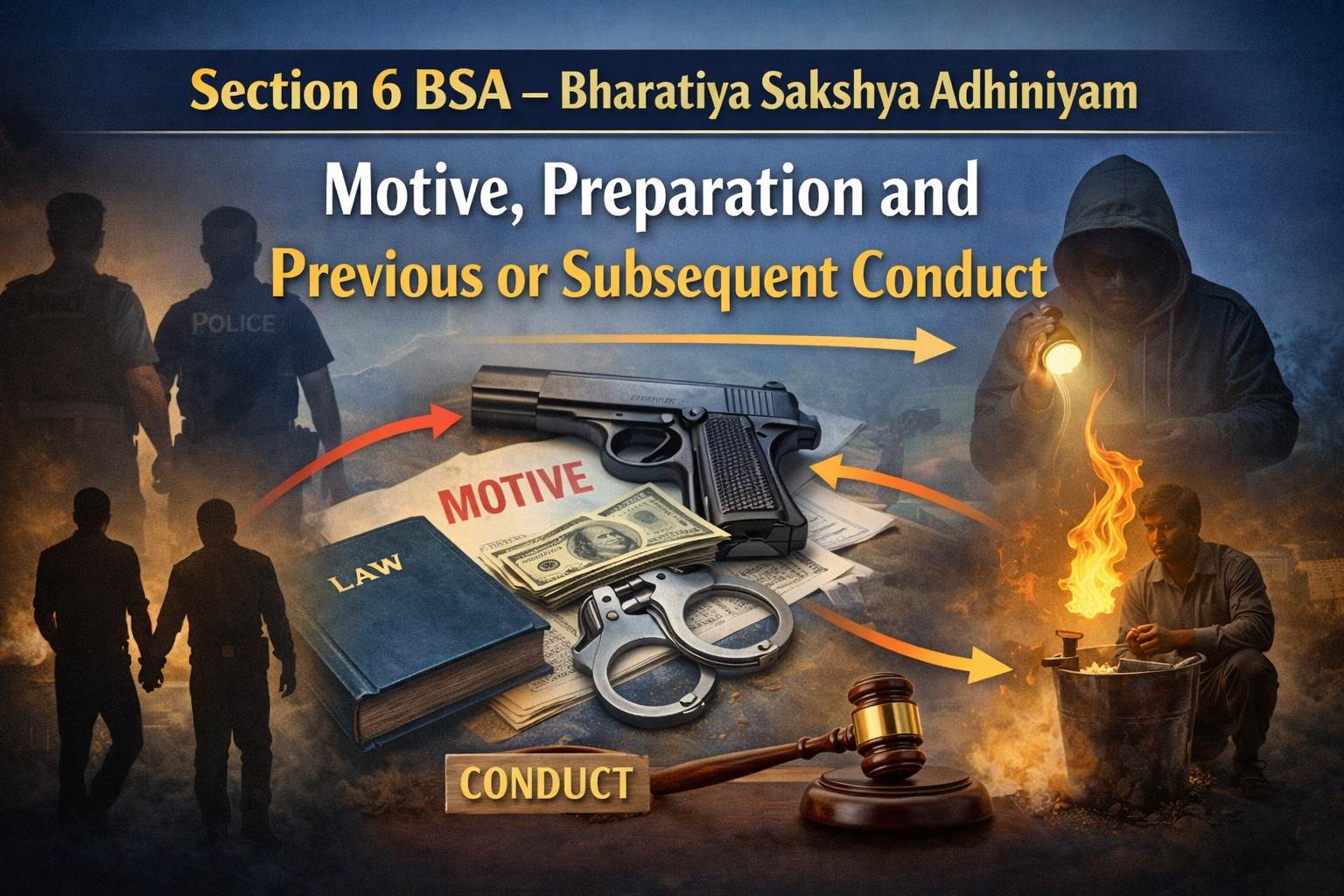
The principle of Section 6 BSA Motive Preparation and Conduct states that any fact showing the motive, preparation, or conduct of a person connected with a relevant fact or issue may be considered relevant evidence in court.
This rule allows courts to examine surrounding circumstances that help explain why an act was committed and how it was planned or carried out.
Under Motive preparation and conduct under BSA, courts may examine:
- The reason behind committing the offence
- The actions taken before the offence was committed
- The behavior of the accused before or after the incident
These elements assist judges in gaining complete understanding of all events that occurred during a criminal incident.
The criminal evidence motive and preparation rule requires courts to evaluate both the actual criminal act and all evidence that shows the defendant’s intentions and their plan for committing the crime.
Understanding Motive Under Evidence Law
1. Meaning of Motive in Criminal Cases
The evidence of motive in criminal law India refers to the reason that motivates a person to commit a crime. Motive explains the underlying cause that drives an individual to perform a particular act.
Examples of motive may include:
- Financial gain
- Revenge or personal rivalry
- Property disputes
- Family conflicts
Although motive alone cannot prove guilt, the importance of motive in criminal evidence law becomes clear when it supports other evidence in the case.
2. Relevance of Motive in Criminal Trials
The relevance of motive in Bharatiya Sakshya Adhiniyam lies in its ability to provide context to the crime. Courts often examine motive when:
- Direct evidence is missing
- The crime appears unusual or unexplained
- The prosecution must establish the intention behind the act
The proof of motive in criminal trials India strengthens the prosecution’s case when it shows that the accused had a logical reason to commit the offence.
Preparation as Evidence in Criminal Cases
1. Meaning of Preparation
Preparation refers to actions taken before committing an offence that indicate planning. Under Section 6 BSA Motive Preparation and Conduct, preparation becomes relevant when it shows that the accused arranged resources or took steps to execute the crime.
Examples of preparation as evidence in criminal cases include:
- Purchasing weapons or tools used in the crime
- Conducting surveillance of the victim
- Arranging transportation for committing the offence
- Collecting materials required for illegal acts
These preparatory actions may show that the offence was not accidental but carefully planned.
2. Importance of Preparation Evidence
Preparation evidence helps establish the mental element of the crime. When courts examine Motive preparation and conduct under BSA, they consider whether the accused deliberately prepared for the offence.
Such evidence may show:
- Premeditation
- Intent to commit the crime
- Involvement of the accused in planning the act
Therefore, Section 6 BSA legal explanation recognizes preparation as an important factor in criminal trials.
Previous and Subsequent Conduct as Evidence
1. Previous Conduct
The previous conduct and subsequent conduct evidence rule allows courts to consider the behavior of a person before the crime occurred.
Examples of previous conduct include:
- Threats made by the accused
- Disputes or conflicts with the victim
- Suspicious activities before the incident
Such actions may indicate hostility or planning related to the crime.
2. Subsequent Conduct
Subsequent conduct refers to the behavior of a person after the alleged offence has taken place.
Examples include:
- Attempting to hide evidence
- Escaping from the crime scene
- Providing false explanations
- Contacting witnesses to influence them
The conduct of accused as evidence in court can reveal whether the person attempted to conceal the offence or avoid legal consequences.
Courts analyze such behavior carefully because it may indicate guilt or consciousness of wrongdoing.
Legal Significance of Section 6 Under Bharatiya Sakshya Adhiniyam
The Section 6 BSA Motive Preparation and Conduct provision plays an essential role in the law of evidence. It helps courts connect different facts that form the complete narrative of a case.
The BSA 2023 Section 6 provisions highlight the importance of surrounding circumstances in determining the truth. Instead of focusing only on direct evidence, courts examine the broader context of events.
Key benefits of this provision include:
- Understanding the intention behind criminal acts
- Identifying planning and preparation for offences
- Evaluating the conduct of individuals involved in the case
- Strengthening circumstantial evidence
This provision is particularly important in cases where eyewitness testimony is unavailable.
Section 6 BSA vs Section 8 Indian Evidence Act
The concept of motive and conduct existed in earlier evidence law as well. The Section 6 BSA vs Section 8 Indian Evidence Act comparison shows how the new law replaced the earlier provision.
| Aspect | Old Law | New Law |
| Governing Law | Indian Evidence Act, 1872 | Bharatiya Sakshya Adhiniyam, 2023 |
| Section | Section 8 Evidence Act | Section 6 BSA |
| Subject | Motive, preparation and conduct | Motive, preparation and previous or subsequent conduct |
The Section 6 BSA legal explanation demonstrates that the principle remains similar, but it is now integrated into the modernized evidence law framework.
Importance of Section 6 in Criminal Justice
The importance of motive in criminal evidence law becomes clear when courts evaluate circumstantial evidence. Motive, preparation, and conduct help establish the sequence of events that led to the crime.
The Section 6 BSA Motive Preparation and Conduct provision strengthens criminal trials by allowing courts to examine the behavior and intentions of individuals connected with the case.
Through this rule, judges can better determine:
- Whether the accused had a motive
- Whether they planned the offence
- Whether their behavior indicates guilt
By analyzing these elements together, courts can form a clearer picture of the truth.
Relevant Case Laws on Section 6 BSA Motive Preparation and Conduct (2025–2026)
Judicial decisions play an important role in interpreting the scope of Section 6 Bharatiya Sakshya Adhiniyam. Courts frequently rely on the principles of Section 6 BSA Motive Preparation and Conduct to examine the behavior, intention, and actions of an accused person before and after an offence. Recent rulings from 2025–2026 have clarified how motive preparation and conduct under BSA should be evaluated while determining criminal liability.
The following cases demonstrate how courts apply the criminal evidence motive and preparation rule in real situations.
1. Arjun Mehta v. State of Maharashtra (2025)
Background of the Case
In this case, the accused was charged with the murder of a business partner following a financial dispute. There was no direct eyewitness testimony linking the accused to the crime. The prosecution relied heavily on circumstantial evidence related to the accused’s motive and preparation.
Investigators discovered that the accused had recently purchased a weapon and conducted repeated visits to the victim’s office before the incident.
Court’s Decision
The court held that the evidence clearly showed preparation as evidence in criminal cases and established a strong chain of circumstances. The court emphasized that under Section 6 BSA Motive Preparation and Conduct, preparatory actions taken before a crime may reveal deliberate planning.
Legal Interpretation
The court observed that:
- The accused had a clear financial motive.
- The purchase of the weapon demonstrated preparation.
- The pattern of behavior supported the prosecution’s narrative.
The judgment reinforced the importance of motive in criminal evidence law and confirmed that preparation evidence may significantly strengthen circumstantial cases.
2. State of Karnataka v. Rakesh Kumar (2026)
Background of the Case
This case involved allegations of kidnapping and extortion. The prosecution argued that the accused had previously threatened the victim and demanded money several weeks before the crime occurred.
During the trial, the prosecution introduced evidence of threatening messages and earlier disputes between the parties.
Court’s Decision
The court ruled that such evidence falls within the scope of previous conduct and subsequent conduct evidence and is therefore relevant under Section 6 Bharatiya Sakshya Adhiniyam.
The court clarified that the earlier threats were directly connected to the motive behind the crime.
Legal Interpretation
The court stated that conduct of accused as evidence in court can provide important insight into the intention of the accused.
According to the judgment:
- Previous threats established the motive.
- Communication records proved preparation.
- Subsequent attempts to hide communication records showed guilty conduct.
This case strengthened the interpretation of Section 6 BSA explained, confirming that behavioral evidence plays a critical role in criminal trials.
3. State of Delhi v. Imran Ali (2026)
Background of the Case
In this case, the accused was charged with involvement in a robbery. After the incident, investigators discovered that the accused attempted to destroy evidence and fled from the city.
The prosecution argued that this behavior should be considered as relevant evidence under Section 6 BSA Motive Preparation and Conduct.
Court’s Decision
The court held that the attempt to hide evidence and escape from the jurisdiction constituted subsequent conduct relevant under BSA 2023 Section 6 provisions.
Legal Interpretation
The court emphasized that:
- Attempting to destroy evidence shows consciousness of guilt.
- Sudden disappearance after a crime can indicate involvement.
- Subsequent behavior may reveal the mental state of the accused.
This decision reinforced the Section 6 BSA legal explanation that both prior and later conduct can be considered when courts evaluate criminal responsibility.
Judicial Significance of These Cases
These rulings collectively demonstrate the practical application of Section 6 BSA Motive Preparation and Conduct in modern criminal trials. Courts increasingly rely on circumstantial evidence to reconstruct the events surrounding a crime.
The cases highlight three important legal principles:
- Evidence of motive in criminal law India helps explain why the offence occurred.
- Preparation as evidence in criminal cases may indicate planning and intention.
- Previous conduct and subsequent conduct evidence can reveal the mental state of the accused.
Through these judicial interpretations, the relevance of motive in Bharatiya Sakshya Adhiniyam has become clearer and more structured.
Conclusion
The Section 6 Bharatiya Sakshya Adhiniyam provides an important rule regarding the relevance of motive, preparation, and conduct in judicial proceedings. The Section 6 BSA Motive Preparation and Conduct principle allows courts to examine not only the crime itself but also the circumstances surrounding it.
The Motive preparation and conduct under BSA framework ensures that courts consider human behavior and intentions while evaluating evidence. By recognizing previous conduct and subsequent conduct evidence, the law allows judges to understand the broader context of a criminal act.
The BSA 2023 Section 6 provisions continue the legal principles that existed earlier while adapting them to the modern legal framework. The BSA Motive Preparation and Conduct section of Section 6 BSA remains an essential rule in Indian evidence law because it assists courts in making just and reasonable decisions during criminal trials.