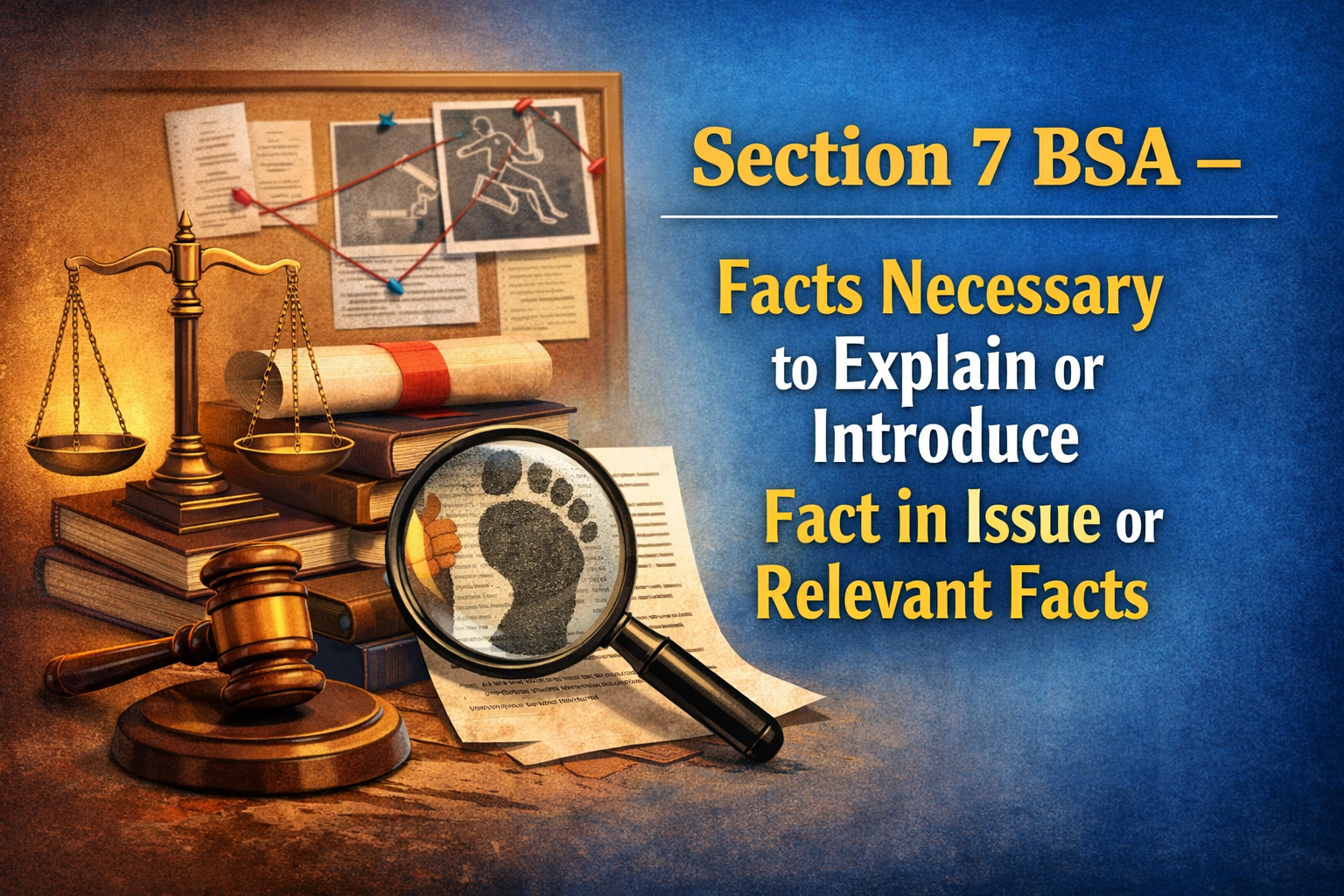
The Bharatiya Sakshya Adhiniyam 2023 BSA has established new standards for establishing fact relevance in court proceedings which replace the Indian Evidence Act 1872. The BSA Section 7 BSA Facts Necessary to Explain or Introduce Fact in Issue provides essential guidelines which assist courts in evaluating additional evidence that aids their understanding of the primary matter at hand.
In every trial, facts do not exist in isolation. They are often connected with surrounding circumstances that explain how an incident occurred. This is where Section 7 Bharatiya Sakshya Adhiniyam becomes significant, as it allows certain explanatory facts to be admitted in evidence.
Meaning of Section 7 BSA Facts Necessary to Explain or Introduce Fact in Issue
Section 7 BSA Facts Necessary to Explain or Introduce Fact in Issue refers to facts that are not directly in issue but are essential to understand the context, background, or circumstances of the main fact.
Under Section 7 BSA explained, such facts are considered relevant if they:
- Help explain the occurrence of the main event
- Provide context to the fact in issue
- Clarify the chain of events
- Remove ambiguity in evidence
These facts fall under the broader category of Relevant facts under Section 7 BSA, making them admissible in court.
Key Legal Principle Behind Section 7 BSA
The principle behind Section 7 BSA Facts Necessary to Explain or Introduce Fact in Issue is that justice requires a complete understanding of events rather than isolated facts.
Core Idea
- Facts that explain or introduce the main fact are relevant
- Courts must consider surrounding circumstances
- Evidence should present a complete narrative
This concept is a vital part of Evidence law Section 7 BSA India, ensuring fairness in judicial decisions.
Types of Facts Covered Under Section 7 BSA
Under Section 7 BSA legal explanation, several categories of facts are considered relevant.
1. Facts Explaining the Occasion
These are facts that explain why a particular incident occurred.
Explanation:
- They provide the reason or background of an event
- Help establish motive or context
Example:
- A dispute before an assault explains the cause of the incident
This falls under Facts necessary to explain fact in issue BSA.
2. Facts Explaining the Cause
These facts explain the cause behind a fact in issue.
Explanation:
- Show how an event was triggered
- Establish a cause-and-effect relationship
Example:
- Evidence of poisoning explains the cause of death
Such facts are essential under Facts necessary to introduce fact in issue.
3. Facts Showing Effect
These are facts that show the result or consequence of an act.
Explanation:
- Help prove that a particular act produced a specific result
- Strengthen the chain of evidence
Example:
- Medical reports showing injuries after an attack
This supports Admissibility of explanatory facts in evidence law.
4. Facts Forming Part of the Same Transaction
Facts that are closely connected in time and place with the main event.
Explanation:
- Known as part of the same transaction principle
- Provide a continuous narrative
Example:
- Events immediately before and after a crime
These are included under Relevant facts under Section 7 BSA.
5. Facts Explaining Identity or Context
These facts help identify persons, objects, or situations related to the case.
Explanation:
- Clarify confusion in evidence
- Establish identity or location
Example:
- CCTV footage showing presence at the crime scene
This is an important aspect of Facts explaining or introducing relevant facts law.
Admissibility Under Section 7 BSA
The Section 7 BSA Facts Necessary to Explain or Introduce Fact in Issue ensures that explanatory facts are admissible only when they are directly connected to the main issue.
Conditions for Admissibility
- The fact must be closely related to the fact in issue
- It must help in explaining or introducing the main fact
- It should not be remote or irrelevant
This principle governs the admissibility of explanatory facts in evidence law.
Section 7 BSA Examples
Understanding Section 7 BSA examples helps clarify its application.
Example 1: Murder Case
- Fact in issue: Whether A killed B
- Relevant fact: A and B had a serious dispute earlier
This explains the motive and falls under Facts necessary to explain fact in issue BSA.
Example 2: Theft Case
- Fact in issue: Theft of property
- Relevant fact: Accused was seen near the location
This helps establish presence and forms part of Relevant facts under Section 7 BSA.
Example 3: Accident Case
- Fact in issue: Cause of accident
- Relevant fact: Road condition and vehicle speed
These facts explain the cause and fall under Section 7 BSA legal explanation.
Section 7 BSA vs Old Law (Indian Evidence Act, 1872)
Old Provision
- Section 7 of the Indian Evidence Act, 1872
New Provision
- Section 7 Bharatiya Sakshya Adhiniyam, 2023
Key Differences
- Language simplified for clarity
- Better alignment with modern evidence practices
- Covers digital and technological contexts
However, the core principle remains the same:
Facts explaining or introducing the main issue are relevant.
This continuity strengthens Evidence law Section 7 BSA India.
Judicial Approach to Section 7 BSA
Courts apply Section 7 BSA Facts Necessary to Explain or Introduce Fact in Issue carefully to ensure fairness.
Courts Examine:
- Whether the fact is closely connected
- Whether it explains the main issue
- Whether it forms part of a continuous chain of events
Judges avoid admitting irrelevant or distant facts to maintain the integrity of evidence.
Importance of Section 7 BSA in Evidence Law
The importance of Section 7 BSA Facts Necessary to Explain or Introduce Fact in Issue lies in its role in ensuring complete justice.
Key Significance
- Provides context to facts in issue
- Prevents misleading interpretation of isolated facts
- Strengthens the chain of evidence
- Helps courts arrive at logical conclusions
This makes it a fundamental provision in Facts explaining or introducing relevant facts law.
Conclusion
Section 7 BSA Facts Necessary to Explain or Introduce Fact in Issue plays a vital role in Indian evidence law by allowing courts to consider surrounding and explanatory facts. These facts provide context, clarify circumstances, and help establish a logical connection between events.
Under Section 7 BSA explained, the law recognizes that understanding a case requires more than just the main fact. It requires a complete picture formed by related facts that explain, introduce, and support the issue in question.
The transition from the Indian Evidence Act to the Bharatiya Sakshya Adhiniyam has retained this essential principle while modernizing its application. As a result, Section 7 BSA legal explanation continues to ensure fairness, accuracy, and clarity in judicial proceedings.