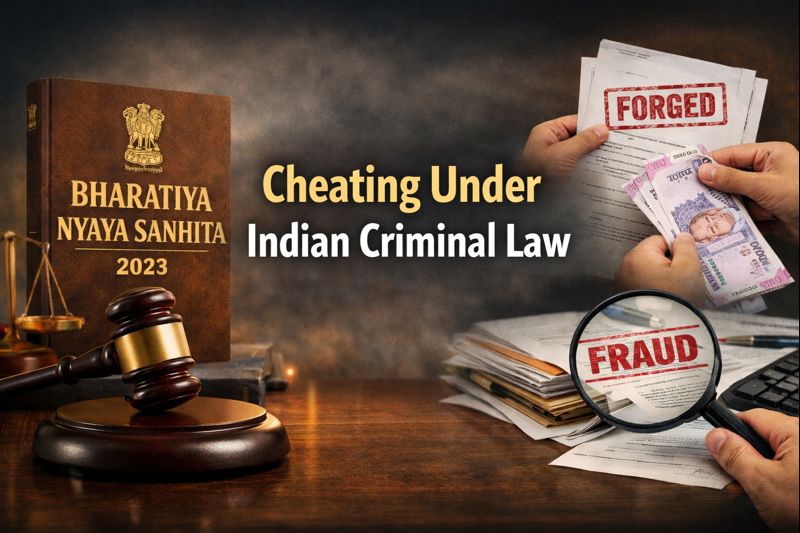
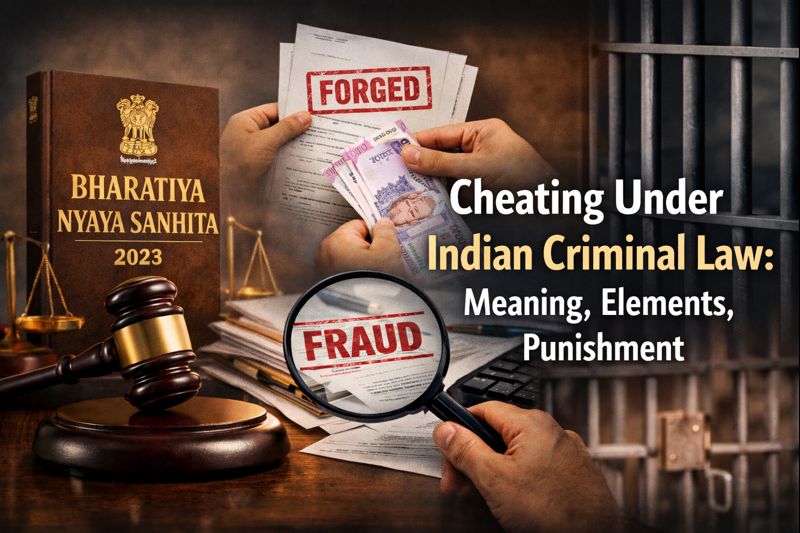
In India, cheating emerges as the most common alleged crime which people raise during legal disputes about money and property and employment matters and business transactions. Indian courts have established that not every broken promise or failed transaction constitutes a criminal offence although financial loss leads to criminal complaints. Indian cheating under Indian criminal law offence which involves deceptive behaviour and dishonest intent with criminal responsibility occurring only when fraud becomes evident.
The Bharatiya Nyaya Sanhita 2023 BNS Act establishes a new legal framework that replaces the Indian Penal Code 1860 yet maintains the fundamental elements of cheating while achieving a better definition of the crime. This article explains what is cheating under Indian criminal law, its legal meaning, essential elements, punishment, judicial interpretation, and leading case laws.
Legal Definition of Cheating in India
The legal definition of cheating in India is rooted in deception coupled with dishonest inducement. A person commits cheating when they deceive another person and fraudulently or dishonestly induce that person to deliver property, money, or valuable security, or to do or omit an act that causes harm.
The foundation of cheating under IPC and BNS is the existence of dishonest intention at the time the representation is made. Courts have repeatedly clarified that intention formed later does not satisfy the requirements of cheating.
What Is Cheating Under Indian Criminal Law
To understand what constitutes cheating under Indian criminal law, it is necessary to examine the mental condition of the defendant. The act of cheating involves a person who intentionally deceives another with the intention to make that person suffer financial losses.
Key aspects include:
- Deception of a person
- Dishonest inducement
- Resulting harm or damage
Thus, cheating under Indian criminal law penalizes fraudulent conduct, not mere failure to keep a promise.
Meaning of Cheating in Criminal Law
The meaning of cheating in criminal law extends beyond ordinary dishonesty. It involves calculated deception intended to mislead another person into parting with property or altering their legal position.
Cheating may occur through:
- False statements of fact
- Suppression of material information
- False promises made with no intention to perform
- Abuse of trust for unlawful gain
This ensures that the criminal offence of cheating targets morally blameworthy conduct.
Cheating Under Indian Criminal Law: Legal Framework
Cheating Offence in India
The cheating offence in India is commonly invoked in cases of financial fraud, fake employment offers, misrepresentation in business transactions, and deceptive property dealings. The law seeks to protect individuals from economic and legal harm caused by fraud.
Cheating Under Bharatiya Nyaya Sanhita
Cheating under Bharatiya Nyaya Sanhita retains the essential principles of the earlier law while presenting them in clearer language. The offence continues to emphasize intention, inducement, and damage, ensuring continuity in judicial interpretation.
Elements of Cheating Offence
For conviction, all elements of cheating must be proved together. These elements prevent misuse of criminal law in purely civil disputes.
1. Deception
- The accused must deceive the victim
- Deception may be through words, conduct, or intentional concealment
2. Dishonest or Fraudulent Intention
- Cheating and criminal intent must exist from the very beginning
- Later failure or change of intention is insufficient
3. Inducement
- The victim must be induced to deliver property, money, or act in a way they otherwise would not
4. Harm or Damage
- The act must cause wrongful loss to the victim or wrongful gain to the accused
If any element is missing, cheating under Indian criminal law is not established.
Difference Between Cheating and Breach of Contract
The difference between cheating and breach of contract is a crucial distinction in Indian jurisprudence.
Cheating
- Dishonest intention exists at the outset
- Constitutes a criminal offence
- Punishable with imprisonment or fine
Breach of Contract
- Intention may be honest initially
- Arises from failure to perform contractual obligations
- Leads to civil remedies such as damages
Courts have repeatedly warned against converting civil disputes into criminal cases under cheating under Indian criminal law.
Punishment for Cheating in India
The punishment for cheating in India depends on the nature and seriousness of the offence.
Nature of Punishment
- Imprisonment
- Fine
- Both imprisonment and fine
Aggravated Forms
- Cheating involving valuable security
- Cheating affecting multiple persons
- Cheating causing significant financial loss
Under cheating under IPC and BNS, punishment is intended to be proportionate and deterrent.
Cheating and Criminal Intent
Cheating and criminal intent form the backbone of the offence. Courts closely examine whether the accused intended to deceive at the time the promise or representation was made.
Indicators of criminal intent include:
- False representations known to be untrue
- Immediate misuse of property obtained
- Pattern of deceptive conduct
This ensures that cheating under Indian criminal law is applied with caution and fairness.
Important Case Laws on Cheating Under Indian Criminal Law
Judicial decisions play a vital role in interpreting cheating provisions.
1. Hridaya Ranjan Prasad Verma v. State of Bihar (2000)
The Supreme Court held that for cheating, dishonest intention must exist at the time of making the promise. Mere breach of contract does not constitute cheating.
2. S.W. Palanitkar v. State of Bihar (2002)
The Court clarified that criminal proceedings should not be initiated where the dispute is essentially civil in nature and lacks fraudulent intent at inception.
3. State of Kerala v. A. Pareed Pillai (2004)
The Court emphasized that deception is the core ingredient of cheating and must be clearly proved.
These cases reinforce the cautious application of cheating under Indian criminal law.
Conclusion
The Indian cheating under Indian criminal law its primary defense mechanism to protect society against fraudulent activities which damage social and economic trust. The Indian legal system establishes criminal responsibility for fraudulent acts through its definition of deception, intention, inducement, and harm. The legislative system maintains a continuous connection between IPC cheating and BNS because it follows a legislative pattern that seeks to achieve equitable treatment and judicial outcomes.
The definition of cheating in criminal law together with its essential components and penalties and judicial interpretations enables people and businesses and legal professionals to identify criminal acts and civil matters which leads to justice being properly administered.