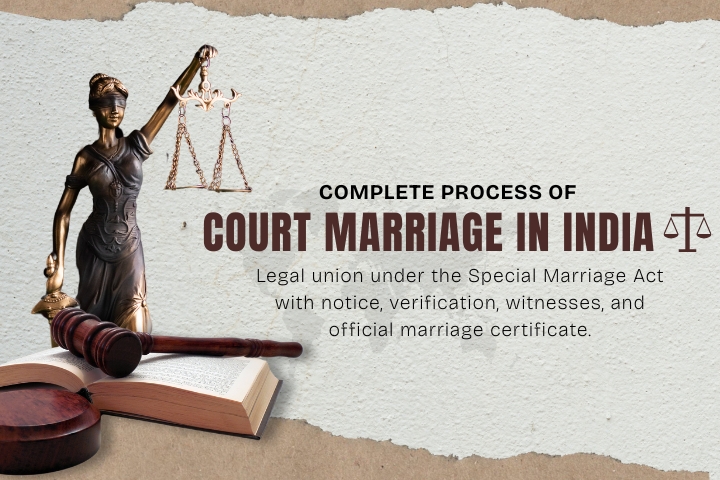
Marriage is very important and a very personal decision most people today take a simple, legally binding, and transparent process. Court Marriage in India has turned out to be a widely accepted path for especially inter-religious, inter-caste, or inter-state partnerships. The Special Marriage Act of 1954 governs this system which permits the legal marriage character across India without going through the religious ceremonies.
This article gives a detailed account of the whole process of Court Marriage in India, covering the requirements, documents, eligibility, fees, and the complete legal process in a step-wise manner.
1. Understanding Court Marriage in India
Court Marriage in India permits two adults to marry without any religious ceremony in front of a Marriage Officer. After the wedding is recorded, the partners get a legal court marriage certificate.
This type of marriage is mostly preferred for:
- Inter-caste court marriage
- Inter-religion court marriage
- Couples who want a simple and legally recognized marriage
- Couples who do not wish to follow traditional rituals
2. Why People Choose Court Marriage
Here are some clear reasons:
- It is legally valid across India.
- It protects the marriage from social pressure.
- Provides a secure certificate needed for visas, passports, or legal rights.
- No religious customs are required.
- The process is standardized under the Special Marriage Act 1954.
3. Eligibility Criteria Under the Special Marriage Act 1954
Before starting the Marriage registration process, both partners must meet the following basic requirements:
Eligibility Requirements
- Age requirement
- Groom: 21 years
- Bride: 18 years
- This fulfills the mandatory court marriage age requirement..
- Mental capacity
- Both parties must be of sound mind and capable of understanding the marriage.
- Both parties must be of sound mind and capable of understanding the marriage.
- Marital status
- Both should be single (unmarried), divorced, or widowed.
- If divorced, a valid decree is needed.
- Relationship
- The partners must not fall under prohibited degrees of relationship unless the custom allows.
4. Required Court Marriage Documents
To complete Court Marriage in India, the following court marriage documents are required:
Documents for Both Partners
- Aadhar card / Passport / Driving Licence / Voter ID
- Date of birth proof (Birth Certificate, 10th Marksheet, or Passport)
- Passport-size photographs
- Proof of current address
- Marital status affidavit
Additional Documents if Applicable
- Divorce decree (if divorced)
- Death certificate of spouse (if widowed)
- NOC from embassy (for foreign nationals)
Documents Required from Witnesses
- ID proof
- Address proof
- Passport size photo
Having all documents ready makes the steps for court marriage smooth and faster.
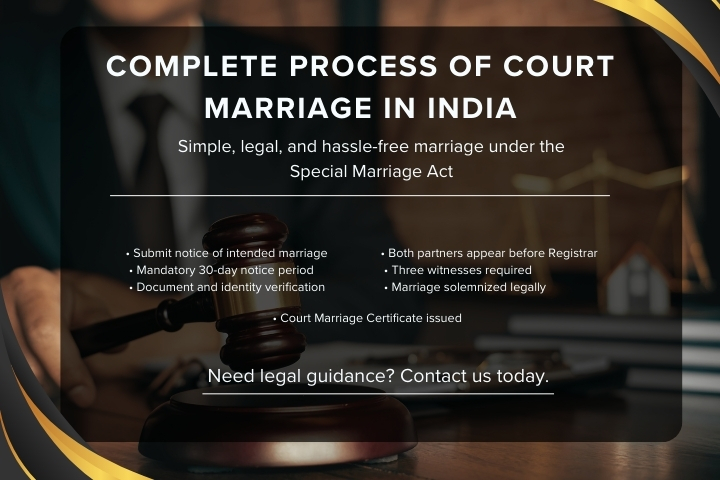
5. Step-by-Step Court Marriage Process
In India, the Court Marriage standard legal procedure is as follows:
Step 1: Submit Notice of Intended Marriage
The couple has to give a written notice to the Sub-Registrar office (Marriage Officer) in the area where the partner has been residing for a minimum of 30 days.
This is the compulsory court marriage notification period.
- The notice is displayed publicly for 30 days.
- Anyone can object within this time.
- This is known as the 30-day notice for marriage.
Step 2: Verification of Documents
During the notice period, the Marriage Officer examines:
- Identity
- Age
- Residential proof
- Relationship status
If all documents match legal requirements, the process moves ahead.
Step 3: Witness Preparation
You need three witnesses for the final day of marriage.
This fulfills all witness requirements for court marriage.
Witnesses must carry:
- ID proof
- Photograph
- Occupation details
Step 4: Marriage Date After Notice Period
Once the 30-day notice period is completed without valid objections, a marriage date is scheduled.
Step 5: Signing Before the Marriage Officer
Also, on the day of the marriage, both the parties and those of the three witnesses must duly sign the marriage register in the presence of the Marriage Officer.
Step 6: Issuance of Court Marriage Certificate
Finally, you receive the court marriage certificate, which serves as the legal proof of marriage for all purposes including immigration, loans, and social security.
These are the complete steps for court marriage required by law.
6. Court Marriage in India — Procedure at a Glance
| Step | Description |
| Visit the Sub-Registrar office marriage department | Select the district office where either partner has lived for at least the past 30 days. |
| Submit the notice with documents | Provide the required documents; your marriage notice is recorded under the Special Marriage Act 1954. |
| Wait for the mandatory notice period | A fixed 30-day notice for marriage is observed before registration. |
| Verification process | The Marriage Officer reviews all documents, eligibility, and any objections during the notice period. |
| Bring three witnesses | Three witnesses are required for signing on the final marriage day. |
| Sign the marriage register | Both partners and witnesses sign before the Marriage Officer, making the marriage legally valid. |
| Collect the marriage certificate | The official certificate is issued, completing the court marriage registration process. |
7. Court Marriage Fees
The court marriage fees differ from state to state but typically include:
- Notice fee
- Registration fee
- Certificate fee
The usual fee range is ₹500 – ₹1,500, depending on the location and additional affidavits.
8. Court Marriage Online Application
Many states now allow couples to start the procedure digitally through court marriage online application services.
Online options may include:
- Filling the notice form
- Booking an appointment
Uploading documents - Checking the status of the 30-day notice
- Downloading application receipts
Actual final registration still requires both partners and witnesses to appear physically at the Sub-Registrar office marriage department.
9. Inter-Caste and Inter-Religion Court Marriage
Inter-caste court marriage and inter-religion court marriage are fully protected under the Special Marriage Act 1954.
Important points:
- No religious ceremony or conversion is required.
- Both can follow their own personal laws after marriage.
- The Act provides legal protection to such couples.
- Police protection can also be requested in some cases.
This is one of the biggest reasons why people choose Court Marriage in India.
10. Advantages of Court Marriage in India
Here are the major benefits:
| Benefit | Explanation |
| Legally strong | The marriage is officially recognized by the government and valid across India. |
| Simple and clear | No elaborate rituals are required; the process is straightforward and formal. |
| Useful for legal and international purposes | The marriage certificate is accepted for visas, passports, bank procedures, property matters, etc. |
| Ideal for couples from different religions or castes | No religious ceremonies or conversions are required for inter-caste and inter-religion couples. |
| Protected under law | The process of marriage in India is legal, transparent, fair, and provides legal protection for the couple. |
11. Important Court Marriage Rules in India
Under the Court marriage rules in India, couples must follow these points:
- Mandatory 30-day notice
- No close blood relationship
- Valid ID and address proof
- Mental capacity to consent
- Physical presence on the final day
- Three witnesses required
- Registration must be done before a certified Marriage Officer
These rules ensure a lawful and valid marriage process.
12. Common Mistakes Couples Make
Avoid these issues to ensure a smooth Court Marriage in India:
- Not staying 30 days in the jurisdiction before filing the notice
- Bringing fewer than 3 witnesses
- Incorrect documents
- Wrong spelling in papers
- Not checking the Sub-Registrar office jurisdiction
- Missing the appointment date
Double-check these details before starting.
Final Thoughts
Court Marriage in India is the very straightforward and honest and safe way for two adults to marry legally. The Special Marriage Act 1954 supports such marriages that are between different castes, religions, states, or bases, and such marriages can be done without any social pressure and in a simple manner.
If you follow all necessary court marriage documents, finish the court marriage notice period, get witnesses, pay the court marriage fees, and go through the marriage registration process, you will definitely receive your court marriage certificate easily.
The steps for court marriage mentioned above will lead you through the whole process whether you are planning an inter-caste court marriage, an inter-religion court marriage, or simply wanting a legally recognized marriage.