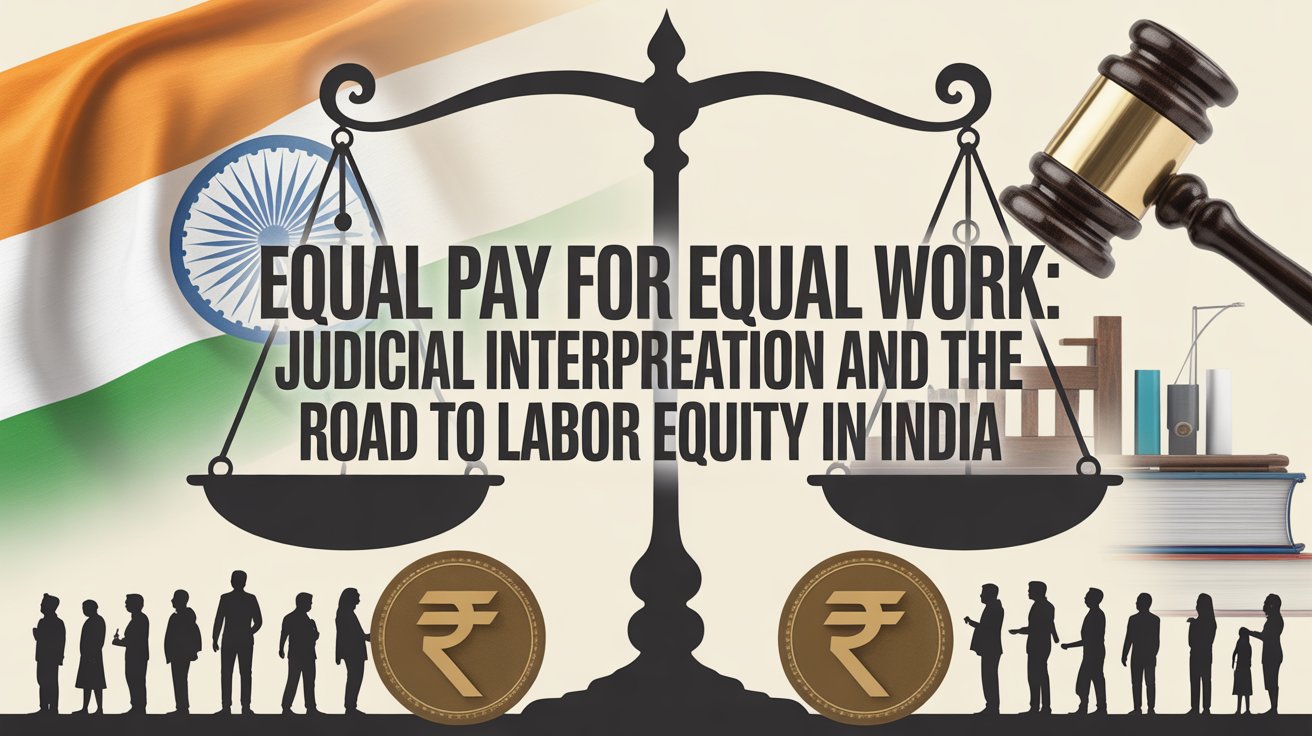
In Indian law, the concept of “Equal Pay for Equal Work” is not just a catchy phrase; it is a major constitutional aim. With the help of this principle, which is supported by the notion of social justice, the human quality of work is not only recognized but also made universal, as all workers are paid the same or at least similar wages irrespective of their skills and the nature of their work. The Indian Supreme Court has lately reiterated this principle by a two-judge bench comprising Justice Ahsanuddin Amanullah and Justice Vipul M. Pancholi, thus clarifying its application to contract and ad-hoc employees who have been in confusion regarding their rights.
The article elaborates on the legal basis of the “Equal Pay for Equal Work” doctrine, the intricacies of the latest judicial developments, and the wider repercussions for the Indian labor market.
1. The Constitutional Foundation: Article 39(d) and Beyond
The phrase “Equal Pay for Equal Work” has not been explicitly mentioned as a Fundamental Right in the Indian Constitution, however, it has been granted that status through continual judicial interpretation.
- Article 39(d): This article under the Directive Principles of State Policy (DPSP) commands the State to provide equal pay for equal work regardless of gender.
- Article 14 and 16: The Supreme Court has skillfully linked Article 39(d) with Article 14 (Equality before Law) and Article 16 (Equality of opportunity in public employment). This implies that any unequal pay between two groups of employees doing the same work is a violation of the fundamental right to equality.
In the famous Randhir Singh v. Union of India (1982) case, the Court stated that although the principle is a Directive Principle, it is an enforceable right when read with the equality clauses of the Constitution.
2. The Recent Judicial Milestone: Justice Amanullah and Justice Pancholi’s Ruling
The reference source highlights a critical case involving educators and technical staff who were hired on a “fixed-pay” or “contractual” basis but performed the exact same functions as “regular” employees.
Key Observations of the Court:
- Substance Over Label: The Court emphasized that the “nomenclature” or “label” of an appointment (e.g., ad-hoc, temporary, or contractual) is irrelevant if the nature of the duties, the level of responsibility, and the required qualifications are identical to those of a regular post.
- The Burden of Proof: For the doctrine to apply, the person claiming parity must prove that their work is “equal” in all respects—including quality, quantity, and the degree of responsibility.
- Against Exploitation: The bench noted that the State, being a “Model Employer,” cannot exploit the unemployment crisis to hire skilled individuals at a fraction of the cost of regular employees while expecting the same professional output.
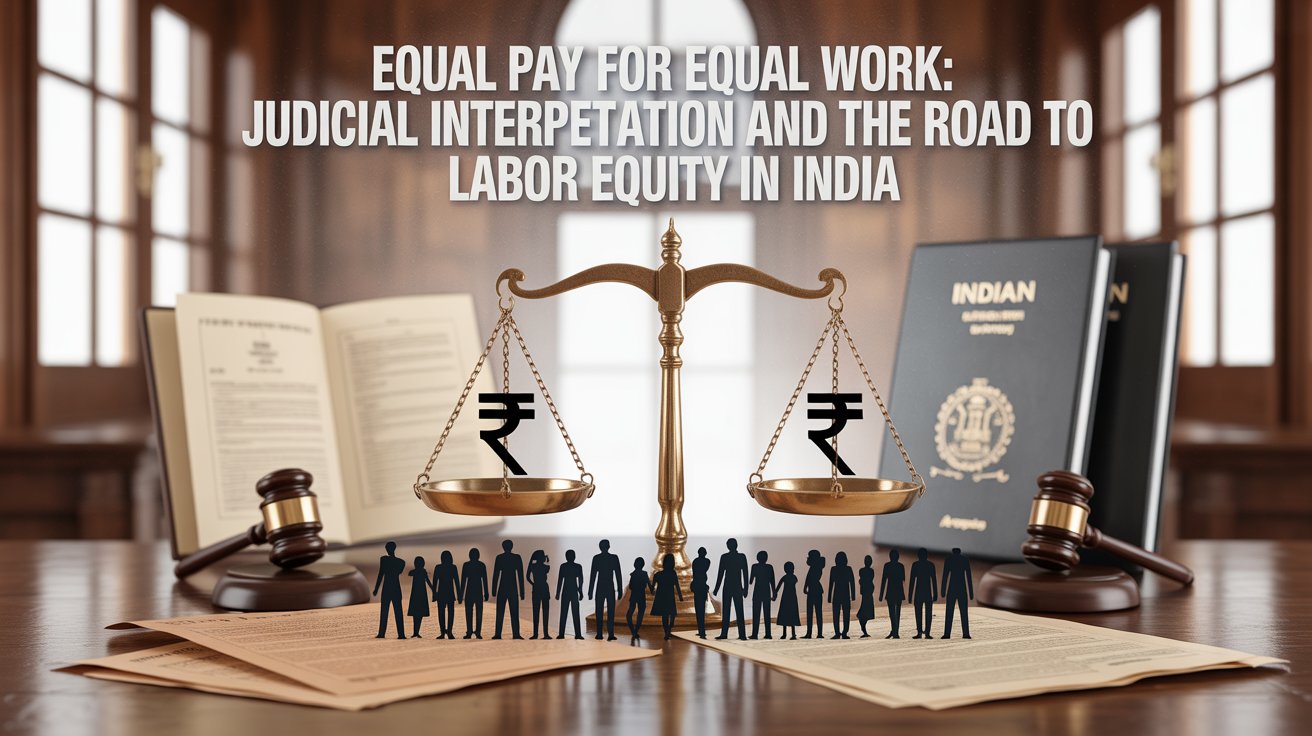
3. Defining “Equal Work”: The Criteria for Parity
The courts have established that “equal work” does not mean “similar work.” To claim equal pay, the following factors must align:
- Nature of Duties: The core tasks performed daily must be the same.
- Educational Qualifications: If a regular post requires a Ph.D. and a contractual post only requires a Master’s, parity may be denied even if the work is similar.
- Responsibility and Accountability: If a regular employee is liable for departmental inquiries or has administrative oversight that a contractual worker does not, the work is not considered “equal.”
- Mode of Recruitment: This remains a contentious point. Often, the State argues that regular employees went through a more rigorous selection process (like UPSC or State PSC), justifying a higher pay grade. However, the recent trend suggests that if the work is identical, the “minimum of the pay scale” must at least be provided to the contractual staff.
4. Industry Trends: From Government to the Gig Economy
The discourse on equal pay is shifting from traditional government offices to the modern corporate and “gig” sectors.
A. The Public Sector Shift
Government departments are increasingly moving away from the “outsourcing” model for core functions after several High Courts and the Supreme Court flagged it as a tool to bypass labor laws. The recent ruling serves as a warning that “fixed-pay” regimes for technical or specialized roles (like Assistant Professors or Engineers) will face strict judicial scrutiny.
B. The Gender Pay Gap
Even though the doctrine of “Equal Pay for Equal Work” continues to exist, the gender pay gap has not yet disappeared from the private sector. The company’s practices in 2024-2025 indicate that ESG (Environmental, Social, and Governance) reporting is compelling firms to reveal their difference in salaries, thus resulting in having more open salary bands.
5. Challenges in Implementation
Despite the clear judicial stance, several hurdles remain:
- Financial Constraint Argument: States often plead “financial inability” to pay arrears or regularize scales. The Supreme Court has repeatedly stated that financial hardship is not a valid ground to infringe upon a worker’s right to equal pay.
- Qualitative Differences: It is often difficult to quantify the “quality” of work in professional roles (e.g., teaching or legal research), giving employers an excuse to maintain pay gaps.
- The “Jagjit Singh” Precedent: In State of Punjab v. Jagjit Singh (2016), the Court held that temporary employees are entitled to the minimum of the pay scale (including DA) as regular employees. However, implementing this across diverse departments remains a slow process.
6. The Road Ahead: Empowerment and Legal Literacy
The ruling by Justice Ahsanuddin Amanullah and Justice Vipul M. Pancholi is a beacon for thousands of “temporary” professionals in India. It empowers employees to challenge the “consolidated pay” structures that have long been used to lower the State’s wage bill at the expense of human dignity.
To ensure this right is realized, there must be:
- Transparent Job Descriptions: Clearly defined roles to allow for easier comparison.
- Legal Awareness: Workers must know that they cannot be forced to waive their right to parity simply because they signed a contract.
- Strict Enforcement: Tribunals and Courts must penalize departments that willfully ignore settled law on parity.
Conclusion
The phrase “Equal Pay for Equal Work” is a legal rule but it also means the constitutional promise of “Justice: Social, Economic and Political” in words. The most recent Supreme Court interventions have made it certain that the State will be responsible for its actions and that the “tag” of a worker will not be used as a means of economic oppression. In its pursuit to be the world’s top economic power, India will have to accept that equal and fair payment of its workers is not merely a matter of law—it is an economic need.
Frequently Asked Questions (FAQs)
Q1: Is “Equal Pay for Equal Work” a Fundamental Right in India?Ans: While not explicitly listed as a Fundamental Right, the Supreme Court has ruled that it is an enforceable right under Articles 14 and 16 of the Constitution, read with the Directive Principle in Article 39(d).
Q2: Can a contractual worker get the same salary as a permanent employee?Ans: Yes, if they can prove that their duties, qualifications, and responsibilities are identical. Usually, the courts grant the “minimum of the pay scale” (the basic pay plus dearness allowance) assigned to the regular post.
Q3: What did the Supreme Court say about “Nomenclature” in the recent case?Ans: The Court held that the name given to a post (like “Ad-hoc” or “Guest”) does not matter. What matters is the actual work performed and whether it matches the work of a regular employee.
Q4: Does this principle apply to the private sector?Ans: While the direct constitutional mandate is for the State, labor laws (like the Code on Wages) and judicial precedents increasingly apply these principles to the private sector to prevent gender-based or arbitrary wage discrimination.
Q5: Can “financial crunch” be a reason for the State to deny equal pay?Ans: No. The Supreme Court has consistently held that the State cannot use financial limitations as an excuse to deny employees their rightful pay for work already performed or to maintain discriminatory pay scales.