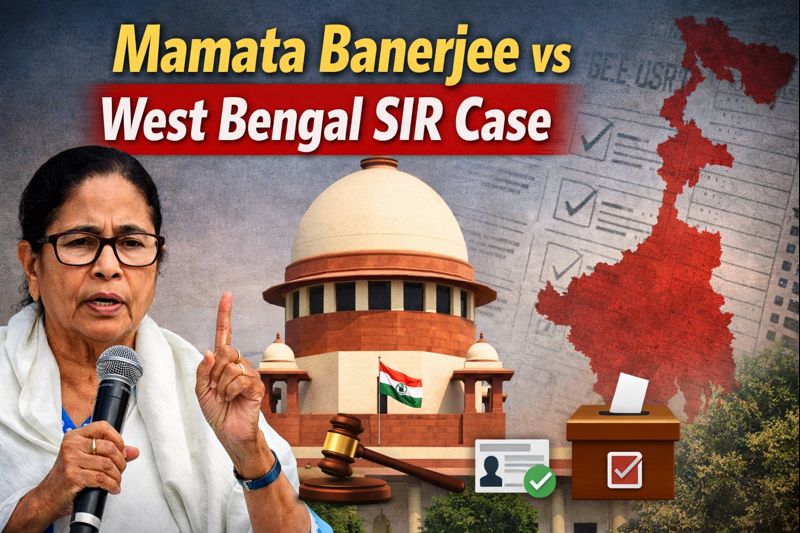
The Mamata Banerjee vs West Bengal SIR Case has become one of the most important constitutional conflicts which Indian courts have faced since independence. The case raises serious questions about electoral fairness, voter inclusion, and the limits of administrative authority exercised by constitutional bodies. The Special Intensive Revision of electoral rolls in West Bengal which the Election Commission of India conducted, has become the main issue at stake because it affects democratic rights.
The dispute goes beyond its administrative aspects which make up its core. The Mamata Banerjee vs West Bengal SIR Case directly affects Indian democracy and voting rights, especially the constitutional guarantee of universal adult suffrage.
Background of the Mamata Banerjee vs West Bengal SIR Case
The West Bengal SIR case originated from the Election Commission of India SIR process which began to update electoral rolls throughout the state. The process of updating electoral rolls received legal authorization however the actual implementation of the process raised major concerns among people.
Mamata Banerjee the Chief Minister of West Bengal brought her case to the Supreme Court which created a major legal case between Mamata Banerjee Supreme Court case. Her petition alleged that the revision could lead to large-scale exclusion of genuine voters without adequate procedural safeguards.
The Mamata Banerjee vs West Bengal SIR Case transformed into a constitutional dispute when it moved beyond its original electoral purpose.
What Is the Special Intensive Revision of Electoral Rolls?
The Special Intensive Revision of electoral rolls is a process that verifies the accuracy and current status of voter lists.
The stated objectives of the process include the following elements:
- Removal of fake or duplicate voters
- Deletion of names of deceased individuals
- Correction of clerical or data discrepancies
- Verification of voter eligibility
However, the ongoing SIR electoral rolls controversy questions whether these objectives can justify large-scale deletions without transparency. The concern is that the process may compromise the Right to vote and SIR safeguards guaranteed under the Constitution.
Grounds of Challenge in the Mamata Banerjee vs West Bengal SIR Case
In the Mamata Banerjee vs West Bengal SIR Case, several grounds have been raised before the Supreme Court:
- The SIR process was initiated suddenly without adequate public notice
- Lists categorizing voters under “logical discrepancies” were not published
- Affected voters were not given sufficient opportunity to respond
- Vulnerable groups such as migrant workers, minorities, and economically weaker sections face disproportionate impact
These issues collectively form the basis of the SIR constitutional challenge pending before the Supreme Court.
Proceedings Before the Supreme Court
During hearings in the Mamata Banerjee vs West Bengal SIR Case, the Supreme Court examined the scope of Election Commission powers Supreme Court review allows. Key developments include:
- Personal appearance of Mamata Banerjee before the Court
- Judicial questioning of the Election Commission of India SIR methodology
- Examination of whether procedural fairness was followed
- Consideration of constitutional limits on electoral administration
Such direct involvement of a sitting Chief Minister highlights the seriousness of the Electoral roll revision dispute.
Legal Analysis ( Articles 14, 19, 21, and 326)
The Mamata Banerjee vs West Bengal SIR Case requires interpretation of several constitutional provisions:
Article 14 – Right to Equality
The SIR process creates unfair treatment to specific communities which leads to a violation of their equal rights under the law. The process of removing elements from the system without proper justification creates significant issues which violate Article 14.
Article 19 – Democratic Participation
The primary method through which people express their political beliefs is through voting. The practice of removing voters from electoral rolls creates an indirect method which restricts the democratic rights that Article 19 of the Constitution guarantees.
Article 21 – Right to Life and Dignity
The Supreme Court has established that human dignity connects to democratic participation. The violation of voting rights without correct legal procedures results in a breach of Article 21.
Article 326 – Universal Adult Suffrage
Under Article 326 voting rights, every eligible citizen has the right to vote. The constitutional mandate requires proper procedures to be followed before any deletions can take place.
Role of the Election Commission
The Election Commission has defended the SIR exercise by stating that:
- The process is lawful and routine
- It aims to protect electoral integrity
- Removal of ineligible voters strengthens democracy
The Judicial review of Election Commission actions protects electoral independence from becoming unrestrained governmental power. The Mamata Banerjee vs West Bengal SIR Case tests the balance between autonomy and accountability.
Impact on Indian Democracy and Voting Rights
The Mamata Banerjee vs West Bengal SIR Case carries nationwide implications:
- It may establish standards for transparency in voter revisions
- It could define mandatory procedural safeguards for deletions
- It strengthens judicial oversight over electoral processes
- It protects vulnerable populations from disenfranchisement
This case is likely to influence future electoral practices beyond West Bengal.
Possible Directions from the Supreme Court
The Supreme Court may issue directions including:
- Mandatory notice before deleting voter names
- Public disclosure of discrepancy lists
- Right to appeal against voter exclusion
- Restrictions on large-scale revisions close to elections
Such measures would redefine Election Commission powers Supreme Court supervision permits.
Conclusion
The Mamata Banerjee vs West Bengal SIR Case represents a critical moment for constitutional democracy in India. The case shows that electoral integrity must protect fundamental rights because both principles require protection. The case establishes that administrative needs must take second place to constitutional rights protections.
The Supreme Court ruling will determine how elections will be managed in the future because it shows that democracy depends on inclusive systems which treat people fairly while upholding constitutional principles instead of focusing only on operational efficiency.