India’s child protection laws protect minors from sexual exploitation and abuse. The Protection of Children from Sexual Offences Act 2012 POCSO Act establishes strict rules which create major problems for handling consensual adolescent relationships. The Romeo-Juliet clause under POCSO Act becomes essential at this point.
The law needs to safeguard children from harmful situations but needs to avoid making criminal offenses out of teenage romantic relationships which exist between two adolescents who share close age differences. The current society and lawmakers must establish a system which balancing child protection and adolescent rights of teenagers to make their own decisions.
Background: When Did the POCSO Act Come Into Force?
The POCSO Act came into force in 2012 and was established on November 14th, 2012.
Its main objectives are:
- To protect children below 18 years from sexual offences
- To provide child-friendly procedures during investigation and trial
- To ensure speedy justice through Special Courts
The law considers any sexual activity involving a person below 18 is an offence to be criminal activity even when those individuals provide their consent. The strict rules of this system produced unexpected results when it handled situations involving teenage couples.
What Is the Romeo-Juliet Clause Under POCSO Act?
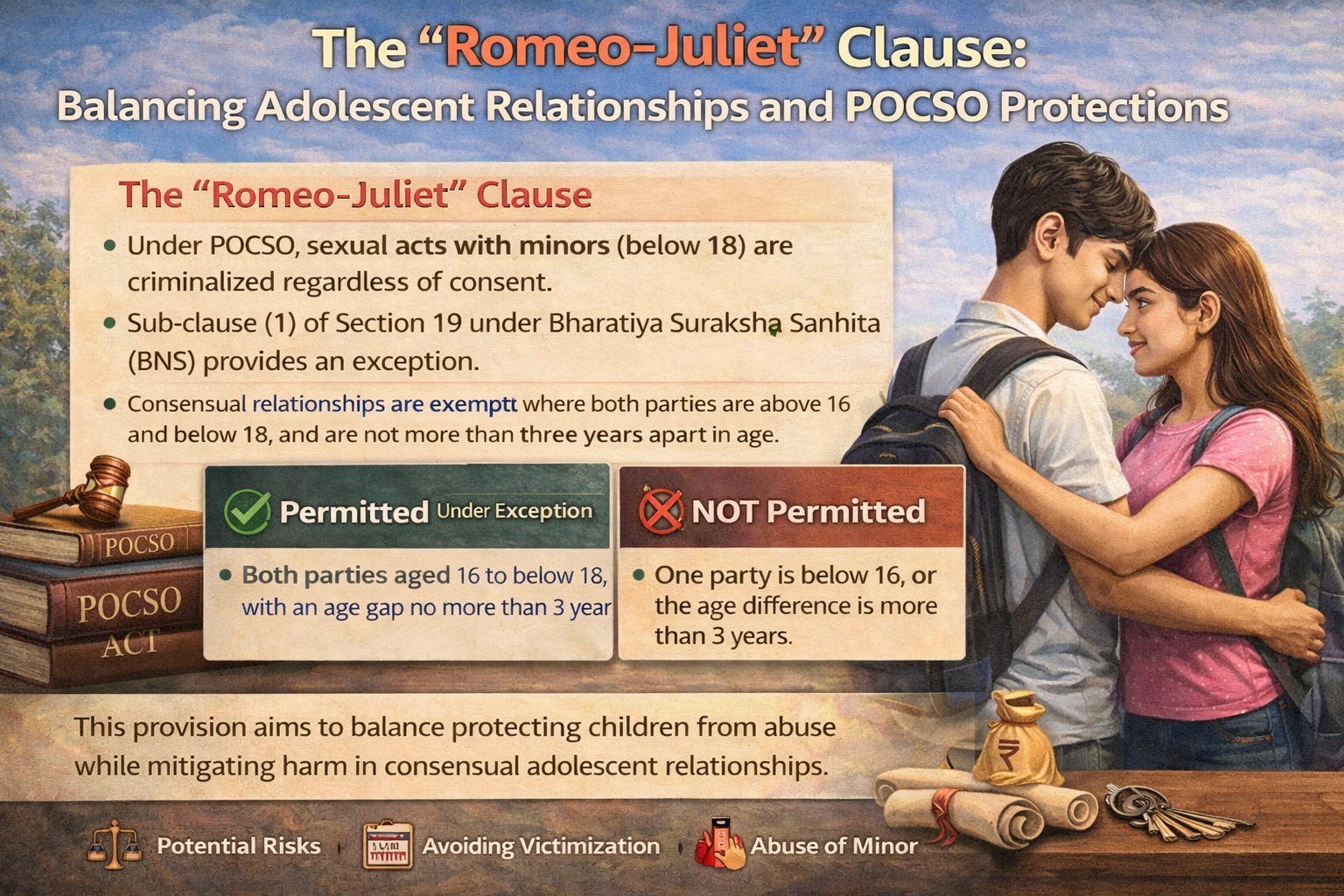
The Romeo-Juliet clause under POCSO Act exists as a legal concept which judges have established through their court discussions. The judicially discussed concept to determine whether two adolescents of similar age can engage in consensual sexual activities without facing severe criminal consequences.
Key Idea Behind the Clause
- Teenagers enter romantic relationships because they want to do so.
- The criminal justice system functions as a permanent destructive force which impacts all individuals involved in a case.
- The law should distinguish abuse from mutual adolescent conduct
This concept draws inspiration from Romeo Juliet law India, which is used in several countries to avoid criminalising consensual teenage relationships.
POCSO Act and Teenage Consensual Relationships
Under current law:
- Consent of a minor has no legal validity
- Even voluntary relationships fall under strict offences
- FIRs are often filed due to parental pressure
This has led to a rise in POCSO Act misuse in teenage relationships, where boys aged 18–21 face prosecution for relationships that were mutual and non-exploitative.
Common Scenarios Seen in Courts
- 16-year-old girl and 17-year-old boy in a relationship
- Relationship opposed by family → FIR under POCSO
- Girl later states the relationship was consensual
Despite consent, prosecution continues because of the strict wording of the law.
Adolescent Consent Under POCSO Act: Legal Position
The POCSO Act age of consent issues remain one of the most debated aspects of the law.
Present Legal Position
- Age of consent = 18 years
- Consent below 18 is legally irrelevant
- Courts cannot ignore statutory mandate
However, judges have repeatedly noted that adolescent consent under POCSO Act cannot be equated with adult exploitation in every case.
Supreme Court View on Romeo-Juliet Clause
The Supreme Court view on Romeo Juliet clause has evolved through multiple judgments.
Key Judicial Observations
- Not every POCSO case involves sexual abuse
- Courts must examine facts, age gap, and circumstances
- Mechanical application defeats justice
In Vijayalakshmi v. State and other cases, courts urged the legislature to consider a Close-in-age exemption POCSO framework.
The Supreme Court has emphasized that criminal law must not destroy young lives when no coercion, threat, or abuse exists.
Close-in-Age Exemption POCSO: Why It Matters
A Close-in-age exemption POCSO would:
- Exclude consensual acts between adolescents close in age
- Focus prosecution on actual exploitation and abuse
- Reduce burden on courts and police
Suggested Parameters (Judicial & Academic Proposals)
- Age difference not exceeding 2–3 years
- Relationship must be voluntary
- No element of coercion, grooming, or force
Such an approach strengthens balancing child protection and adolescent rights.
Types of Cases Under POCSO Act
The POCSO Act covers:
- Penetrative sexual assault
- Aggravated sexual assault
- Sexual harassment
- Use of child for pornographic purposes
In teenage relationship cases, charges usually involve:
- Sections 3, 5, or 7 of POCSO
- Often accompanied by IPC provisions
Many of these cases eventually collapse during trial, highlighting misuse concerns.
Bail in POCSO Act Cases: Full Legal Position
Is POCSO a Bailable Offence?
- POCSO offences are non-bailable
- Bail depends on judicial discretion
Factors Courts Consider for Bail
- Age of accused and victim
- Nature of relationship
- Medical evidence
- Statement of the minor
- Possibility of coercion
In POCSO Act and teenage consensual relationships, courts increasingly grant bail when facts show a consensual bond.
Challenges Due to POCSO Act Misuse in Teenage Relationships
- Young accused face long incarceration
- Education and careers get destroyed
- Victims suffer secondary trauma
- Families misuse law to control choice
These outcomes contradict the very purpose of child protection laws.
Need for Legislative Reform
The continued debate around the Romeo-Juliet clause under POCSO Act highlights an urgent need for reform.
Why Reform Is Necessary
- Law must reflect social realities
- Adolescence involves emotional development
- Justice must be contextual, not mechanical
Several committees and courts have recommended legislative review to address POCSO Act age of consent issues.
What Is the “Romeo-Juliet Clause” in Simple Terms?
In the context of Indian law, the Pocso Act states that any sexual activity involving children below the age of 18 is considered a crime. This is a strict law meant to safeguard minors from exploitation and abuse.
But here’s where the “Romeo-Juliet Clause” comes into play:
- The Supreme Court has suggested adding an exception within the Pocso Act to account for consensual relationships between adolescents who are close in age.
- This exception has been informally called the “Romeo-Juliet Clause” because it aims to prevent minor teenagers from being prosecuted when they are involved in consensual relationships with each other, especially when their age difference is small.
Conclusion
The Romeo-Juliet clause under POCSO Act serves as an essential legal framework which enables society to discuss fundamental social issues. The POCSO Act serves as necessary protection for children against sexual abuse, yet its application to consensual teenage relationships results in unfair treatment of adolescent relationships.
The current situation needs an appropriate solution which should respect adolescent relationships that have received mutual consent between partners and follow POCSO regulations while also recognizing adolescent consent under POCSO Act and preventing POCSO Act misuse in teenage relationships.
True justice exists when authorities protect children while they maintain their rights as teenagers, and it should not treat teenage dating relationships as criminal offenses.