Corruption is a factor that leads to the loss of public trust, resulting in the weakening of the institutions and the following of the law being undermined. The democracies cannot do without the efficient investigation and prosecution of corruption as they are the very breath of accountability. The Supreme Court of India, in a recent landmark decision, has defined the extent of the powers of investigative agencies under the Prevention of Corruption Act, 1988 (PC Act) and the role of the Central Government employees at the same time, when the offence was committed in a state that has already got the limits set by the agencies. The article will examine the background, the legal issues involved, the interpretation of the statute done by the court, the implications, and the ruling’s significance in a wider context.
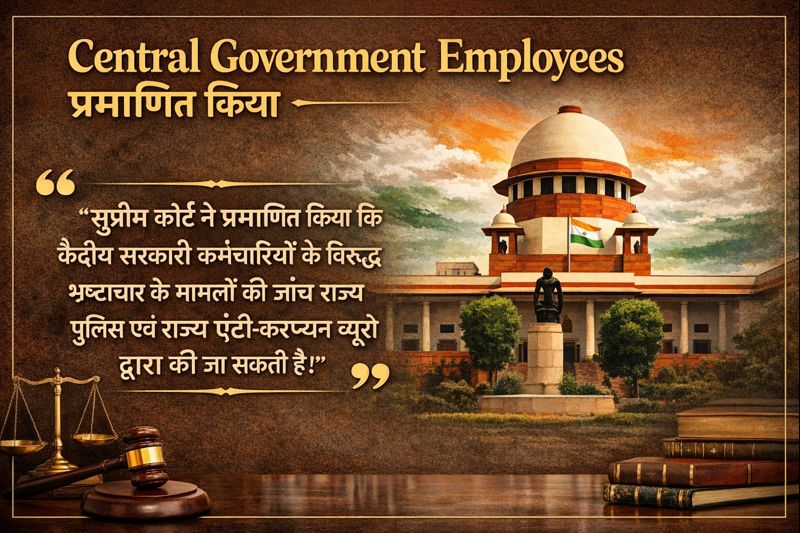
The judgment was delivered on 19 January 2026, by a two-judge bench consisting of Justice J.B. Pardiwala and Justice Satish Chandra Sharma, which stated that the State Anti-Corruption Bureaus (ACBs) and state police agencies can act by registering, investigating, and filing charge sheets against Central Government employees for the offences under the PC Act without any prior approval from the Central Bureau of Investigation (CBI). This has firmly rebutted the theory that only the CBI has the exclusive jurisdiction to conduct the investigations relating to these cases.
Legal Background: The Prevention of Corruption Act (1988)
The 1988 Prevention of Corruption Act is the main anti-corruption law in India. By classifying and imposing penalties for acts like bribery, misuse of public office, and corrupt activities of officials, the Act takes a strong stance against corruption. The objectives of the PC Act include putting an end to malpractice in the public domain and making available to the public judicial decisions and law enforcement that are fast and efficient.
One of the most important sections in this regard is Section 17 of the PC Act, which outlines the investigative authority for crimes committed under the Act. Section 17 indicates that the crimes will be subject to the following investigation:
- Police officers of the rank of Superintendent of Police or above;
- Officers of the CBI;
- Officials of any special police establishment constituted under law.
It is important to point out that Section 17 does not explicitly restrict jurisdiction to the CBI alone in cases where a Central Government employee commits an alleged offence. This lack of clarity has resulted in various interpretations by the courts and the parties involved in litigation.
Facts and Procedural History
The Supreme Court heard the case through a Special Leave Petition (SLP) that challenged the ruling of the Rajasthan High Court. In the case, a corruption FIR was filed against a Central Government employee by the ACB of Rajasthan under the PC Act for alleged offences within the state of Rajasthan. The accused contended that the investigation should be solely handled by the CBI, which argument led to the High Court being approached to quash the proceedings.
The High Court turned down this petition, stating that the State ACB was not only competent but also had the right to investigate the case even if the accused was a Central Government employee. The High Court concluded that the PC Act does not give CBI exclusive jurisdiction, and that corruption in a state should not be left uninvestigated by the state merely because the perpetrator is a central government employee. The Supreme Court’s bench approved this rationale and rejected the Special Leave Petition.
The Supreme Court’s Interpretation
1. Section 17 of the PC Act – No Exclusive CBI Jurisdiction
The Supreme Court emphasized that Section 17 expressly provides that any authorized police officer may investigate a PC Act offence, provided that they meet the rank requirement. The bench observed:
- There is no express exclusion in the statute barring state agencies from investigating offences by Central Government employees.
- The statute’s language is expansive: “any police officer not below the rank of Superintendent of Police” can investigate PC Act offences. This language encompasses both state police and special anti-corruption bureaus.
This interpretation aligns with longstanding precedent under Indian criminal law that jurisdiction to investigate normally follows the territorial locus of the offence unless specifically restricted by statute. Neither the PC Act nor any other law explicitly divests state agencies of jurisdiction over offences committed within their territorial limits.
2. Rejecting CBI’s Exclusive Role
The Supreme Court dismissed the reasonings based on the Delhi Special Police Establishment Act (DSPE Act) which implied that only the CBI was allowed to investigate the cases against the employees of the Central Government. The court made it clear that the DSPE Act does not work in a manner that it takes away the basic powers of the state investigative agencies under the PC Act.
To support this interpretation, the court cited the decision in A.C. Sharma v. Delhi Administration (1973) which proclaimed that the DSPE Act, while empowering the CBI, does not oust or diminish the powers of other law enforcement agencies to investigate the offences. The DSPE Act, therefore, does not create an exclusive investigative monopoly but rather enables the CBI to operate as per the law.
3. No Requirement for CBI Approval or Sanction
One more main feature of the ruling is the court’s explanation that the earliest approval or permission from the CBI is not needed by the government offices to start a lawsuit under the PC Act. The judges stated that state investigations or charge-sheets were not affected by the lack of CBI approval, that is, they were not invalidated. This situation shows that the requirement for sanction comes up only when the law explicitly states it, and, there is no such overarching requirement in the PC Act’s structure for state-initiated actions on corruption complaints.
4. Statutory Harmony and Cooperative Enforcement
The court pointed out that it is important that state and central agencies work together instead of separately or at cross-purposes. The process of corruption is usually beyond the borders of departments and areas, and it needs a combined federal action to be effective. Through the rule of empowering state agencies, the Supreme Court made an integrated enforcement ecosystem stronger in which:
- State ACBs and police can investigate within their territorial domain;
- The CBI continues to investigate complex or multi-state cases, or where directed by law or executive orders;
- Both central and state agencies can pursue cases as per statutory authority and coordination.
Implications of the Ruling
1. Broader Investigative Reach for State Agencies
The Supreme Court’s ruling significantly enhances the operational scope of state anti-corruption forces. By removing jurisdictional ambiguity, the decision enables state police and ACBs to investigate corruption by Central Government employees for offences committed within the state seamlessly. This has implications for:
- Speedy investigations by removing procedural bottlenecks;
- Reduction in backlogs that might occur if all cases were funneled to the CBI;
- Local accountability, as state agencies are closer to the scene and context of alleged corruption.
2. Checks and Balances Between Agencies
The court ruling does not allow any single agency to completely take control over the investigation but rather maintains the checks and balances between the central and state authorities. Moreover, the judicial decision assures the public that the law enforcement system is up to the task by allowing different agencies to operate under the same statute.
3. Protecting the Integrity of the PC Act
The Supreme Court, by interpreting Section 17 in its most comprehensive sense, confirmed that the PC Act is a flexible law that empowers the investigating authorities instead of limiting them by exclusive jurisdiction. In this way, the Act stays effective and in line with the policy imperatives of anti-corruption.
4. Precedential Impact on Criminal Procedure
The ruling carries wider consequences for the jurisdictional provisions in criminal statutes interpretation. It brings to the forefront the rule that when the statutory language does not explicitly limit the court’s jurisdiction to certain authorities, the investigative powers should always be viewed as being along the lines of area covered and practical law enforcement.
Reactions and Legal Commentary
Legal analysts have remarked that the outcome of this ruling is going to be the improved efficiency of enforcement since state authorities will not have to wait for the assignment or clearance from CBI before acting. Opponents of the previous strict interpretations said that the limitations on civil accountability were the main reasons behind the growing impunity for corruption. That ruling removes such doubts and supports the notion that public officials, no matter who pays their salary, are always accountable under the law.
Moreover, the ruling does not contradict but rather complements previous High Court rulings in other states—Madhya Pradesh, Andhra Pradesh, and Kerala—where it was similarly decided that state agencies are entitled to investigate Central Government employees for corrupt practices. The Supreme Court’s backing of this interpretation strengthens legal uniformity throughout India.
Conclusion
Supreme Court’s ruling, which was given by Justices J.B. Pardiwala and Satish Chandra Sharma, has been the reason for a total and progressive change in India’s anti-corruption law. The court has thus established the CBI as a reluctant partner in the process of bringing accountability to the democratic governance front by stating that the state police and anti-corruption bureaus have jurisdiction to register, investigate, and file charge-sheets against Central Government employees for corruption under the PC Act without requiring CBI approval.
This decision provides a clearer legal basis, reduces procedural barriers, and adds power to the state law enforcement agencies, thus offering a more responsive, united, and efficient anti-corruption enforcement system in India.
Frequently Asked Questions (FAQs)
1. Can state police investigate corruption cases against Central Government employees under the PC Act?
Yes — the Supreme Court has ruled that state police and anti-corruption bureaus can register, investigate, and file charge-sheets for offences under the Prevention of Corruption Act committed by Central Government employees within the state’s territorial limits.
2. Is CBI approval required before a state agency investigates such cases?
No — the Supreme Court clarified that no prior approval from the CBI is required for state agencies to investigate corruption by Central Government employees.
3. What statutory provision governs who can investigate PC Act offences?
Section 17 of the PC Act governs investigative authority and allows any qualified police officer or agency to investigate offences, without exclusively conferring jurisdiction on the CBI.
4. Does this ruling affect the CBI’s jurisdiction?
The CBI retains authority to investigate cases under the PC Act, but it is no longer the exclusive authority for cases involving Central Government employees. Both state and central agencies can proceed within their statutory powers.
5. Will state agencies’ investigations be valid if no CBI sanction was obtained?
Yes — according to the Supreme Court, the absence of CBI sanction does not invalidate state-initiated investigations or charge-sheets