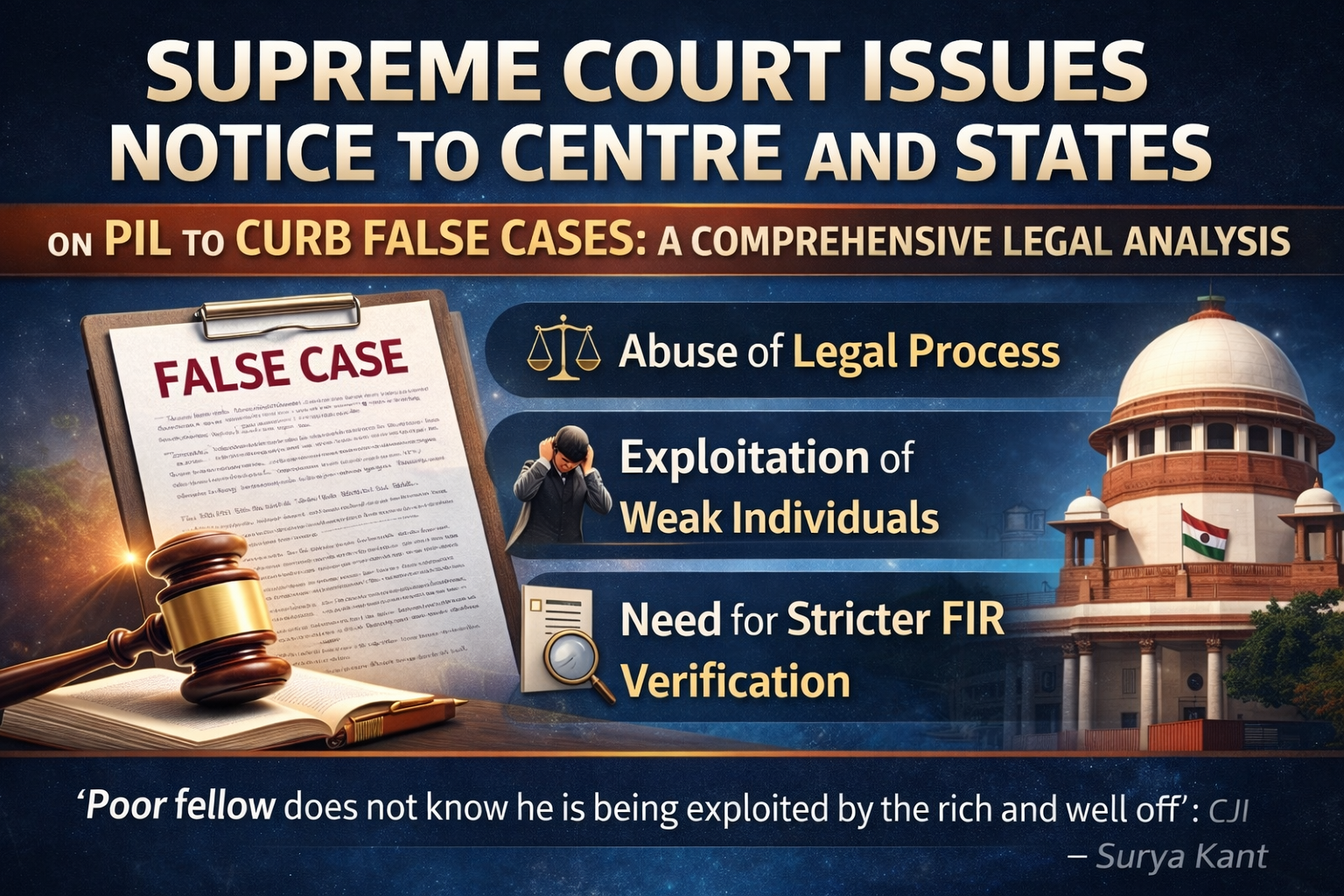
The Supreme Court of India registered a PIL to curb false cases which seeks to combat false arrest cases after it officially summoned the Union Government and all State governments and Union Territories. The Chief Justice of India Surya Kant together with Justice Joymalya Bagchi and Justice Vipul Pacholi issued the notice on February 26 2026 during their examination of a Public Interest Litigation which Advocate Ashwini Kumar Upadhyay filed under Article 32 of the Constitution of India.
The PIL to curb false cases seeks a series of administrative and legislative measures to address the growing menace of false complaints, fabricated evidence, and malicious prosecution. The petitioner claims that these problems which exist in the Indian justice system, create excessive pressure on trial courts and result permanent damage to innocent citizens. This blog analyses the petition, the court’s observations, the reliefs sought, and the broader legal significance of this case.
Why Was This PIL to Curb False Cases Filed?
The filing of the PIL to curb false cases reflects growing concern in legal circles and civil society about the misuse of India’s criminal justice system. The petition was filed under Article 32 of the Constitution which allows any citizen to directly approach the Supreme Court for enforcement of fundamental rights because the State failed to prevent false complaints and fabricated evidence which directly violates Articles 14 19 and 21 of the Constitution.
Advocate Ashwini Kumar Upadhyay, who appeared in person before the Supreme Court, has previously filed numerous public interest litigations on matters of governance and fundamental rights. The petitioner of this PIL to curb false cases establishes systemic issues because no administrative system exists to prevent false and malicious criminal complaints despite the Bharatiya Nyaya Sanhita 2023 BNS legal provisions.
The Scale of the Problem: NCRB Data and Low Conviction Rates
The petition in the PIL to curb false cases relies heavily on data from the National Crime Records Bureau (NCRB), which indicates that conviction rates under several special criminal laws remain comparatively low. The petitioner claims that false complaints together with fabricated evidence result in most cases, where people receive acquittals under Section 498A IPC and SC/ST (Prevention of Atrocities) Act and Dowry Prohibition Act and Protection of Children from Sexual Offences (POCSO) Act.
- The low conviction rates which result from special laws create doubts about the authentic nature of registered complaints and their actual quality.
- The resolution of land disputes leads to the filing of criminal FIRs which the law uses to protect vulnerable communities because authorities treat these cases as criminal offenses instead of civil matters.
- Innocent citizens face negative consequences when their criminal cases continue for extended periods due to false accusations which originated from untrue complaints.
- The case of Nambi Narayanan shows how false charges against the ISRO scientist led to his Supreme Court case which serves as a warning about the serious damage that comes from malicious prosecution.
What the PIL to Curb False Cases Seeks: Reliefs Prayed For
The Public Interest Litigation false cases demonstrate its effectiveness through the practical solutions which it recommends for implementation. The petition requests actual institutional systems which will stop false complaint filings at their origin instead of requesting only theoretical declarative statements. The key reliefs sought are outlined below.
1. Display Boards at Police Stations, Courts, and Public Institutions
The main prayer of this PIL to curb false cases requires all Union and State governments to set up display boards at police stations and court premises and panchayat offices and municipal offices and educational institutions. The boards will show forth the penal provisions and punishments which the Bharatiya Nyaya Sanhita 2023 law establishes for individuals who make false complaints and present false evidence and provide false statements.
The rationale behind this proposal is straightforward: many persons who file false complaints are unaware that doing so carries serious criminal consequences. Public warnings which people can see would function as an effective deterrent while creating basic public knowledge about the main aim of the PIL to curb false cases.
2. Informing Complainants of Penal Consequences Before FIR Registration
The petition also seeks a direction that all complainants be formally informed of the penal consequences of filing false FIRs and false complaints before an FIR is actually registered by the police. The police must inform complainants about BNS provisions after which complainants need to sign their understanding before proceeding with the process.
3. Mandatory Affidavit or Undertaking From Complainants
A key prayer in the PIL to curb false cases is the direction that every complainant be required to file a mandatory affidavit or undertaking affirming that the allegations and evidence being presented are true and correct. The proposal establishes a formal legal requirement which forbids complainants from submitting false evidence and making dishonest claims because any future verification of their submitted evidence will result in their legal responsibilities being enforced against them.
4. Consecutive Sentences for False Complaints and False Evidence
The petitioner further seeks a declaration from the Supreme Court that sentences imposed for offences relating to false complaints, false charges, and fabricated evidence must run consecutively — and not concurrently. This would significantly increase the effective punishment for persons who misuse the criminal justice system and file multiple false cases.
Supreme Court’s Key Observations on the PIL to Curb False Cases
The Supreme Court evaluated the public interest litigation which aimed to eliminate false cases through its hearing process. The Chief Justice of India Surya Kant delivered important statements which showed that the court understood the serious nature of the issue.
On Sensitising Society
CJI Surya Kant stated that false complaint issues have become embedded in social customs which require more than legal solutions for resolution. He explained that societies must achieve both knowledge and understanding of fundamental rights for their permanent solution.
“We will be accused of gagging… but why should we be afraid of gagging? Because people abuse and then disappear away. We need to create a very informed society with sensitising people and they should know fundamental right of their neighborhood also. Principle of fraternity needs to be cultivated.” — CJI Surya Kant
The Chief Justice of India used the term fraternity which serves as a fundamental value that the Preamble to the Constitution establishes. The Public Interest Litigation which aims to reduce false cases shows that its purpose extends beyond creating penalties.
On False Complaints Filed Without the Complainant’s Knowledge
The Supreme Court also highlighted a deeply troubling dimension of the problem: cases where false complaints are filed using forged signatures or in the name of a person who has no knowledge that a complaint has been lodged in their name. CJI Surya Kant pointed out that in such situations, the actual victim is doubly wronged — their identity is misused, and the real accused walks free.
“The problem is when false complaints are lodged… the de facto complainant does not even know that it is filed. It is done by fake signs etc and the poor fellow does not even know that he is being exploited by the rich and well off.”
Legal Framework: Chapter XIV of BNS and Existing Penal Provisions
The PIL to curb false cases bases its main function on Chapter XIV of the Bharatiya Nyaya Sanhita 2023 which establishes legal procedures for handling cases of false evidence and false complaints and perjury and record fabrication. The petitioner argues that although these legal provisions exist on paper there is no effective system which can enforce these laws or stop their violation from occurring during the initial complaint process.
- The BNS provisions for false evidence according to BNS provide a maximum jail term of seven years together with financial penalties, yet actual cases brought under these regulations remain infrequent.
- Section 498A of the IPC which now exists as the BNS equivalent has met widespread reporting about its misuse during matrimonial conflicts which the Supreme Court addressed in multiple past rulings.
- The petition under the SC/ST Atrocities Act claims that people use land and property conflicts to create false atrocity allegations which lead to severe difficulties for the accused who mostly remain innocent.
- The petition under the POCSO Act reveals how people create false POCSO allegations during personal or property disputes.
The petition further relies on the Law Commission’s 277th Report on wrongful prosecution, which recommended systemic reforms to protect persons who are falsely implicated in criminal cases. The PIL to curb false cases also draws from the landmark Supreme Court judgment in S. Nambi Narayanan v. Siby Mathews, where the court recognised that reputation is a component of the right to life under Article 21 — and that false prosecution directly violates this right.
Fundamental Rights Violated by False Complaints and Malicious Prosecution
The constitutional foundation of the PIL to curb false cases rests on the argument that the State’s failure to prevent false complaints and malicious prosecution directly violates the fundamental rights of innocent citizens. The petition specifically invokes Articles 14, 19, and 21.
- Article 14 — Right to Equality: False complaints and biased enforcement of criminal laws create an unequal justice system which allows wealthy people to use legal systems as weapons against vulnerable individuals.
- Article 19 — Freedom of Speech and Expression: The constitutional rights of people who face malicious prosecution threats become restricted because their ability to speak freely becomes restricted by their need to conceal their identity.
- Article 21 — Right to Life and Personal Liberty:The combination of fabricated evidence and false complaints leads to unlawful arrests which result in extended detention periods and damage to reputation and permanent destruction of human life and freedom. The court in Nambi Narayanan recognized reputation as part of the right to life which directly relates to the public interest litigation that seeks to stop false legal cases.
- Right to Speedy Justice: False complaints and frivolous FIRs create congestion problems for the criminal justice system which already experiences excessive workload, thus causing delays to justice processes that affect both authentic victims and actual accused individuals.
Significance and Implications of the Supreme Court’s Notice
The Supreme Court issued a notice for the PIL to curb false cases as its first major achievement. The court established that the petition had sufficient merit to proceed by ordering both the Union and State governments to submit their responses. The upcoming development will create extensive impacts throughout various areas.
- National-level policy reform: A Supreme Court order to implement display boards and require complainants to provide sworn statements will create a nationwide obligation for all State police departments and court systems to cooperate which will transform how false complaints are handled.
- Protection of vulnerable groups: While the petition highlights misuse of special laws, it also recognises that these laws exist to protect genuinely vulnerable communities. Any reform must balance deterrence of false complaints with protection of genuine victims.
- Judicial burden reduction: The proposed measures from the PIL to curb false cases will bring about a major decrease in useless criminal lawsuits which will help to diminish the workload of trial courts.
- Institutional accountability: A mandatory affidavit from complainants and information about penal consequences before FIR registration would make the entire complaint-filing process more accountable and responsible.
What Happens Next?
The Supreme Court has granted notice for the PIL to curb false cases from occurring. Each of the Union Government and all State governments and Union Territories must submit their court documents. The responses will likely address questions such as:
- Current systems that handle false complaints and malicious prosecution cases exist to combat these issues.
- The proposed display board system for police stations and courts according to the PIL requires evaluation to determine its effectiveness in decreasing false cases.
- The implementation of mandatory affidavits for complainants will not prevent genuine victims from reporting their cases.
- The government possesses data about BNS prosecutions which include charges of false complaints and fabricated evidence.
The result of the Public Interest Litigation to curb false legal cases will create major judicial decisions from the Supreme Court which will change how police and the criminal justice system of India handle complaint processing and investigation procedures. The Supreme Court will treat this case with all necessary importance because of the Nambi Narayanan precedent and the specific court remarks made during the hearing.
Conclusion
The Supreme Court’s notice in the PIL to curb false cases marks an important moment in India’s ongoing effort to reform its criminal justice system. The existence of false complaints and fabricated evidence together with malicious prosecution activities represents a serious legal issue which fails to protect human life and public trust in governmental operations and the fundamental principles of law enforcement. The petition, filed by Advocate Ashwini Kumar Upadhyay, has successfully brought this critical issue before the nation’s highest court.
The proposed measures which include display boards for police stations and mandatory affidavits from complainants and penalties which need to be explained to complainants and consecutive sentencing for false evidence provide practical solutions that show legal validity. The Supreme Court would take a historic action to protect innocent people from harm caused by false complaints when it issues binding rules through the PIL which aims to reduce false case filings throughout India because these rules will protect innocent people while maintaining the criminal justice system as a protective shield against wrongdoers.