Skip to content
The Supreme Court of India has recently issued a critical clarification on how magistrates must handle complaints alleging offences by public servants under Section 175(4) BNSS, 2023. The guidance which was delivered on 27 January 2026 provides procedural direction which explains the specific times and particular methods a magistrate must use to obtain a superior officer report before beginning an investigation. The ruling has important implications for how the BNSS balances accountability for public servants with procedural fairness and safeguards against abuse of the criminal process.
The Legal Context: Section 175 BNSS and Its Purpose
The Bandishya Nagarik Suraksha Sanhita Section 175 establishes the procedure that police officers will follow to investigate complaints. The public servant must commit the alleged offence during his official duties according to Sub-section (4). The older criminal procedure system allowed magistrates to start investigations through CrPC Section 156(3) without obtaining information from their superior officers. The Section 175(4) BNSS establishes a new procedure which requires magistrates to review police reports about the defendant’s conduct when the case involves official behavior. The procedural distinction protects public servants from facing unjustifiable legal actions while enabling proper investigation of valid claims.
Supreme Court’s Interpretation of Section 175(4) BNSS
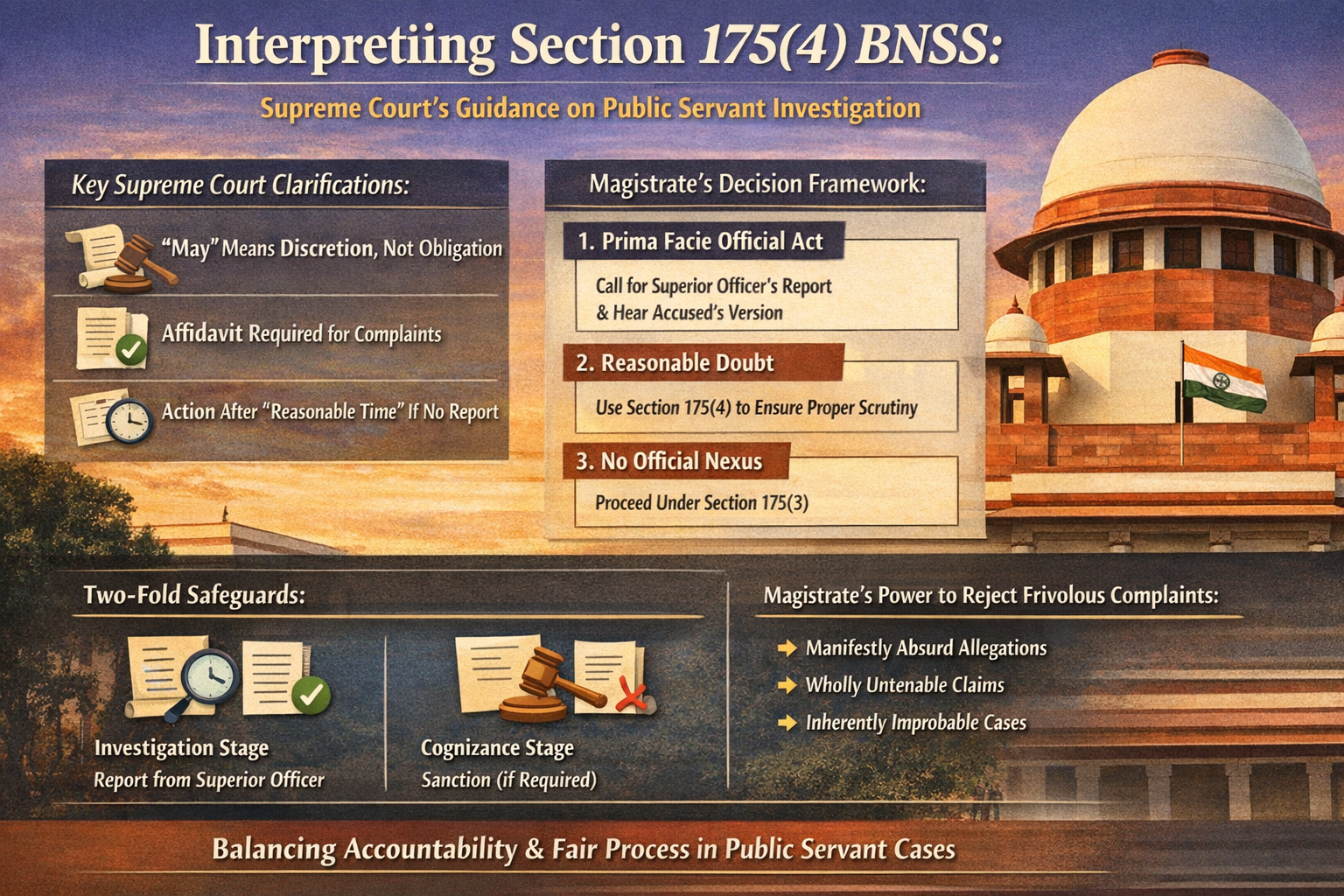
Key Clarification: “May” Means Discretion
The Supreme Court bases its interpretation on proper understanding of the word “may” which appears in Sub-section (4). The Court maintained that the term should maintain its standard meaning of discretion which it should not interpret as an obligation to act (“shall”). The recognition establishes that magistrates possess the authority to choose when to use Section 175(4) procedure based on their assessment of the complaint’s presentation.
Three Situations Identified by the Court
The Supreme Court offered magistrates a structured framework to decide how to proceed when faced with a complaint involving a public servant:
1. Prima Facie Official Act
If the magistrate, upon reading the complaint, is prima facie satisfied that the alleged offence arose in the course of performing official duties, the magistrate should follow the procedure under Section 175(4). This includes seeking a report from the superior officer and considering the accused public servant’s version of events.
2. Reasonable Doubt
If the magistrate has a prima facie doubt about whether the alleged conduct was connected to official duties, the magistrate “may err on the side of caution” and invoke the Section 175(4) process. This ensures procedural safeguards are considered even if the official nexus is not immediately clear.
3. No Official Nexus
When the magistrate is satisfied that the alleged offence did not arise in the course of official duty and lacks any reasonable nexus to official functions, the magistrate can proceed under the general procedure of Section 175(3). This often means directing a standard investigation without requiring a superior’s report.
This structured approach ensures that Section 175(4) BNSS is applied in a way that respects both procedural safeguards and the investigatory needs of criminal justice.
Two-Fold Safeguard Under Section 175(4)
The Supreme Court emphasized that Section 175(4) introduces a dual safeguard for public servants:
1. Investigation Stage
The magistrate must:
- Call for a report from the superior officer, and
- Afford the accused public servant an opportunity to be heard.
This stage protects against impulsive or ill-founded allegations.
2. Cognizance Stage
Before taking cognizance of the offence, a sanction under BNSS Section 218(1) may be required. However, the Court noted certain categories of offences—such as specific sexual offences—may be exempt from the sanction requirement due to statutory exceptions.
Mandatory Affidavit Requirement
A key clarification in the Supreme Court’s judgment was that complaints under Section 175(4) must be supported by a sworn affidavit. Although Sub-section (4) mentions only a “complaint,” the Court held that this term should be harmonised with Section 175(3), which expressly requires an affidavit in complaint-based proceedings.
The reasoning was practical and logical: it would be inconsistent to demand an affidavit when allegations are made against a private individual but exempt similar requirements when the allegations are against a public servant. This interpretation prevents misuse of the criminal process.
What Happens If the Superior’s Report Is Not Submitted?
The Supreme Court also addressed a scenario where a superior officer fails to submit the report within a “reasonable time.” The Court held that magistrates are not obliged to wait indefinitely for compliance. If a reasonable period has passed, the magistrate may proceed under Section 175(3) after considering the version of the accused public servant, if available on record.
What constitutes “reasonable time” cannot be rigidly defined; it depends on the specific facts and circumstances of each case. This flexibility ensures that procedural safeguards do not inadvertently hinder timely justice.
Magistrate’s Power to Reject Frivolous Complaints
The Supreme Court made it clear that a magistrate retains the authority to reject a complaint against a public servant under Section 175(3) if:
- The allegations are manifestly absurd,
- They are wholly untenable, or
- No reasonable person could conclude that an offence is disclosed.
However, such rejection cannot be arbitrary and must be supported by valid reasons.
Practical Implications and Judicial Trends
This Supreme Court clarification aligns with broader judicial thinking on statutory interpretation and procedural fairness. Similar principles are reflected in High Court decisions such as the Orissa High Court’s view that a magistrate must consider the public servant’s defence and obtain a superior officer’s report before directing an investigation under Section 175(4) BNSS.
Moreover, this guidance brings BNSS in sync with the overarching objective of criminal procedure codes: to ensure that investigations against public officials are initiated only after due procedural consideration and not as a matter of routine or harassment.
FAQs (Frequently Asked Questions)
Q1. What does Section 175(4) BNSS require?
A: It allows a magistrate to order an investigation against a public servant only after considering a report from the superior officer and the public servant’s assertions if the alleged offence occurred during official duties.
Q2. Is the magistrate required to always follow Section 175(4) procedure?
A: No. The statute uses “may,” indicating discretion. The magistrate applies it when prima facie the complaint involves official duty, or if there is reasonable doubt. Otherwise, Section 175(3) applies.
Q3. Does the complaint need to be supported by an affidavit?
A: Yes. The Supreme Court held that complaints under Section 175(4) must also have an affidavit, for consistency with Section 175(3).
Q4. What if the superior officer doesn’t submit a report?
A: The magistrate may proceed after a reasonable time under Section 175(3), considering the accused’s version if on record.
Q5. Can a magistrate reject a complaint against a public servant?
A: Yes, if the complaint is manifestly absurd, untenable, or inherently improbable, with valid reasons supporting rejection.
Conclusion
The Supreme Court’s interpretation of Section 175(4) BNSS provides a balanced and structured framework for magistrates handling complaints against public servants. The judgment establishes discretionary powers and affidavit requirements and superior officer report functions to maintain fair procedures while preventing improper use of the system. The BNSS statutory protection system receives enhancement through this process that guarantees proper assessment of authentic claims. The BNSS system shapes India’s contemporary criminal justice system while this guidance functions as an essential reference for magistrates and police and litigants.