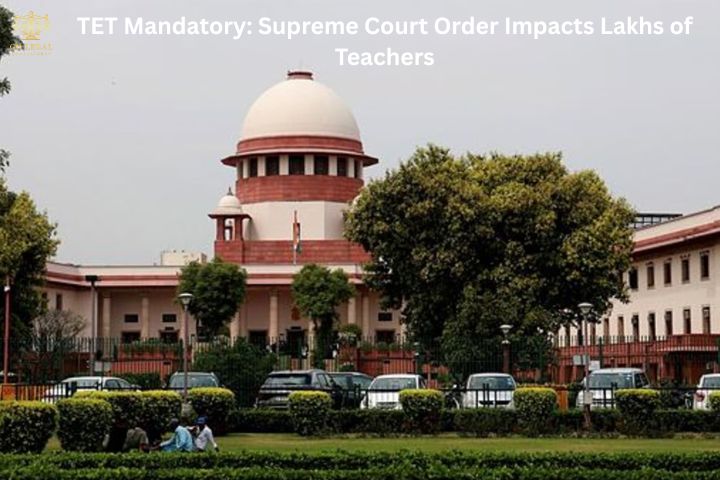
The lives of millions of government school teachers across India changed dramatically after a landmark Supreme Court ruling. The TET Mandatory rule now applies to all teachers because it extends beyond its initial requirement for new teacher recruits. The Supreme Court TET order has created widespread disruption throughout the education system because teacher unions and state governments and all other groups face its effects.
This blog gives you the complete picture of the TET Mandatory Supreme Court order — what it says, who it affects, which states are pushing back, and what teachers must do next.
What Is TET? — A Quick but Essential Background
The Teacher Eligibility Test (TET) serves as a compulsory qualification assessment which the National Council for Teacher Education (NCTE) implemented on 23 August 2010 as part of Section 23 of the Right to Education (RTE) Act 2009. The examination establishes basic requirements for teaching professionals who work with students in Classes 1 through 8 throughout educational institutions in India.
TET exists in two forms:
- CTET (Central Teacher Eligibility Test): Kendriya Vidyalayas and government schools
- State TET: These are conducted by individual states such as UPTET, TNTET, KTET, MAHA TET, REET and others.
Before 2011, a large number of teachers received appointments without passing TET. They continued in service under older norms. That loophole stayed open for years — until the Supreme Court finally shut it with this historic ruling.
The Supreme Court’s Landmark Ruling — Every Key Detail
Education experts identify the ruling which Justice Dipankar Datta and Justice Manmohan issued on 1 September 2025 through their two-judge bench as one of the most important decisions in Indian legal history.
The Supreme Court declared that Teacher Eligibility Test (TET) passing now serves as mandatory requirement for all teachers across India through its main decision which affects hundreds of thousands of teachers throughout the nation.
The order rests on three clear pillars:
Pillar 1 — Teachers with more than 5 years of service remaining: In-service teachers who began working before the RTE Act 2009 and who possess more than five years of service must complete the TET examination within two years to maintain their employment. The failure to achieve this requirement results in automatic retirement from service.
Pillar 2 — Teachers with less than 5 years of service remaining: In-service teachers appointed before the RTE Act need not clear the TET if they have only five years of service left. However, they remain ineligible for any promotion without a TET qualification.
Pillar 3 — Minority institutions: The judgment referred to a larger bench the question of whether minority educational institutions, currently exempt from the RTE Act, should also be brought under its purview to prevent misuse of minority status to bypass teacher qualification norms.
The Scale of Impact — Numbers That Tell the Real Story
This order is not just a legal directive on paper. It directly affects the careers of millions of teachers, the livelihoods of their families, and the education of crores of children sitting in classrooms across India.
- At the national level: The Supreme Court’s September 1, 2025 ruling affects approximately 20 to 30 lakh teachers in non-minority schools handling Classes 1 to 8. The ruling excludes teachers who have less than five years until their retirement date.
- In Tamil Nadu: Tamil Nadu employs over 4.49 lakh teachers in government and aided schools, and nearly 3.9 lakh of them are not TET-qualified. The situation creates significant challenges which affect the entire educational system of the state.
- In Kerala: According to V. Sivankutty, the Kerala Education Minister, the judgment could affect almost 50,000 teachers in Kerala alone.
- In Uttar Pradesh: Alone in UP, some 0.25 million teachers face the impact of this decision.
How the TET Mandatory Order Is Shaking States Across India
Uttar Pradesh — Protest, Pain, and Political Response
Uttar Pradesh witnessed the most intense reaction to this order. The looming crisis of job security compelled two teachers — 49-year-old Manoj Kumar Sahu of Mahoba and 52-year-old Ganeshi Lal of Hamirpur — to end their lives out of distress, as claimed by their families and teacher associations.
Teacher associations across districts from Baghpat to Deoria and Chitrakoot to Mau held sustained protests during which they delivered memoranda to the state government. CM Yogi Adityanath responded by directing the department to file a revision petition against the ruling, stating that experienced teachers who have received government training over the years deserve better than to have their careers judged by a single exam.
Tamil Nadu — Warning of Empty Classrooms
Tamil Nadu has submitted a review petition to the Supreme Court which states that the order’s execution will lead to widespread teacher disqualification thus creating an educational crisis which will affect millions of students in the state. The situation directly violates Article 21A which guarantees all children the right to free mandatory education.
Yes in addition, this technology also plays a crucial role in manufacturing and medical research.
Kerala — Legal Challenge Filed
The Kerala Education Minister Sivankutty announced that the judgment will establish nationwide effects which will impact thousands of teachers employed in government schools, aided schools, and private schools. The Kerala government declared its intention to approach the Supreme Court through a review petition or a request for implementation clarification.
The minister pointed out that Kerala has historically protected existing staff for teacher qualification norms revision time, and lied to the fact that it was absent during this revision.
Delhi — India’s Largest Teacher Protest
Under the banner of Teachers Federation of India, educators from across the country gathered at Delhi’s Ramlila Maidan, demanding immediate government intervention and warning that the order threatens the livelihoods of nearly 20 lakh teachers. The protest became one of the largest coordinated movements by educators in recent years, with teachers calling the ruling “retrospective and unjust.”
The Legal Foundation — Why the Court Ruled This Way
The TET Mandatory rule did not emerge from thin air. It rests on a clear and consistent legislative history:
- NCTE Act, 1993: Gave NCTE the authority to determine minimum teacher qualifications
- RTE Act, 2009: Declared NCTE the academic authority under Section 23
- NCTE Notification, August 2010: Made TET compulsory for teaching Classes 1 to 8
- 2014 Regulations: TET was made mandatory not just for new recruitment but also for promotions
- 2017 Amendment: Required all in-service untrained teachers to complete training by 31 March 2019
This decision settles years of legal confusion and conflicting High Court orders — in 2017, the Allahabad High Court had made TET mandatory for promotions, which froze the promotion process in Uttar Pradesh; in 2023, the Madras High Court held that promotions to upper primary schools required passing the corresponding TET.
With this Supreme Court ruling, the law is now uniform across all states.
What Teachers Are Saying — Their Concerns Are Real
Teacher unions are not opposing TET as a concept. Their objection is about fairness and retrospective application. Their key arguments are:
On experience versus examination: Teachers argue that experience cannot be replaced by an exam, and that a teacher who has guided students for 20 to 25 years should not have their career decided by a single test.
On the difficulty of clearing TET: In recent years, the success rate in UP TET has drastically dropped — even those who prepare full-time struggle to clear it. Working teachers, managing families and classrooms simultaneously, face an even steeper challenge.
On confusion between CTET and State TET: CTET focuses more on teaching methodologies while UP TET has more subject-based questions. Serving teachers are well-versed in the subjects they teach but often weak in other areas, making this dual-option system more confusing than comforting.
These are legitimate concerns, and the judiciary, state governments, and the Centre all need to address them through practical implementation measures.
What States Are Doing to Help — Special TET Sessions
Several state governments have moved quickly to create pathways for in-service teachers to comply with the TET Mandatory directive:
- Tamil Nadu: The Tamil Nadu School Education Department approved three special TET exams for 2026 — scheduled for January, July, and December — through a government order issued on October 13, 2025. The program aims to reach more than 170000 unqualified teachers who work in government and aided schools.
- Kerala: The Kerala government announced a Special KTET Exam in February 2026 to give in-service teachers who had not yet cleared the test an additional opportunity to secure promotions while protecting their job security.
- Odisha: The state education department announced special TET sessions to enable in-service teachers to complete their requirements on time while they maintain their teaching duties. The state education department established dedicated TET testing sessions for educators who work in TET testing.
These efforts show that the path to compliance exists — teachers simply need to act on it without delay.
The Court’s Perspective — The Bigger Picture Behind the Ruling
The Supreme Court did not issue this order to punish teachers. It issued it to protect children.
The bench acknowledged that the decision may appear harsh, but they stated that qualified teaching personnel must be provided because it constitutes an essential requirement of Article 21A, which protects the right to free and compulsory education for children aged 6 to 14.
The ASER 2023 study shows that 50 percent of Class 5 students read at a Class 2 reading level which demonstrates the direct link between teacher quality and student learning results.
The TET mandate began implementation in 2011 but faced inconsistent enforcement because multiple active teachers were permitted to work without completing the required examination. The Supreme Court decision eliminates the existing loophole while it establishes new standards for classroom quality that will be enforced with greater strictness.
The court’s logic is straightforward: a child’s right to a qualified teacher is not negotiable.
A Complete Clarity on Who Is Affected and Who Is Not
Many teachers remain confused about where exactly they stand. Here is a simple breakdown:
Category 1 — Must clear TET within 2 years: Teachers appointed before the RTE Act (2009) who have more than 5 years of service remaining. Deadline: September 2027. Failure means compulsory retirement with terminal benefits.
Category 2 — Exempt from TET for service continuity but not for promotion: Teachers who have less than five years of service remaining are permitted to continue working until superannuation, but no in-service teacher — regardless of remaining service — will receive a promotion without passing TET.
Category 3 — Currently exempt: Teachers who work at minority educational institutions do not face any requirements at this time because the larger bench needs to decide whether RTE Act regulations apply to their institutions.
Category 4 — Already compliant: Teachers who were recruited post-2011 have cleared TET in their entry appointment. This order has no effect on them.
Practical Steps Every Affected Teacher Must Take Right Now
If you are an in-service teacher who has not yet cleared TET, here is your action plan:
Step 1 — Determine your category: Find out how many years of service you have remaining; this fixes your deadline and duties under the order.
Step 2 — Download the official syllabus: CTET or your state TET syllabus must be downloaded from the specific NCTE or state board website. Make sure that you are not using any unofficial source.
Step 3 — Build a daily study routine: Dedicate at least 2 hours daily to preparation. Focus on NCERT textbooks, child development and pedagogy, and past year question papers.
Step 4 — Register for special sessions: Watch your state education department’s notifications for special TET exams designed specifically for in-service teachers. These are your best opportunity.
Step 5 — Use digital resources: Structured preparation resources from the platforms need to be followed unfailingly: Byjus, DIKSHA, Adda247, and their respective state DIET workshops.
Step 6 — Join teacher communities: Teachers who are preparing for TET should use this platform to connect with each other. Your chances of passing the exam increase when you study together and share study materials and hold each other responsible.
Conclusion — The Road Ahead for India’s Teachers
The TET Mandatory Supreme Court order is a defining moment in Indian education history. It is challenging for lakhs of teachers — there is no denying that. But it is also a necessary step toward ensuring that every child sitting in a government school classroom receives education from a genuinely qualified professional.
The Supreme Court has explicitly ruled that TET is an essential qualification — meaning no teacher can continue in service indefinitely without it.
The three parties involved need to work together to establish teacher support systems that enable teachers to pass the TET examination. The implementation of special exam sessions and dedicated coaching programs together with digital resources and reasonable implementation timelines will create a fair and workable solution for all parties involved.
The deadline is September 2027. There is still time. The question is not whether to prepare — it is whether to start today or wait until it is too late.