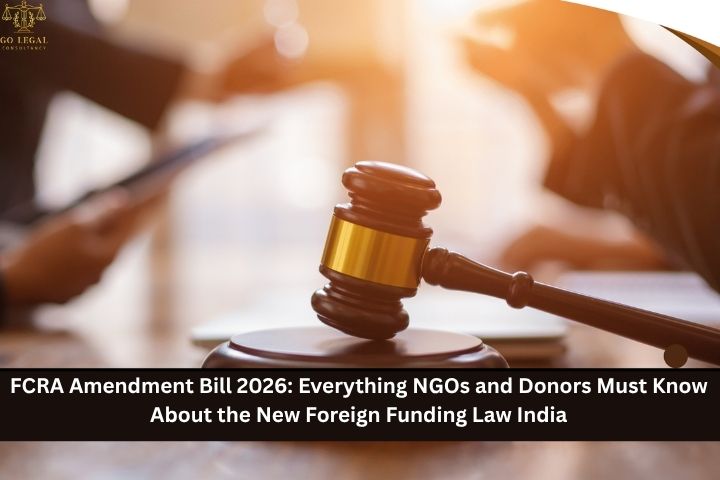
India’s foreign donation law India landscape changed dramatically on March 25, 2026. The Union Government introduced the FCRA Amendment Bill 2026 in Lok Sabha — and it is not a minor tweak. It is a fundamental restructuring of how foreign contribution rules for NGOs India work.
If your organisation receives foreign funds, this law directly affects you. Just like email marketing metrics help a business measure the health of its outreach campaigns, FCRA compliance requirements India help the government measure — and now tightly control — the health of foreign money flowing into Indian civil society.
Right now, approximately 16,000 associations hold FCRA registration in India, collectively receiving around ₹22,000 crore annually. Every single one of those organisations must understand what this bill changes, what compliance steps they must take immediately, and what legal risks they now face.
“NGOs need dedicated corporate law services India to stay FCRA-compliant in 2026.”
What Is the FCRA Amendment Bill 2026? A Plain-Language Explanation
FCRA Amendment Bill 2026 explained simply: it amends the Foreign Contribution (Regulation) Act, 2010 — India’s central law that governs how individuals, trusts, societies, and NGOs accept and use foreign money.
The 2010 Act was already amended in 2016, 2018, and 2020. Each amendment added stricter rules. The FCRA 2026 changes India go further than any previous amendment. The bill introduces:
- A brand-new Chapter IIIA — a full statutory framework for asset management
- A government-appointed “Designated Authority” with sweeping powers
- Expanded personal liability for organisational leaders
- Reduced imprisonment — but centralised investigation control
- Automatic registration cessation triggers
Think of it this way: just as email marketing metrics are the measurable indicators of how a campaign performs, the new FCRA framework creates measurable checkpoints — and penalties — for every stage of foreign fund receipt and use.
Why Email Marketing Metrics and FCRA Compliance Both Demand Constant Monitoring
Email marketing metrics — open rates, click rates, bounce rates — tell an organisation exactly where its communication health stands. Miss a key metric and your entire campaign fails silently. The same logic now applies to FCRA compliance requirements India. Miss a renewal date, fail an audit, or improperly account for a single asset — and the government can now seize everything your organisation owns.
Just as you track email marketing metrics weekly to protect your outreach investment, NGOs must now track FCRA compliance daily to protect their assets. Email marketing metrics punish neglect with poor conversions. FCRA 2026 punishes neglect with complete asset confiscation.
The parallel is precise: both systems require active, ongoing monitoring. Both punish passive management. Both demand internal accountability at every level.
The 5 Most Important Changes in FCRA 2026 — Explained With Full Detail
1. The Designated Authority — Government Takes Over Your Assets
What it is: The bill inserts Chapter IIIA, which creates a “Designated Authority” — a government-appointed official with the power to take over, manage, and sell assets of any NGO whose FCRA registration process India results in cancellation, surrender, or non-renewal.
What it means practically:
- If your registration expires and you fail to renew it in time, this Authority immediately takes provisional control of all assets created from foreign funds
- The Authority can transfer those assets to central or state government ministries
- If assets cannot be returned, they are sold — and the proceeds go to the Consolidated Fund of India
- Even mixed assets — where only part of a building or property was funded by foreign money — can fall under this provision
What you must do: Treat your FCRA registration renewal as the single highest-priority compliance task in your annual calendar. Set reminders 12 months before expiry — not six.
2. Expanded Definition of “Key Functionary” — Personal Liability Is Now Real
What it is: Earlier, the term “key functionary” had a narrow meaning. The FCRA latest updates 2026 now expand it to include:
- Directors
- Partners
- Trustees
- Karta of Hindu Undivided Family (HUF)
- Office-bearers of societies, trusts, and trade unions
- Any person who exercises control over management decisions
What it means practically:
- Each of these individuals can be held personally liable for any FCRA violation
- They cannot escape liability by claiming they were “unaware” — unless they can prove specific due diligence was taken
- This mirrors how email marketing metrics accountability works in organisations: the campaign manager, not just the brand, answers for poor results
What you must do: Conduct board-level training on NGO legal compliance India. Every key functionary must understand their personal exposure under this bill.
3. Registration Cessation — Automatic and Immediate
What it is: The bill introduces “deemed cessation” of registration. Your certificate is automatically treated as ceased if:
- No renewal application was submitted before expiry
- A renewal application was denied
- Renewal was not obtained before the certificate expired
What it means practically:
- There is no grace period under the new framework
- The moment cessation occurs, the organisation cannot receive or use any foreign contribution
- Assets created from foreign funds immediately fall under provisional government control
- This significantly worsens the risk for organisations under FCRA license cancellation rules
What you must do: Apply for renewal at least 6 months before expiry. Build an internal compliance calendar that treats the renewal date as a legal deadline — not a target.
4. Asset Restrictions During Suspension — No Selling, No Mortgaging
What it is: When an organisation’s FCRA registration is under suspension, the new rules under foreign funding law India 2026 now expressly prohibit it from:
- Selling any asset created from foreign funds
- Mortgaging or encumbering any such asset
- Transferring any such asset to any third party
All of the above require prior Central Government approval during the suspension period.
What it means practically:
- Organisations with ongoing construction projects, infrastructure, or land funded by foreign money are effectively frozen during suspension
- This creates serious cash flow and operational problems for legitimate organisations facing procedural delays
What you must do: Do not allow your registration to enter suspension. Address any compliance queries from MHA within the prescribed timeframe. Keep every communication in writing.
5. Prior Government Approval Required for Investigations
What it is: Under the previous framework, investigation for FCRA offences could be initiated without Central Government sign-off. The FCRA Amendment Bill 2026 explains this: prior Central Government approval is now mandatory before any investigation begins.
What it means practically:
- This centralises enforcement power at the federal level
- State-level agencies cannot initiate FCRA investigations independently
- Critics argue this increases government control on NGOs India beyond what is constitutionally proportionate
What you must do: Understand that investigations are a serious matter requiring legal counsel immediately. Do not respond to any investigation query without a qualified advocate.
Is Me Kya Dhyan Rakhna Chahiye? (Key Compliance Checklist for NGOs)
Every organisation subject to NGO funding regulations India 2026 must track these points:
- Registration renewal date — Apply 6 months before expiry, without exception
- Designated FCRA bank account — Maintain your SBI New Delhi account as the sole foreign contribution receipt account
- Sub-granting restrictions — Do not transfer foreign funds to any organisation without valid FCRA registration
- Asset accounting — Maintain separate, auditable records for every asset — distinguishing foreign-funded from domestically-funded portions
- Key functionary list — Keep an updated list of all key functionaries and train them on their personal liability
- Suspension period restrictions — Never alienate or encumber assets during suspension without prior Central Government approval
- Prior permission timeline — Use foreign contribution received under prior permission within the prescribed period (3 years for receipt, 4 years for utilisation)
Just as tracking email marketing metrics without acting on them is useless, tracking these compliance points without internal enforcement makes them meaningless.
Yeh Kis Section Me Aata Hai? (Legal Sections Reference)
| Provision | Section |
| Registration and prior permission | Section 11 & 12, FCRA 2010 |
| Suspension of registration | Section 13, FCRA 2010 |
| Asset restriction during suspension | Section 13(2)(c) — newly inserted |
| Cancellation of registration | Section 14, FCRA 2010 |
| Cessation of registration | Section 14A — amended |
| Asset vesting framework | Chapter IIIA — newly inserted |
| Designated Authority powers | Chapter IIIA, Clause 17A onwards |
| Key functionary liability | Section 14B — expanded |
| Penalties and imprisonment | Section 35 — reduced to 1 year |
| Prior approval for investigation | Section 43A — newly inserted |
Case Study: What Happens When an NGO Misses Its Renewal — A Real-World Scenario
Background: An educational NGO based in Kerala operates 14 schools in tribal areas. It has held FCRA registration since 2009. It receives approximately ₹4.2 crore annually from a UK-based charity for teacher salaries and school infrastructure.
The problem: The NGO’s FCRA certificate expired on December 31, 2025. Due to administrative gaps, no renewal application was submitted. Under the FCRA 2026 changes India, this triggers automatic cessation.
What happened under the old framework (pre-2026):
- The NGO would lose the ability to receive foreign funds
- Assets were to vest in “such authority as may be prescribed” — but no authority had been formally notified
- In practice, most organisations in this situation operated in a legal grey zone
What happens under the new 2026 framework:
- Cessation is immediate and automatic upon expiry
- A Designated Authority is notified and takes provisional control of all school buildings, equipment, and land built from foreign funds
- The NGO cannot sell, mortgage, or transfer any of those assets
- The UK donor cannot transfer new funds to the organisation
- If the NGO fails to restore registration within the prescribed period, the Designated Authority may sell the schools — directing proceeds to the Consolidated Fund of India
- Teachers lose salaries. Children lose schooling. The foreign donor loses the ability to fulfil its charitable intent
The lesson: This is not a hypothetical. This is the direct operational consequence of failing to treat FCRA compliance requirements India as a non-negotiable legal obligation. The foreign funds monitoring India regime under 2026 removes every safety net that previously existed.
Critical Debate: Is This Regulation or Expropriation?
The FCRA Amendment Bill 2026 has faced strong criticism from legal experts, civil society groups, and opposition parties. The core arguments on both sides:
Government’s position:
- The bill plugs genuine legal gaps where no clear mechanism existed to manage abandoned or cancelled organisation assets
- It protects against misuse of foreign donation law India provisions by shell organisations
- Centralising investigation approval prevents politically motivated state-level harassment
Critics’ position:
- The bill transforms NGO audit rules India FCRA from a regulatory tool into a confiscatory one
- Even a minor procedural delay — a missed form, a postal delay — can trigger complete asset seizure
- Mixed-asset provisions allow full seizure of properties where only a fraction of funding came from foreign sources
- The “chilling effect” on organisations working in human rights, environment, and accountability areas is disproportionate
Just as poor email marketing metrics can lead to hasty decisions that damage long-term brand trust, poorly designed laws that penalise procedural errors equally with deliberate fraud ultimately damage the credibility of the regulatory framework itself.
What NGOs Must Do Right Now — Action Points
- Audit your FCRA registration status today. Check your certificate expiry date immediately.
- Update your key functionary list. Every director, trustee, and managing partner must know their personal liability under the new rules.
- Segregate your asset accounts. Maintain clear, auditable records separating foreign-funded assets from domestic ones.
- Review all sub-granting arrangements. Confirm every partner organisation holds valid FCRA registration process India certification.
- Brief your board. Your governing body must understand the NGO foreign funding rules India changes — not just your compliance team.
- Retain legal counsel. Given the severity of penalties and the personal liability exposure, having an FCRA-specialist advocate on retainer is no longer optional.
Conclusion
The FCRA Amendment Bill 2026 explained — in one sentence: India’s government has replaced a regulatory framework with a control framework, and every NGO in the country must treat compliance as an existential priority.
The foreign funding law India 2026 changes mean that a missed deadline, an incomplete renewal, or an improperly documented asset can now result in total asset seizure, personal prosecution of directors, and the permanent closure of an organisation’s foreign funding channel.
Track your FCRA compliance requirements India with the same rigour that a marketing team tracks email marketing metrics. In both cases, the data tells you whether you are surviving or failing — and in both cases, ignoring the signals has irreversible consequences.
Stay compliant. Stay informed. And if you need legal guidance on NGO legal compliance India under the new framework, consult a qualified advocate immediately.