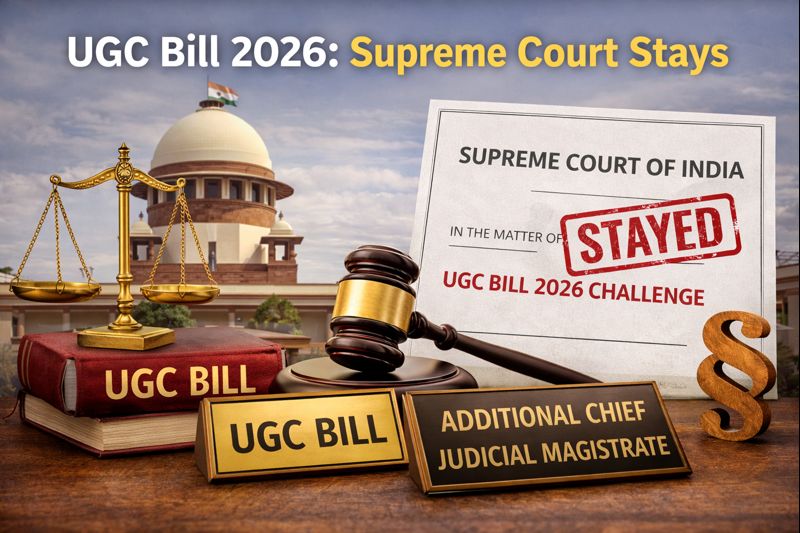
Indian higher education institutions face judicial examination during this crucial time period. The UGC Bill 2026 Supreme Court Stay transformed university campus regulations through its January 29 2026 legal implementation. The current interim order has suspended the implementation of the “University Grants Commission (Promotion of Equity in Higher Education Institutions) Regulations, 2026” which has generated public controversy. The decision follows both widespread academic unrest and multiple legal petitions which have challenged the fundamental fairness of the proposed guidelines.
The Supreme Court expressed serious social division concerns about the anti-discrimination framework which the University Grants Commission (UGC) developed to update existing regulations. The 2012 anti-discrimination regulations will continue as the active legal standard until the court reaches its ultimate decision according to the UGC Bill 2026 latest news update today. For students and administrators alike this stay represents a crucial moment of reflection on how equity should be defined and enforced in a modern democracy.
UGC Bill 2026 Supreme Court Stay: The Judicial Intervention
The UGC Bill 2026 Supreme Court Stay was issued by a Bench headed by Chief Justice Surya Kant along with Justice Joymalya Bagchi. The court’s primary motivation for this Interim stay by the Supreme Court was the “vagueness” found in the new regulatory language. The specific regulation 3(c) which describes caste-based discrimination serves as an example of a rule which may produce unexpected results.
The court observed that any policy intended to promote equality must be robust and clear. The judiciary suspended the enforcement of new rules which protects universities from having to operate a system that could infringe on their academic freedom. The court issued a stay that protects against enforcement of laws which the court deemed to be excessively broad and prone to misuse.
Key Directives from the Interim Order:
- Abeyance of 2026 Rules: The implementation of the 2026 equity regulations is suspended with immediate effect.
- Revival of 2012 Regulations: The earlier 2012 framework is restored to prevent a legal vacuum in campus grievance redressal.
- Notice to Stakeholders: Formal notices have been issued to the Union of India and the UGC to file detailed responses by March 19, 2026.
- Redrafting Proposal: The court suggested that a committee of eminent jurists should review and potentially remodel the language of the bill.
Why did the Supreme Court stay UGC Bill 2026?
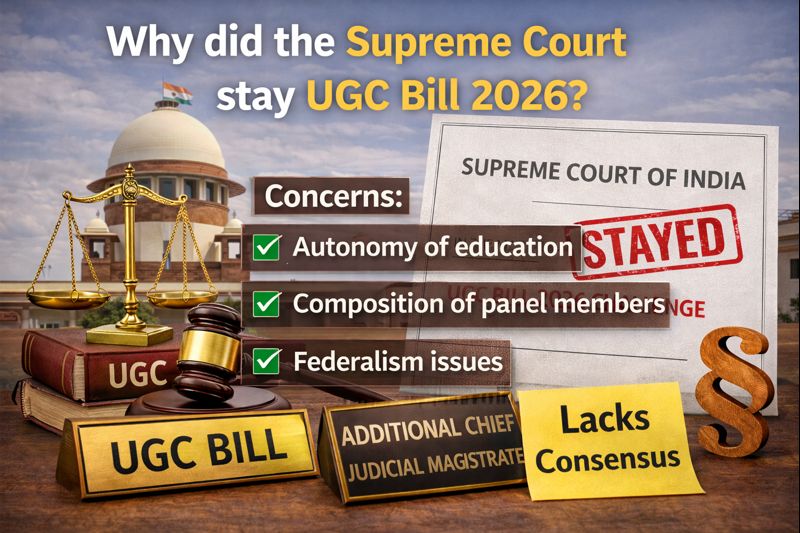
The Supreme Court stayed the UGC Bill 2026 because this matter explains its status. The judges used their legal arguments to demonstrate that social decline would become an established practice through this institutional framework. The court expressed deep concern that the regulations, which aimed to unite the student community, would actually create divisions among students.
- The bench found that Regulation 3(c) defines discrimination through parameters which exclude particular groups from its definition. The definition restricts its scope to particular categories which results in excluding other groups that might experience harassment.
- The Chief Justice Surya Kant led the Bench which stated that “mischievous elements” would use the vague language to settle personal disputes. The law designed for protection would become an engine of harassment.
- The court expressed special concern about rules that established separate hostels and separate systems for reporting. The Chief Justice remarked, “For God’s sake, don’t do this. We have lived in hostels together. Educational institutions must demonstrate the national unity which exists in India.
The UGC Bill 2026 Supreme Court Stay functions as an essential stop which protects against unexpected social clashes that might emerge through legislative processes.
Constitutional validity of UGC Bill 2026
The UGC Bill 2026 needs constitutional assessment because its validity will determine its legal standing. Petitioners argue that the bill violates Article 14 (Equality before Law) and Article 15 (Prohibition of discrimination) by adopting a “non-inclusionary” approach. The state established a “hostile classification” which disregards the current social conditions in India through its specific caste restrictions on victim identification. The Legal challenges to UGC reforms demonstrate that Article 15(4) permits special measures for disadvantaged groups although these measures need to protect against “social regression.” The court is currently examining whether the bill complies with the “principle of no-regression,” which requires that new protective laws must not reduce existing rights and freedoms of different societal groups..
Impact of SC stay on UGC new guidelines 2026
The impact of SC stay on UGC new guidelines 2026 is immediate for all Higher Education Institutions (HEIs). Universities that were preparing to overhaul their administrative structures must now pause these changes.
- Administrative Relief: Institutions are no longer required to set up the multi-member “Equity Committees” or “Equity Squads” mandated by the 2026 rules.
- Funding Security: The threat of losing UGC grants or degree-granting privileges for non-compliance with the 2026 rules is temporarily removed.
- Status Quo on Grievances: All ongoing and new complaints will be handled under the 2012 regulations, which involve an Anti-Discrimination Officer and an Equal Opportunity Cell.
This Impact of SC stay on UGC new guidelines 2026 provides a cooling-off period, allowing for a more democratic discussion among teachers’ bodies and student groups regarding the future of campus equity.
Is UGC Bill 2026 scrapped by the Supreme Court?
People do not understand the current situation about the legislation because they need to know whether the Supreme Court has canceled the UGC Bill 2026. The bill remains active because it has not been permanently canceled.
The UGC Bill 2026 Supreme Court Stay is an interim measure. It “puts on hold” the implementation until the court can hear arguments from both sides on March 19, 2026. The government has been asked to explain how they plan to prevent the misuse of the rules. The final status will only be decided after the court examines the responses from the Centre and the UGC.
What happens after the Supreme Court stays on UGC rules?
For those wondering What happens after the Supreme Court stays on UGC rules?, the focus shifts to the upcoming judicial hearings.
- Submission of Responses: The Union Government and the UGC must submit their justification for the new rules.
- Expert Review: There is a high probability that the court will direct the formation of a committee involving sociologists and legal experts to “modulate” the language of the regulation.
- Potential Amendments: The government has the option to change Regulation 3(c) which they view as controversial by making it “caste-neutral”. The UGC reforms face legal challenges which this solution will address.
- Campus Governance: The 2012 guidelines will serve as the sole legal framework until the Supreme Court lifts its stay of the UGC Bill 2026 or issues its final decision.
Violation of academic freedom and Campus Climate
One of the most profound concerns raised during the hearings was the potential Violation of academic freedom. Critics argued that the 2026 regulations created an atmosphere of surveillance on campus. With mobile “Equity Squads” and mandatory 24/7 helplines, faculty members feared that open academic discussions could be misinterpreted as discrimination.
The UGC Bill 2026 Supreme Court Stay ensures that the “free and equitable atmosphere” of universities is preserved. The judiciary has signaled that while preventing discrimination is vital, it cannot come at the cost of turning campuses into zones of identity-based polarization. The court’s goal is to protect all students without creating a “regressive policy” that takes the country backward in its journey toward a casteless society.
Conclusion: The Road Ahead for UGC Bill 2026
The UGC Bill 2026 Supreme Court Stay is a milestone in the history of Indian educational law. It highlights the judiciary’s role as a balancing force between the executive’s intent to reform and the protection of constitutional values. The UGC Bill 2026 latest news update today brings relief to those who sought a more inclusive and balanced approach to campus equity.
As we move toward the final hearing, the focus remains on creating a framework that is “progressive, not regressive.” The challenge for the UGC will be to draft a regulation that provides a “strong and robust mechanism” against genuine discrimination while ensuring it is not exploited for division. This judicial pause provides the perfect opportunity to align the bill with the true spirit of the Indian Constitution.