Skip to content
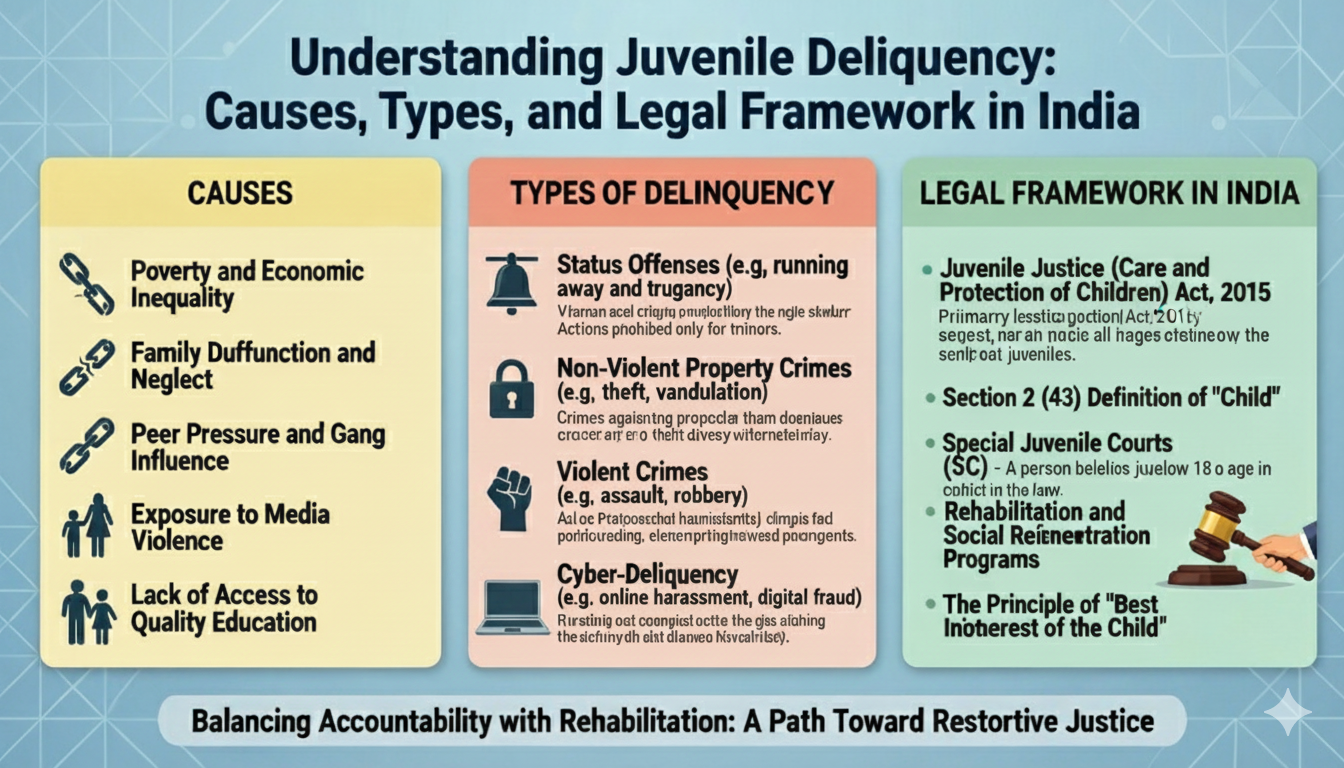
Juvenile delinquency is a major social and legal problem that raises serious questions and concerns, not only by the unlawful young individuals but also their parents, the neighborhood, and the whole judicial system. The treatment of juvenile offenders in India has been through a tremendous change over the years—from the traditional punishment-restricted method to the contemporary reform and rehabilitation procedures. It is important to view the issue in a very broad manner considering its causes, forms, and the legal measures that are used to tackle it.
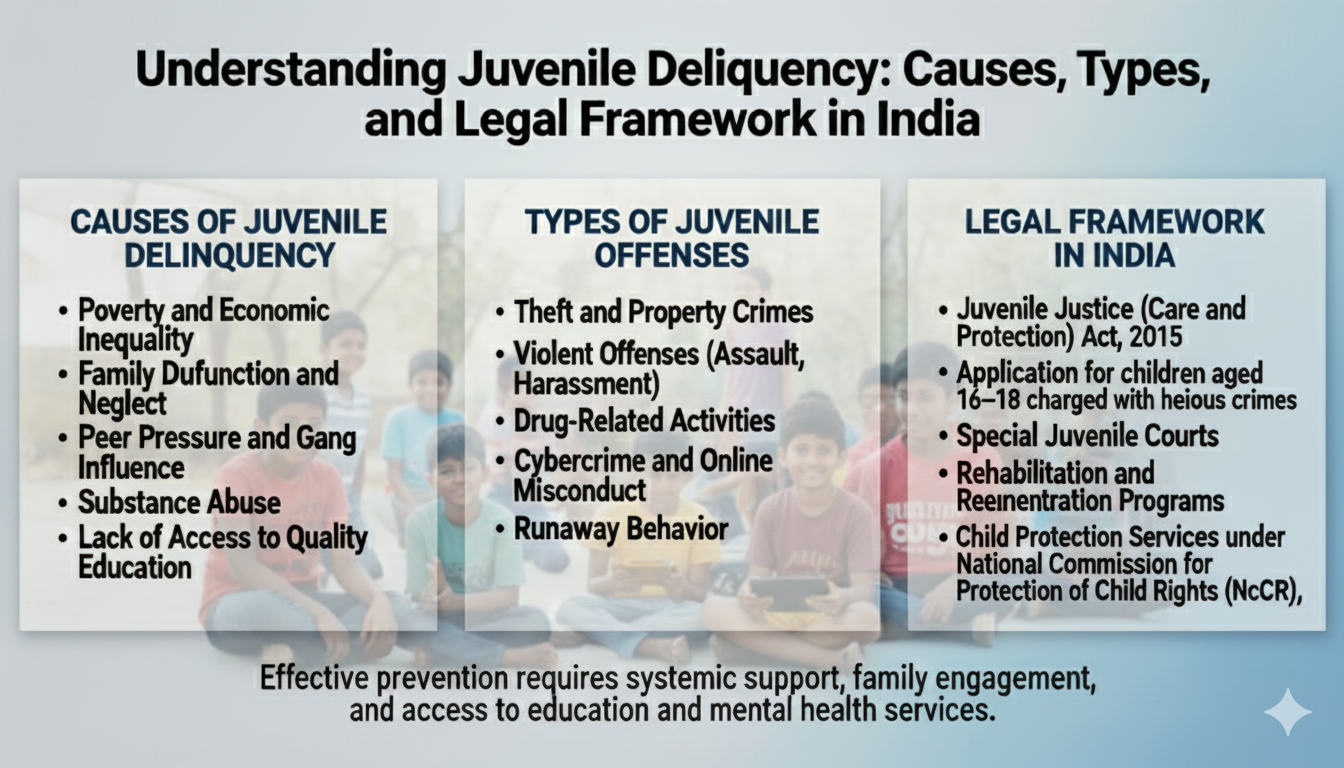
The paper elaborates on the subject of delinquency in India, the factors behind it, the different kinds of criminal activity by the inactive types, and the law covering children especially in relation to the latest developments in the juvenile justice system.
What Is Juvenile Delinquency?
Juvenile delinquency denotes minor’s illegal or immoral conduct, generally a person under 18 years old. Legally speaking, the child is labeled as a “child in conflict with law”, instead of a criminal, which indicates that the system is more concerned with rehabilitation than punishment. The range of juvenile delinquency can cover actions that are typically treated as crimes if the perpetrator was an adult, such as robbery, battery, or swindling, and, on the other hand, it also includes status offenses like absence from school, escaping from home, or being disrespectful to parents.
Historical Perspective of Juvenile Justice in India
In the course of time, India’s juvenile justice system has been completely remodeled:
- Juvenile Justice Act, 1986 – The initial all-inclusive regulation treating juvenile delinquents as subjects.
- Juvenile Justice (Care and Protection of Children) Act, 2000 – Advocated for child rights and a treatment over punishment approach.
- Juvenile Justice Act, 2015 – The statute even wider prison door such a significant change particularly where hefty crimes committed by young people of 16 to 18 were concerned.
- 2021 Revisions – Reorganized and made stronger the child protection and adoption processes.
The shifting handling in the court of Indian juveniles shows the Indian political will to strike a balance among the three: rights of the child, the demand for public safety, and the need for justice.
Major Causes of Juvenile Delinquency
Juvenile delinquency does not arise in isolation. It is often the result of multiple interrelated factors:
1. Family-Related Factors
- Dysfunctional families, divorce or domestic violence
- Absence of parents or their emotional withdrawal
- Child abuses like physical, mental and sexual
Children raised in unstable environments are more likely to misbehave.
2. Socio-Economic Factors
- Problems about Settlement
- Out-drawing of public schools
- Residenting in crime-prone neighborhoods
Economic hardship often pushes juveniles toward theft, drug trafficking, or other illegal activities.
3. Psychological and Emotional Factors
- Learned trauma from childhood
- Depression and mental health problems
- Self-esteem issues and identity conflicts.
Unaddressed psychological issues can manifest as aggressive or delinquent behavior.
4. Peer Pressure
- Delinquent peer groups have a strong impact on minor offenders.
- The need for social approval and recognition
- Criminal gang culture and social media’s ironic acceptance of crime
During teenage years, the influence of peers becomes very intense, and that is when the adolescent gets involved in illegal activities.
5. Technological and Digital Influence
- Exposure to violent or inappropriate online content
- Cyberbullying and online radicalization
- Easy access to digital platforms that facilitate cyber offenses
Digital crimes become a part of formidable juvenile delinquency that changes with the trends of society.
Types of Juvenile Delinquency
Juvenile delinquency can be broadly classified into the following categories:
1. Individual Delinquency
Offenses committed by a juvenile independently, often due to psychological or emotional factors.
2. Group-Based Delinquency
Crimes committed in association with peers or gangs, such as vandalism or assault.
3. Organized Delinquency
Well-planned criminal activities involving multiple juveniles, often under adult influence.
4. Status Offenses
Acts that are not crimes for adults but are illegal for minors, such as truancy or underage drinking.
5. Serious and Heinous Offenses
The aforementioned crimes include rape, murder, and armed robbery among others. Indian legislation considers that minors between 16 and 18 years of age who participate in serious offenses might be given the same treatment as adults in the court of law.
Legal Framework Governing Juvenile Delinquency in India
1. Juvenile Justice (Care and Protection of Children) Act, 2015
This is the primary legislation dealing with juveniles in India. Its core objectives include:
- Rehabilitation and social reintegration
- Protection of child rights
- Adoption of child-friendly legal procedures
2. Juvenile Justice Boards (JJBs)
Juveniles are not tried in regular criminal courts. Instead, cases are heard by Juvenile Justice Boards, comprising:
- A Metropolitan or Judicial Magistrate
- Two social workers (including at least one woman)
The JJB ensures a non-intimidating, child-friendly environment.
3. Age Determination and Assessment
For juveniles aged 16–18 years accused of heinous offenses, the Board conducts a preliminary assessment to evaluate:
- Mental capacity
- Physical ability
- Understanding of consequences
Based on this, the case may be transferred to a Children’s Court.
4. Focus on Rehabilitation, Not Punishment
Unlike adult offenders, juveniles are subjected to:
- Counseling and therapy
- Community service
- Educational and vocational training
- Placement in observation or special homes
The maximum period of institutionalization is three years, regardless of the offense.
Rights of Juveniles in Conflict with Law
Juveniles are entitled to special protections, including:
- Right to legal aid
- Right to privacy and confidentiality
- Protection from police abuse or handcuffing
- Separation from adult offenders
- Speedy and fair inquiry
These rights are aligned with constitutional guarantees and international conventions like the UN Convention on the Rights of the Child (UNCRC).
Current Trends and Challenges
- Rising cyber delinquency among minors
- Increased involvement of juveniles in organized crimes
- Debate over lowering the age of criminal responsibility
- Need for better mental health infrastructure and rehabilitation programs
India continues to refine its juvenile justice system to address these emerging challenges while safeguarding child welfare.
FAQs on Juvenile Delinquency in India
Q1. Who is considered a juvenile under Indian law?
A juvenile is a person below 18 years of age.
Q2. Can a juvenile be tried like an adult in India?
Only in heinous offenses and after a preliminary assessment for juveniles aged 16–18.
Q3. What is the maximum punishment for a juvenile?
A juvenile can be institutionalized for a maximum of three years.
Q4. Are juvenile records permanent?
No, juvenile records are confidential and generally not treated as criminal records.
Q5. What is the role of Juvenile Justice Boards?
They handle juvenile cases using a rehabilitative and child-friendly approach.
Conclusion
Juvenile delinquency is not simply a legal issue; it is more of a social, psychological, and developmental matter. India’s juvenile justice system is a reflection of a progressive standpoint that favors reformation rather than punishment, thereby accepting the fact that children, nonetheless their mistakes, deserve another chance.
Through dealing with basic problems like poverty, education deficiency, domestic problems, and digital exposure; also, by promoting rehabilitation systems, India can progress to a more efficient and compassionate juvenile justice system which will be advantageous to both children and society.