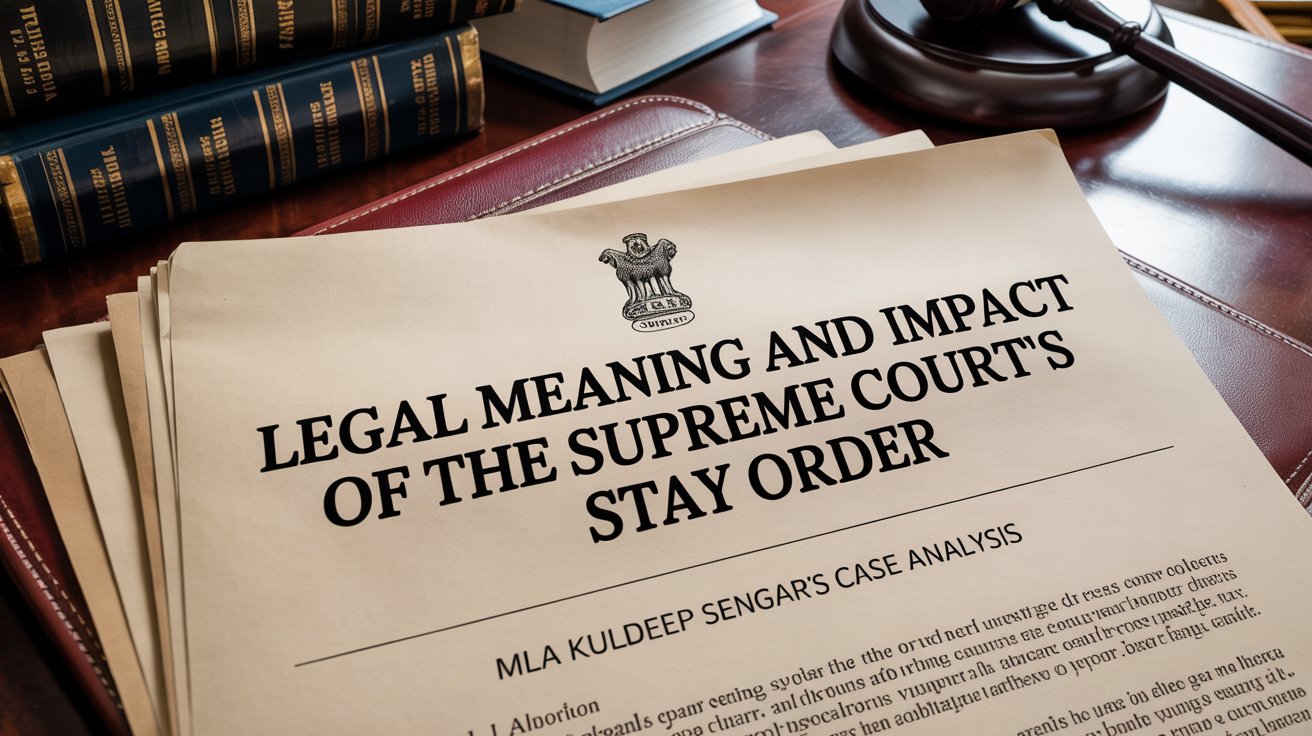
On December 29, 2025, the Supreme Court of India delivered one of the most important judicial interventions in the high-profile Unnao rape case by staying the Delhi High Court’s order that had suspended the life sentence of Kuldeep Singh Sengar and granted him bail.
This development has significant legal, social, and institutional implications — not just for this case but for how courts handle serious sexual offences and sentence relief applications in India.
In this article, we explain in depth:
- What the Supreme Court’s stay order legally means;
- Why it was issued;
- Its key legal and social impact;
- And what may happen next.
Case History – The Unnao Rape Case
The Unnao rape case dates back to 2017 when a then–MLA (Member of Legislative Assembly) from Uttar Pradesh, Kuldeep Singh Sengar, was accused of kidnapping and raping a minor girl in Unnao district. The Economic Times The trauma of the victim’s family deepened with events including custodial death and alleged intimidation attempts.
After CBI investigation and prosecution:
- Sengar was convicted in December 2019 by a Delhi trial court for rape under Section 376(2) of the IPC and under the Protection of Children from Sexual Offences (POCSO) Act.
- He was sentenced to imprisonment for life in the rape case and to 10 years’ jail in a related custodial death case.
The case had been moved to Delhi to ensure neutrality, protect the victim, and expedite justice.
High Court Order: Suspension of Sentence and Bail (Dec 23, 2025)
On December 23, 2025, the Delhi High Court delivered a controversial order granting suspension of Sengar’s life sentence and conditional bail while his appeal was pending.
The High Court’s reasoning included:
- Noting that Sengar had already served over seven years in custody;
- Questioning whether he qualified as a “public servant” at the time of the offence under definitions in POCSO and the IPC.
Conditional bail included requirements such as bonds and restrictions. However, this order triggered much legal and public criticism.
Why High Court’s Order Provoked Backlash
The bail order drew sharp protests:
- Women’s rights groups and civil society condemned the suspension of sentence for a convicted rapist.
- Demonstrations took place outside the court and in public spaces demanding justice
There were also concerns about how the legal interpretation used by the High Court could undermine protections intended by the POCSO Act and criminal justice norms.
Supreme Court’s Stay Order (Dec 29, 2025): Legal Meaning
On December 29, 2025, a three-judge bench of the Supreme Court led by Chief Justice Surya Kant stayed the operation of the Delhi High Court’s order that suspended Sengar’s life sentence and granted bail.
What ‘Stay Order’ Means
A stay order is a judicial direction that temporarily suspends the implementation of a lower court’s order, pending further examination or final adjudication.
Key points:
- It does not change the original conviction;
- It stops the High Court’s order from taking effect;
- It preserves the legal position until the Supreme Court gives a final ruling.
In this case:
✔ Sengar will not be released from jail based on the High Court’s order.
✔ His original life sentence remains in place.
Why the Supreme Court Stayed the High Court Order
The Supreme Court cited several legal concerns:
1. Peculiar Facts of the Case
The bench noted that this is not a typical appeal; Sengar is also serving another sentence (10 years) in a separate matter, giving the case unique legal complexity.
2. Substantial Questions of Law
The Court observed that the High Court’s reasoning — particularly on whether an MLA qualifies as a “public servant” for aggravated offences under the POCSO Act — raises important legal questions that require deeper scrutiny.
The Supreme Court noted a paradox:
If an MLA is excluded from the definition of public servant, then inconsistently, even a police constable or patwari could be treated as a public servant while an MLA is not — a counterintuitive outcome.
Such questions could have far-reaching implications for future criminal jurisprudence.
3. Protecting Victim’s Rights and Public Interest
The Supreme Court accepted the CBI’s appeal challenging the Delhi High Court order, emphasizing that granting bail to a convict of serious sexual offences without fully examining legal issues could jeopardize justice and public confidence in the judicial system.
Legal Impact of the Supreme Court’s Order
The Supreme Court’s stay has multiple legal ramifications, some of which extend well beyond this specific case:
1. Upholding Sentencing Integrity
By staying the High Court’s order, the apex court:
- Protects the original life sentence passed by the trial court;
- Ensures that suspending the sentence does not become routine in serious offence cases simply because an appeal is pending.
2. Clarification on “Public Servant” in Sexual Offence Context
The dispute over whether an MLA qualifies as a public servant for aggravated POCSO offences has potential implications:
- It could affect how similar cases involving legislators and elected officials are prosecuted;
- It could influence how aggravated sexual offences are interpreted legally in future.
3. Victim Protection and Sentencing Norms
By intervening, the Supreme Court reinforced that:
- Serious convictions, especially involving minors, cannot be lightly set aside;
- The legal system must balance accused rights with public safety and victim dignity.
Social and Broader Institutional Impacts
1. Restoring Public Confidence
The stay order was widely welcomed by the survivor and civil society as a reaffirmation that:
- The judiciary takes sexual offence convictions seriously;
- There is no leniency based on political status.
2. Reigniting National Debate
The case has made headlines and sparked nationwide debate over:
- Women’s safety;
- Rule of law;
- Judicial accountability.
Several protests and public statements followed the High Court order, with calls for stronger legislative and judicial measures to protect vulnerable citizens.
What Happens Next?
1. Supreme Court Hearing on Merits
The Supreme Court issued a notice to Sengar, giving him time to file a counter-affidavit. The case will proceed to full hearing on the appeal filed by the CBI.
2. Possible Final Outcomes
The Supreme Court could:
- Uphold the High Court order, if convinced legally;
- Strike it down permanently;
- Modify sentencing standards for similar cases.
3. Potential Legal Clarifications
The apex court may clarify:
- The jurisdiction of High Courts in suspending sentences in serious offences;
- The correct interpretation of aggravated offences under POCSO;
- How legislative office holders are treated under criminal laws regarding sexual violence.
These clarifications may affect future criminal jurisprudence and sentencing norms nationwide.
FAQs
Q1. What did the Supreme Court do in the Unnao Rape Case?
The Supreme Court stayed the Delhi High Court’s December 23, 2025 order that had suspended Kuldeep Singh Sengar’s life sentence and granted him bail. This means the High Court order is not operational and Sengar will remain in jail pending further hearing.
Q2. Why did the Supreme Court stay the High Court’s order?
The Supreme Court found that the High Court’s legal interpretation raised substantial questions of law — especially on definitions related to public servants and aggravated sexual offences — and that these issues needed careful judicial scrutiny.
Q2. Why did the Supreme Court stay the High Court’s order?
The Supreme Court found that the High Court’s legal interpretation raised substantial questions of law — especially on definitions related to public servants and aggravated sexual offences — and that these issues needed careful judicial scrutiny.
Q3. Does the stay order cancel Sengar’s conviction?
No. A stay order is temporary and does not overturn or cancel the original conviction. It simply stops the Delhi High Court’s release and suspension order from taking effect until the Supreme Court hears the full appeal.
Q4. Will the victim’s safety be affected by this decision?
The Supreme Court’s intervention was in part to ensure that the victim’s rights and safety are not jeopardized by premature release or sentence suspension in a serious sexual offence case.
Q5. What legal definitions are under scrutiny in this case?
A key issue is whether a former MLA — at the time of the offence — qualifies as a public servant for the purposes of aggravated sexual offences under the POCSO Act, which has implications for sentencing severity.
Conclusion
The Supreme Court’s stay order in the Unnao Rape Case is a defining legal moment in the criminal justice system of India. It highlights that:
- The courts need to be extremely careful while allowing suspension of sentence for serious crimes;
- The meaning of laws and interpretative issues can have a considerable impact on major cases;
- Judicial scrutiny is still very important in upholding the law and the rights of the victims.
This case will probably be the main reason or at least one of the reasons behind the continued and developing legal discussion regarding the Indian judiciary’s criminal appeals, sentencing standards, and institutional balance.