The Election Commission of India (ECI) has published voter information through its official website after the Supreme Court of India ordered them to release names of voters who had been marked with “logical discrepancies” status. The Special Intensive Revision (SIR) process in the state reaches its first major milestone through this process that will be executed during the assembly elections which are scheduled to occur from April to May 2026. The decision to make these lists public comes amid intense scrutiny over the voter verification process, concerns about transparency, and questions over administrative preparedness. The Supreme Court’s involvement in the case functions as a mechanism to enhance electoral system integrity while safeguarding voter rights before the upcoming state election, which has emerged as one of the most observed electoral contests throughout the nation.
Understanding the ‘Logical Discrepancies’ Category
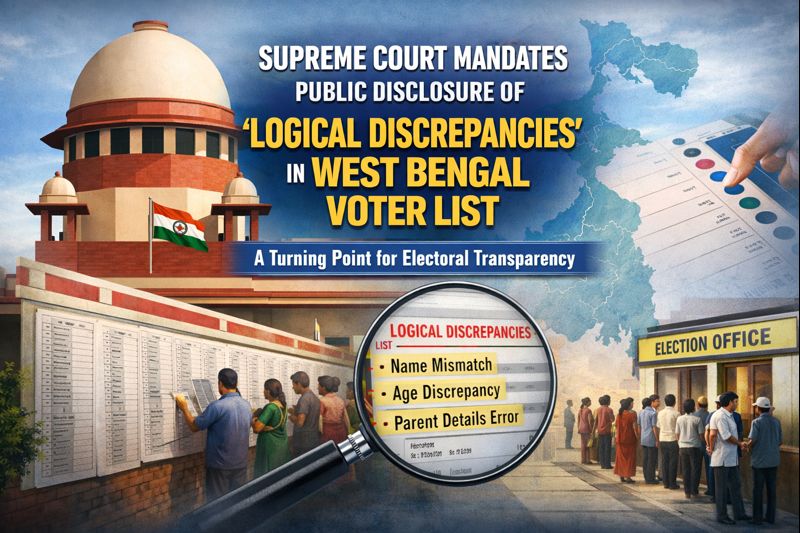
The ongoing SIR process which occurs at regular intervals for electoral roll maintenance has led the ECI to identify 1.25 crore voters in West Bengal through the “logical discrepancies” category. The identified discrepancies represent technical inconsistencies which occur when current data fails to match historical voter records. The officials identified these triggers as common reasons for problems to occur on their system.
The system encountered problems because it could not verify the parent information of the voter who had different names listed on the 2002 voter registration list.
- The system encountered problems because it could not verify the parent information of the voter who had different names listed on the 2002 voter registration list. The system encountered problems because it could not verify the parent information.
- The system encountered problems because it could not verify the parent information of the voter who had different names listed on the 2002 voter registration list.
The conditions serve as algorithmic flags but the number of names involved created operational challenges and legal issues. The critics maintained that the discrepancies occurred because of data format problems and spelling inconsistencies and digitisation mistakes rather than authentic eligibility issues.
Supreme Court’s Directive: What Changed?
A Supreme Court three-judge bench which Chief Justice Surya Kant headed delivered a ruling on January 19 2026 that required public identification of individuals who had been flagged with logical discrepancies which they could then challenge through document submission.
Key directions included:
- The local display of lists occurs at all West Bengal gram panchayat bhavans and block offices and taluka headquarters and urban ward offices across the state.
- The system provides physical and online access because citizens can use both online publication and physical display to verify their own status and their family members’ status on the list.
- Those listed must be given 10 days from the display date to present their documents and objections at local offices that have been designated for this purpose.
- The court assigned the West Bengal administration with its duty to maintain order while enabling the legal proceedings to continue without any interruptions.
The court’s decision derived from two reasons because it wanted to protect procedural rights and voter rights for citizens who would otherwise lose their voting ability because of technical issues.
Implementation — From Web to Panchayat Offices
The ECI uploaded the complete name list to its website after the court ordered it to do so. District electoral officers have been instructed to download and physically display these lists at the designated local offices — making the exercise as visible and accessible as possible.
The hybrid method combines online publication with local display to help reach different user groups who need assistance, especially voters in rural areas who face internet access challenges.
The operation has encountered multiple challenges. Several district and local officers reported delays in receiving the necessary digital tools and software to download and process lists promptly, which raised concerns about meeting the Supreme Court’s deadline.
Political and Administrative Responses
The move has drawn mixed political reactions:
- The Trinamool Congress (TMC) welcomed the Supreme Court’s decision as a victory for electoral transparency, portraying it as a safeguard against perceived attempts to disenfranchise legitimate voters.
- Opposition parties, including the Bharatiya Janata Party (BJP), have criticised the rollout delays, calling for clearer communication and better administrative coordination.
- Local administrators have underscored the technical challenges — including data inconsistencies, software rollouts, and staff readiness — that complicate compliance.
There are also growing calls for the ECI to refine its data infrastructure, incorporating better machine-readable systems and more robust human oversight to prevent AI-driven errors that have plagued the process.
Why This Matters: Implications for Voter Rights and Electoral Integrity
This episode symbolizes more than a bureaucratic adjustment:
1. Strengthening Voter Confidence
Making data public counters opacity and builds trust that no eligible voter is silently removed due to procedural technicalities.
2. Legal Precedent for Transparency
The Supreme Court’s ruling reinforces judicial oversight over electoral processes, especially where fundamental voting rights are at stake.
3. Administrative Accountability
The directive places clear responsibility on electoral machinery — from the ECI to district officials — to act transparently and fairly.
4. Preparatory Benchmark for National Processes
Given the scale of SIR exercises nationwide, the West Bengal case could inform future best practices in voter roll updates.
FAQs
Q1: What exactly is a ‘logical discrepancy’?
A: A logical discrepancy refers to inconsistencies detected by software between a voter’s current details and historical electoral records. Common issues include mismatches in parental names or implausible age relationships.
Q2: How many voters are affected?
A: Approximately 1.25 crore voters in West Bengal have been flagged under this category.
Q3: Will these names be removed from the voter list?
A: Not automatically. The purpose of publication is to allow voters to verify and submit documents or objections if their names were flagged erroneously.
Q4: Where can people check if they are on the list?
A: The lists are available online on the ECI website and are also displayed at local offices (gram panchayat bhavans, block offices, ward offices).
Q5: What is the deadline to raise objections?
A: Those listed typically have 10 days from the local display date to submit supporting documents or objections.
Q6: Does this affect the upcoming elections?
A: The exercise is part of the SIR process before the 2026 assembly elections, and ensuring accurate voter lists is considered crucial for fair polls.