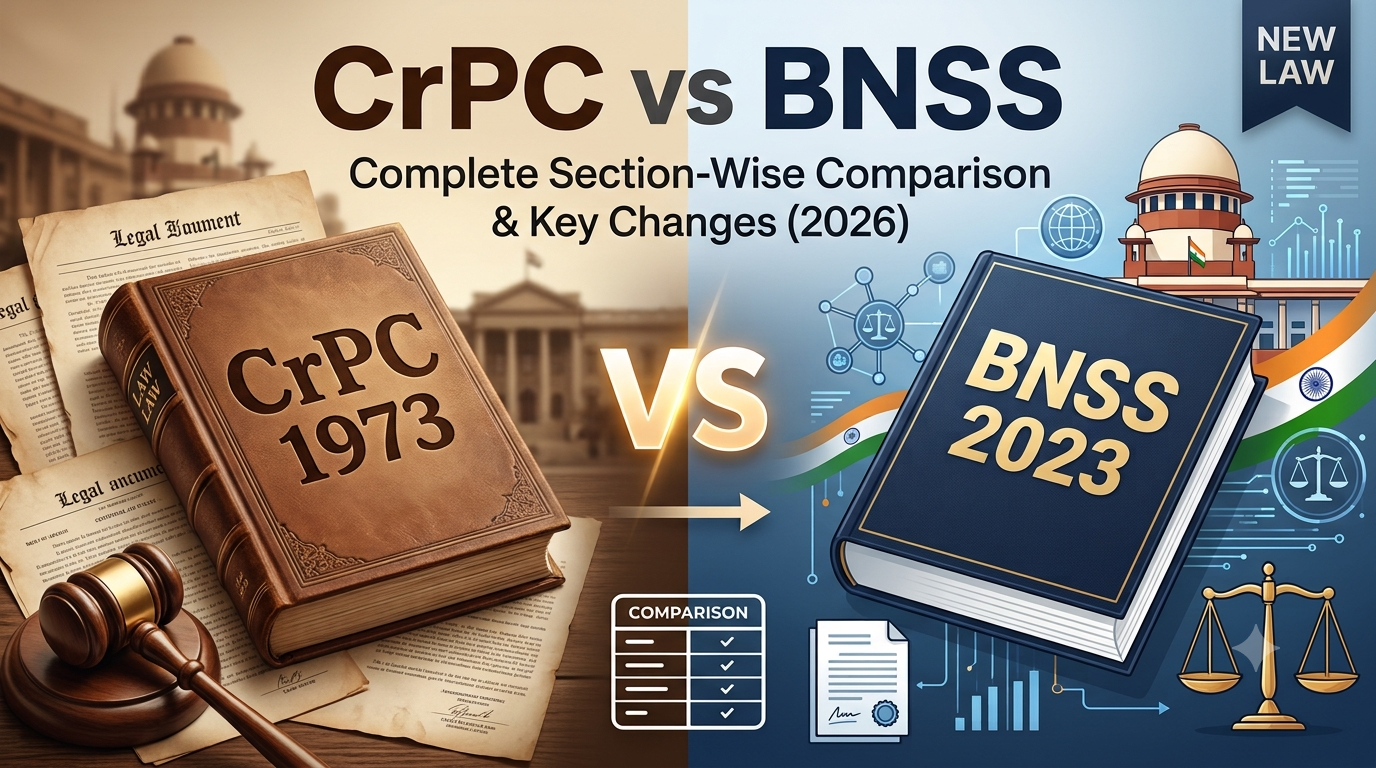

India’s criminal justice system has undergone a major shift after the introduction of the Bharatiya Nagarik Suraksha Sanhita (BNSS) 2023, which replaced the old Criminal Procedure Code (CrPC) 1973. One of the most important areas of change under the new criminal laws is BNSS Bail—how bail is granted, the rights of the accused, arrest powers, and judicial assessment.
The previous CrPC had several loopholes: delayed bail hearings, unclear arrest procedures, cases dragging for years, and inconsistent bail rules across states. With India’s New Bail Rules, the BNSS attempts to create a clearer, time-bound, and more citizen-friendly justice system.
This blog explains how BNSS 2023 has reshaped bail in India, the major differences between old and new rules, and why the new BNSS Bail structure is being discussed across courts, police departments, and legal communities.
Understanding the New BNSS Bail System

The concept of BNSS Bail refers to the updated bail rules under the Bharatiya Nagarik Suraksha Sanhita (BNSS) 2023, which introduced procedural restructuring in India’s criminal justice process. The new criminal laws came into effect to modernize policing, investigation, trial, and bail.
Why the BNSS Bail System Was Needed
The CrPC was drafted in 1973, based on laws from the colonial era. With rising crime, digital offences, delays in trial, and slow case disposal, India required more structured BNSS Bail Rules that:
- Reduce unnecessary arrests
- Protect individual liberty
- Make the legal process faster
- Create accountability on police and magistrates
- Ensure transparency in bail hearings
Therefore, BNSS 2023 attempts to balance public safety with personal liberty.
Major Changes Introduced in BNSS Bail Rules
This section highlights how the BNSS Bail framework has evolved compared to the earlier law.
| Topic / Reform | Old CrPC (Before BNSS) | New BNSS 2023 Rules | BNSS Sections |
| 1. Arrest Powers – Stronger Checks on Police | Police often arrested without proper justification | Police must record written reasons for arrest | Sec 35 |
| No need to justify arrest | Police must justify necessity of arrest | Sec 36 | |
| No clear alternative to arrest | Mandatory notice of appearance instead of arrest | Sec 37 | |
| Weak safeguards against wrongful arrest | Strong legal protection against unnecessary arrest | Sec 35–37 | |
| Effect on Bail | Arrest first, bail later | Encourages bail instead of arrest | Linked to Sec 35–37 |
| Why It Matters | Police discretion too wide | More transparency; courts can review arrest decisions | Sec 35–37 |
| 2. Presumption of Innocence – Stronger Under BNSS | Not strongly codified | Courts must consider if accused is cooperating | Sec 480 |
| Liberty often ignored | Arrest only if absolutely necessary | Sec 35–36 | |
| No clear rule for avoiding detention | Liberty must be protected if possible without custody | Sec 37 | |
| Effect on Bail | Bail often discretionary | Bail becomes rule; jail becomes exception | Sec 479–480 |
| No need to explain bail denial | Judge must record written reasons for rejecting bail | Sec 479 | |
| 3. Faster Bail Hearings & Time-Bound Process | Bail hearings delayed | Courts must process bail faster | Sec 349–357 |
| No strict timeline for investigation | Investigation deadlines now defined | Sec 193 | |
| Delays rarely questioned | Police/magistrate must justify any delay | Sec 193, 230 | |
| Effect on Bail | Slow relief; long detention | People get timely relief under new rules | Sec 349–357 |
| Benefit to Citizens | Jail overcrowding increased | Faster bail reduces unnecessary jail time | Linked to Sec 193 & 349–357 |
Types of Bail Under BNSS (Updated Definitions)
The BNSS has clarified and strengthened all types of bail categories.
This is important for lawyers, citizens, and police alike.
| Type of Bail | BNSS Section | Meaning | Key Requirements Under BNSS | Why It Matters (Benefits) |
| 1. Regular Bail | Section 193 BNSS | Bail after arrest (for bailable & non-bailable offences). | • Judge must check: – Is custody really required? – What is the seriousness of offence? – Is the accused cooperating? – Can liberty be protected without jail? | • Bail process becomes clear and predictable. • Police cannot keep accused in custody without strong reasons. • Strengthens Right to Liberty. |
| 2. Anticipatory Bail | Section 482 BNSS | Bail before arrest to prevent unnecessary arrest. | • Court checks possibility of misuse of arrest. • Allows protective conditions (e.g., no tampering of evidence). • Protects people from harassment and false FIRs. | • Ensures freedom even before arrest. • Gives preventive protection. • Human-rights-friendly and safer for innocent persons. |
| 3. Default Bail (Statutory Bail) | Section 187(3) BNSS | Bail when police fail to file chargesheet on time. | • Strict deadlines for investigation. • If police miss the timeline, bail becomes mandatory. • Magistrate must release accused once conditions are met. | • Strongest protection of liberty. • Prevents long illegal custody. • Forces police to complete investigation on time. |
Key Highlights: BNSS and BNS Criminal Laws Working Together
Since IPC replaced by BNS, and CrPC replaced by BNSS, India now has a fully updated criminal code.
This affects bail because:
- BNS redefines offences
- BNSS redefines procedure
- Both work in sync
Why this pairing matters:
- The seriousness classification of crimes in BNS affects the bail decision under BNSS
- New offences (digitally-related, organised crime, etc.) have structured bail rules
- The whole criminal justice chain becomes more organized
Thus, BNSS and BNS Criminal Laws create a more logical justice system.
India’s New Bail Law: Citizen & Police Impact
The updated New Bail Law India transforms how citizens interact with the system.
Impact on Citizens
- More protection from arbitrary arrest
- Faster bail decision
- Improved rights during investigation
- Increased transparency
Impact on Police
- Must justify arrests
- Must follow strict timelines
- Must maintain digital records
- Must ensure fair procedures
These changes solve long-standing challenges that existed under the old CrPC.
BNSS Key Changes Affecting the Bail System
- Mandatory recording of arrest reasons
- Stronger presumption of innocence
- Faster bail hearings
- Reduced reliance on detention
- Better safeguards for accused persons
- Timelines for investigation strengthened
- Modernized procedures suitable for digital age
- Fewer pending cases due to structured process
All these lead to a more balanced justice system.
Conclusion: A New Era of Bail in India
The introduction of BNSS 2023 marks a turning point in India’s legal landscape. The new BNSS Bail rules aim to create a fair, fast, and citizen-friendly bail system. By reducing unnecessary arrests, enforcing time-bound decisions, improving transparency, and strengthening the rights of the accused, the BNSS attempts to modernize criminal procedure for the future.
Compared to the older CrPC, the BNSS pushes India toward a justice system that values liberty, accountability, and fairness. As the system evolves, both authorities and citizens will adjust to a more structured and predictable bail mechanism.