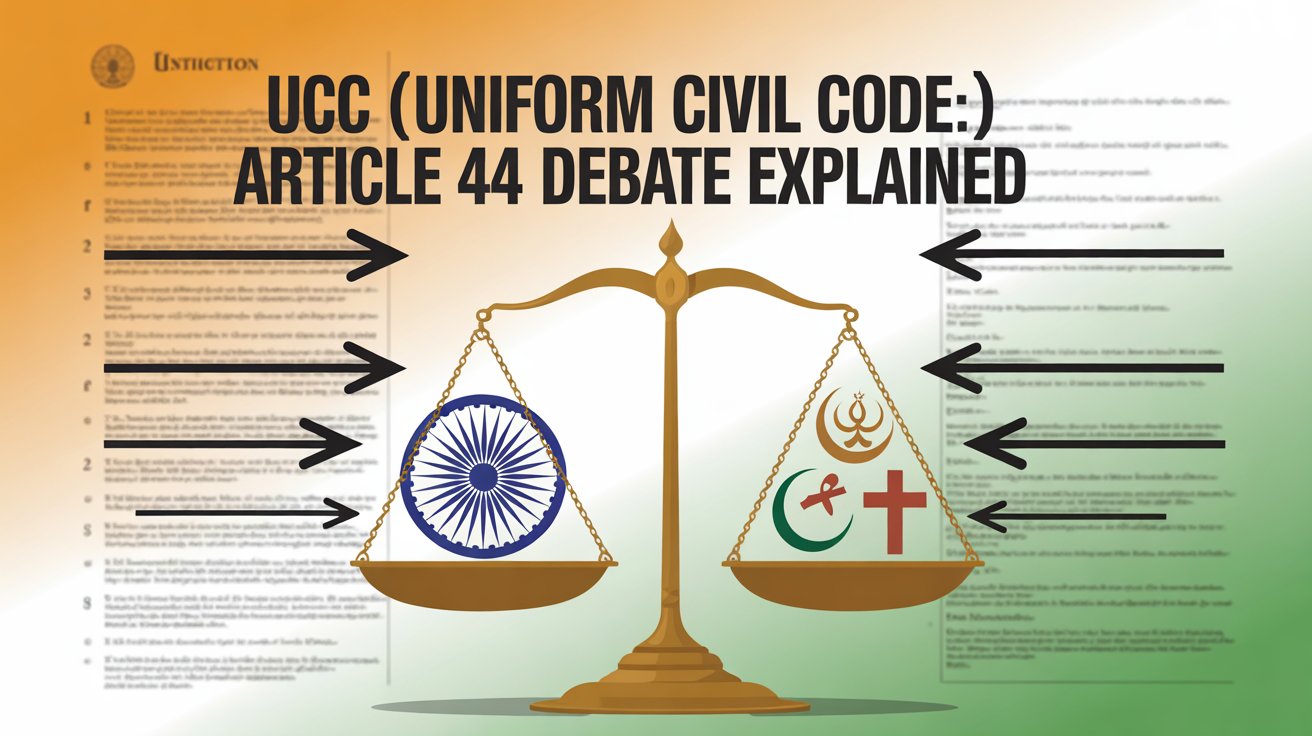
The UCC debate has influenced the conversations in India’s constitutional, political, social, and legal circles for several decades. It is mostly portrayed as an issue of parity, personality, and uniformity in the case of personal laws.
This post elaborates on UCC Meaning, UCC Debate India, Article 44 UCC, UCC Pros and Cons, Directive Principles Article 44, and UCC in India Explained through easy and organized detail.
Understanding the Uniform Civil Code (UCC)
The Uniform Civil Code (UCC) is interpreted as a single uniform legal framework for all the Indian populace, without any discrimination on the basis of religion, caste, gender, or community.
These laws would govern:
- Marriage
- Divorce
- Adoption
- Inheritance
- Property rights
- Guardianship
Currently, India follows multiple personal laws:
- laws are applicable to Hindus, Jains, Sikhs, and Buddhists
- The Muslim Personal Law relates to Muslims Hindu only
- Christian and Parsi Acts are applicable to their corresponding communities
All these different legal systems give rise to a number of questions concerning equality, fairness, and uniformity. Thus, this situation forms the basis for the larger UCC Debate India.
Why the Uniform Civil Code (UCC) Is Central to Article 44 UCC Discussion
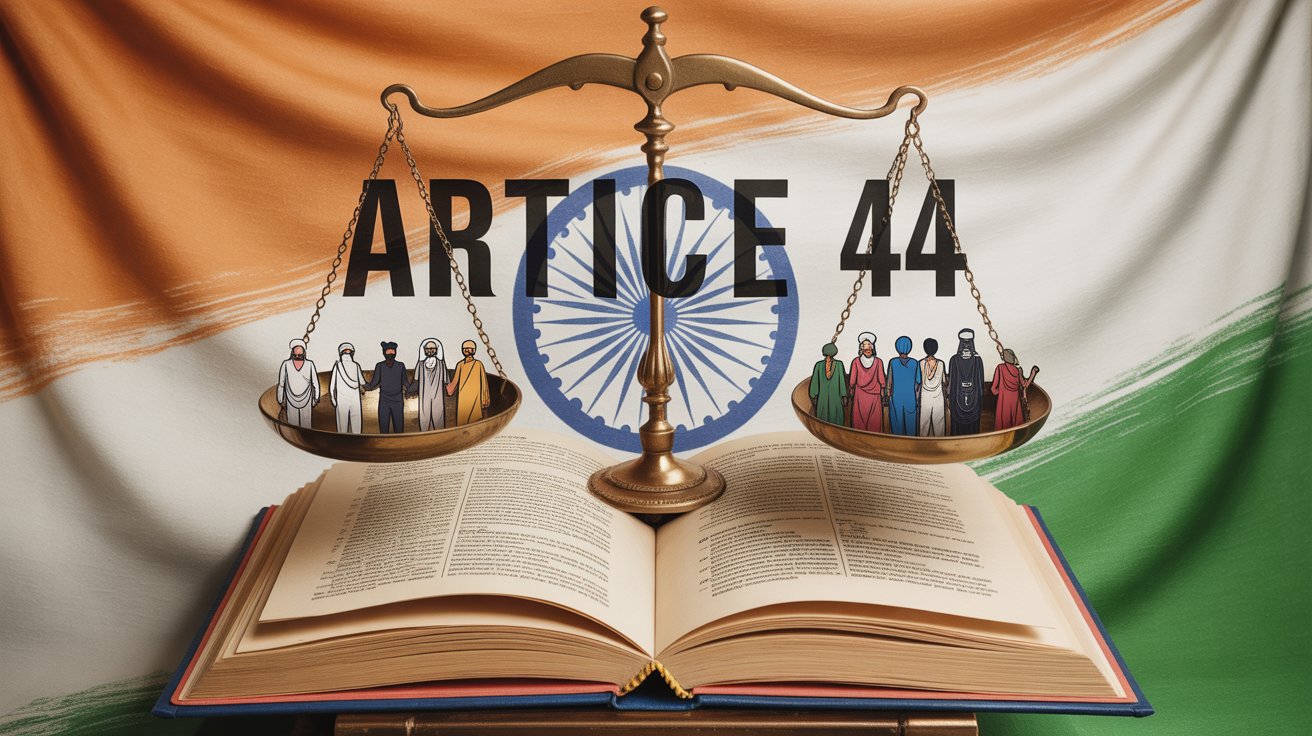
The basis of the Uniform Civil Code (UCC) is in Article 44 UCC which is pointed out under the Directive Principles Article 44 of the Indian Constitution.
Article 44 Constitution of India says:
“The State shall work to give all citizens the same civil laws in all parts of India.”
This is a principle of direction and not a law enforced outright. However, it shows the constitutional conception of guaranteeing justice and equality in the matter of personal relations.
Why UCC India Is Widely Discussed
India’s diversity is the primary reason the UCC India concept gets attention. India is a country with various religions and every religion is different in terms of customs, rituals, and even legal interpretation. Supporters argue that the harmonization of civil laws will result in equal treatment, whereas, opponents consider it a cultural domination that might eventually cause identity dilution.
The debate on the Uniform Civil Code is very passionate and complicated with the presence of unusual and different viewpoints.
Key Aims of the Uniform Civil Code (UCC)
1. Promoting equality among citizens
- Uniform rules reduce discrimination
- Women gain equal rights in marriage, property, and inheritance
- Eliminates unequal provisions across various personal laws
2. Ensuring clarity in civil laws
- Multiple personal laws create overlap and confusion
- A single civil framework makes legal procedures simpler
- Citizens understand their rights better under one standard code
3. Strengthening national unity
- A unified code reflects equal treatment for all
- Helps reduce friction caused by differing legal systems
- Encourages a sense of belonging under one common legal umbrella
4. Protecting vulnerable groups
- Women and children often face disadvantages under certain personal laws
- UCC aims to safeguard their rights through clear and fair provisions
Uniform Civil Code Debate: Why Is It So Intense?
The Uniform Civil Code Debate still to date is a very sensitive issue since it involves both the freedom of personal religion and the law’s prerogative over legal rights. The dispute between the positions taken on these matters gives the discussion between the nation a powerful and continuous nature.
1. Supporters argue:
a. Equal rights for all citizens
- Proponents believe Uniform Civil Code (UCC) ensures equal treatment, irrespective of religious background.
b. Strengthening women’s rights
- Numerous personal laws support males over females in issues like inheritance, divorce, and guardianship. The implementation of a comprehensive code could remedy these inequalities.
c. Reducing legal complexity
- A single civil law makes the legal system easier for citizens and the judiciary.
d. Removing outdated customs
- Some personal laws may contain provisions that do not align with modern principles of equality and justice.
2. Critics argue:
a. Threat to cultural and religious identity.
- They argue that it may fail to take into account the varied customs and rites that are followed by the minority ethnic groups in different parts of the world.
b. Risk of imposing majority culture
- It is feared that the UCC might entail reflecting the belief and practices of the majority community, thereby truncating minority rights.
c. Lack of clarity on implementation
- The complexity of India’s social fabric is one of the factors that make it difficult to execute. Detractors argue that the change needs to be very delicately managed..
d. Fear of political misuse
- Many view UCC as a subject used for political advantage, creating mistrust among communities.
How the Supreme Court Views the UCC Debate India
The judiciary has sought often the view of united independent law, but at the same time, it has expressed its consent despite the diversity in this matter implying the jadedness of such issues.
Notable cases:
1. Shah Bano Case (1985)
- The Court stressed the necessity of a common civil structure for safeguarding women’s rights.
2. Sarla Mudgal Case (1995)
- The Court highlighted the issue of personal law misuse as a main concern for the legal system.
3. John Vallamattom Case (2003)
- It recognized the disparities among various personal laws and recommended their revision.
Such remarks keep on stimulating the debates about the Uniform Civil Code (UCC).
UCC Meaning: Understanding What It Represents
To many, UCC Meaning stands for equal civil rights for all.
To others, it raises concern about preserving cultural traditions.
Therefore, understanding its meaning requires attention to constitutional values as well as social sensitivities.
Goa as an Example of Civil Code Uniformity
Goa is often highlighted because it already follows a common civil law for all communities.
The state’s civil code is cited during the UCC Debate India as a functional model, though it also has its own complexities.
Pros and Cons of the Uniform Civil Code (UCC)
Below is a clear explanation of UCC Pros and Cons, which shape national conversations.
| Pros of Uniform Civil Code (UCC) | Explanation |
|---|---|
| 1. Ensures equal rights | A unified law prevents discrimination among citizens. |
| 2. Strengthens the position of women | Many outdated personal laws restrict women’s rights; UCC can correct these inequalities. |
| 3. Reduces legal confusion | Multiple civil codes create inconsistency; one uniform code offers clarity. |
| 4. Encourages social unity | Common laws promote harmony among various communities. |
| Cons of Uniform Civil Code (UCC) | Explanation |
| 1. May conflict with religious freedom | Some communities fear UCC may override their customs and traditions. |
| 2. Difficult to implement | India’s cultural and religious diversity makes uniform implementation challenging. |
| 3. Could affect minority identities | Minorities fear UCC could reduce the uniqueness of their personal laws. |
| 4. Risk of creating tension | If not implemented sensitively, UCC may lead to social conflict. |
UCC in India Explained: What Lies Ahead
Understanding UCC in India Explained requires observing the broader context.
The government has shown interest, but no finalized draft has been shared publicly.
The roadmap may include:
- Dialogue with all communities
- Gradual reforms in existing personal laws
- Creation of a balanced civil framework
- Protection of constitutional rights
This measured approach may help address social concerns and build a stronger foundation.
Conclusion
The Uniform Civil Code (UCC) is a legal issue, which is a case of equality, identity, and constitutional vision.
Even though UCC Article 44 indicates the intention of unifying the different civil systems, its application will take time, conversation, and care.
The way India will shape the future of the Uniform Civil Code Debate will be determined by the balancing of the constitutional values and the cultural diversity.