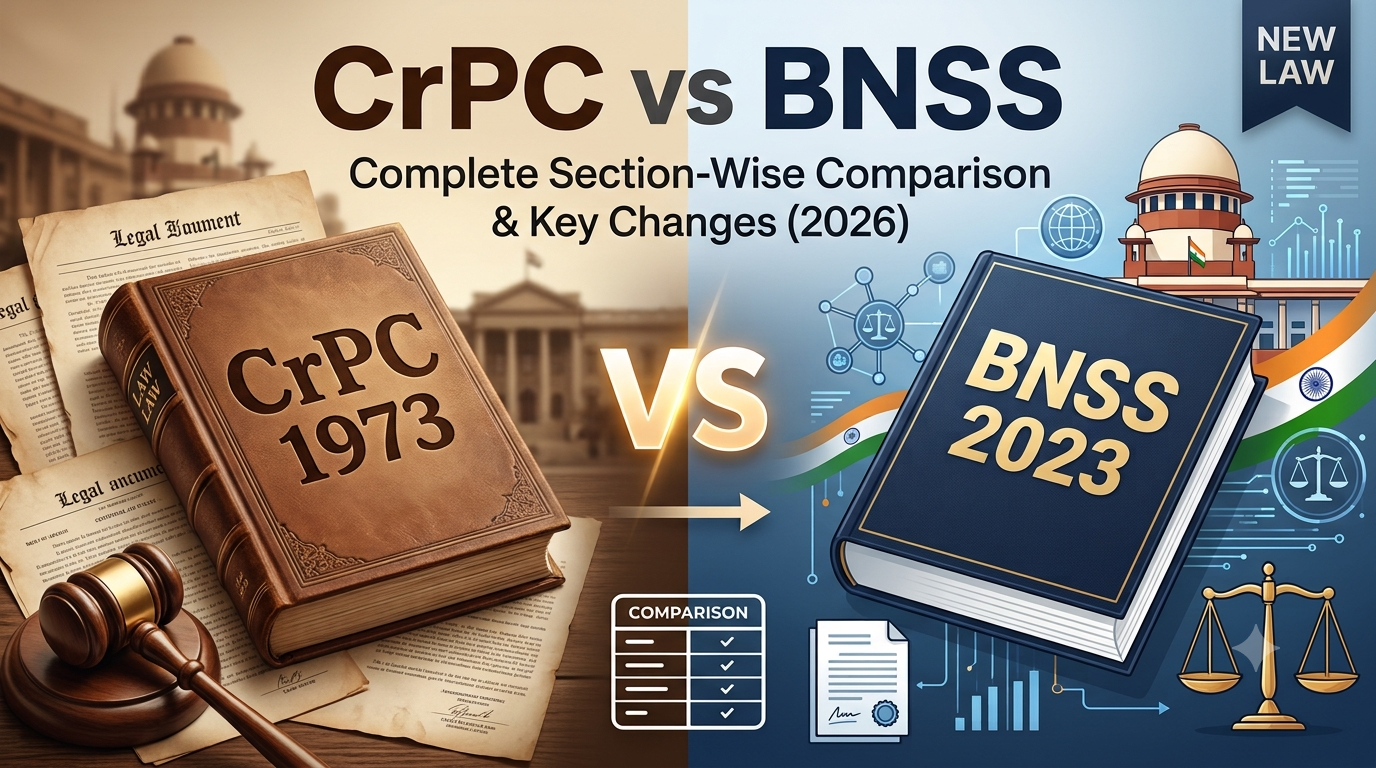
The Code of Criminal Procedure, 1973 (CrPC) governed how crimes were investigated, tried, and punished in India for fifty years. On 1 July 2024, it was replaced by the Bharatiya Nagarik Suraksha Sanhita, 2023 (BNSS). If you are a law student, an advocate, or a citizen trying to read an FIR or a bail order, one question keeps coming up — which old CrPC section is now which BNSS section? This CrPC vs BNSS guide gives you a clear section-wise mapping table and a simple breakdown of every major change.
CrPC vs BNSS: What Actually Changed?
The CrPC had 484 sections. The BNSS reorganises criminal procedure into 531 sections. The core structure — arrest, investigation, bail, trial, and appeal — stays intact, but the section numbers have changed, many timelines are now fixed by law, and technology has been built into the process for the first time.
The biggest themes in the CrPC vs BNSS shift are speed, transparency, and digitisation. The new code sets strict deadlines to reduce delays, makes electronic records central to investigation and trial, and strengthens the rights of both victims and the accused.
CrPC vs BNSS Section Mapping Table
The table below maps the most searched and most important CrPC sections to their new BNSS equivalents.
| Provision | Old Law (CrPC 1973) | New Law (BNSS 2023) |
| Arrest without warrant | Section 41 | Section 35 |
| Rights of an arrested person | Section 50 | Section 47 |
| Accused to be produced within 24 hours | Section 57 | Section 58 |
| FIR / information in cognizable cases | Section 154 | Section 173 |
| Examination of witnesses by police | Section 161 | Section 180 |
| Recording of confessions and statements | Section 164 | Section 183 |
| Police report / charge sheet | Section 173 | Section 193 |
| Prohibitory orders (public nuisance/danger) | Section 144 | Section 163 |
| Cognizance of an offence | Section 190 | Section 210 |
| Examination of the complainant | Section 200 | Section 223 |
| Compounding of offences | Section 320 | Section 359 |
| Compensation to the victim | Section 357 | Section 395 |
| Bail in bailable offences | Section 436 | Section 478 |
| Release of undertrial prisoners | Section 436A | Section 479 |
| Bail in non-bailable offences | Section 437 | Section 480 |
| Anticipatory bail | Section 438 | Section 482 |
| Special bail powers of High Court/Sessions | Section 439 | Section 483 |
| Maintenance of wife, children, parents | Section 125 | Section 144 |
| Inherent powers of the High Court | Section 482 | Section 528 |
Note: The BNSS renumbering is not sequential. A single CrPC section may map to more than one BNSS provision, so always read the full section for exact wording.
Key Differences Between CrPC and BNSS
1. Zero FIR and e-FIR
Under the BNSS, a person can now register a Zero FIR at any police station, regardless of where the crime took place; it is then transferred to the correct station. Complaints can also be filed electronically (e-FIR), and the police must give the informant a free copy of the FIR. This makes the very first step of the criminal process faster and more accessible.
2. Fixed Timelines for Speedy Justice
Delay was the biggest criticism of the old system. The BNSS answers it with hard deadlines. Investigation in certain cases must be completed within set periods, charges are to be framed within a fixed time, and judgment must be delivered within 45 days of the trial ending. The complainant must also be updated on the progress of the investigation within 90 days.
3. Forensic Investigation Made Mandatory
For offences punishable with seven years or more, the BNSS makes it compulsory for forensic experts to visit the crime scene and collect evidence, with the process recorded on video. This is designed to improve conviction quality and reduce reliance on weak or tampered evidence.
4. Use of Technology and Video Recording
The BNSS allows trials, appeals, and the recording of evidence to be conducted through electronic and video-conferencing modes. Search and seizure operations must be videographed. Statements of victims in certain cases, especially sexual offences, are also recorded on camera to protect their testimony.
5. Trial in Absentia for Absconders
A significant new feature is the provision for trial in absentia. If a proclaimed offender absconds to avoid trial, the court can now proceed and even pronounce judgment in their absence, closing a gap that fugitives often exploited under the CrPC.
Does the CrPC Still Apply in 2026?
Yes, but only to older matters. Any case where the process began before 1 July 2024 continues under the CrPC, while every new investigation and trial from that date runs under the BNSS. This is why police stations, lawyers, and courts currently use both codes together, and why a clear grasp of the CrPC vs BNSS mapping remains essential.
Why This Comparison Matters
For a law student, the section mapping is exam-critical and interview-ready knowledge. For a practising advocate, filing a bail application under the wrong section can cause real delay, so quoting the correct BNSS number matters daily. For an ordinary citizen, knowing that anticipatory bail moved from Section 438 CrPC to Section 482 BNSS, or that an FIR is now Section 173 BNSS, helps in understanding any legal document placed before them. The CrPC vs BNSS transition is a genuine modernisation of criminal procedure, and staying updated protects your rights.
Frequently Asked Questions (FAQs)
1. When did the BNSS replace the CrPC? The Bharatiya Nagarik Suraksha Sanhita, 2023 came into force on 1 July 2024, replacing the Code of Criminal Procedure, 1973.
2. How many sections does the BNSS have compared to the CrPC? The CrPC had 484 sections; the BNSS has 531 sections.
3. What is Section 154 CrPC in BNSS? The FIR provision, earlier under Section 154 CrPC, is now Section 173 BNSS.
4. What is anticipatory bail under the BNSS? Anticipatory bail, earlier under Section 438 CrPC, is now under Section 482 BNSS.
5. What is a Zero FIR under the BNSS? It allows a person to register an FIR at any police station, which is then transferred to the station that has jurisdiction.
6. Does the CrPC still apply after 1 July 2024? Yes, but only to cases that started before that date. New cases follow the BNSS.
7. What are the biggest new features of the BNSS? Zero FIR and e-FIR, fixed timelines for speedy justice, mandatory forensics for serious crimes, video recording of key steps, and trial in absentia for absconders.
Conclusion
The move from CrPC to BNSS is the most far-reaching change to Indian criminal procedure in half a century. The stages of a criminal case remain familiar, but the numbering, timelines, and technology-driven rules have all been updated. Bookmark this CrPC vs BNSS comparison and mapping table so you can always find the new section behind any old one.