A lawyer’s reputation is the foundation of the practice. Once it is damaged, clients disappear and years of work can unravel. That is exactly what happened when a bank’s panel advocate found his name on a “caution list” and watched institution after institution drop him. On 7 July 2026, the Supreme Court stepped in with an important ruling: the Indian Banks’ Association (IBA) cannot effectively blacklist a lawyer by placing his name on a caution list merely on allegations of negligence in a fraud. The judgment protects the independence of the legal profession and reaffirms who really holds power over a lawyer’s conduct.
What the Supreme Court Held
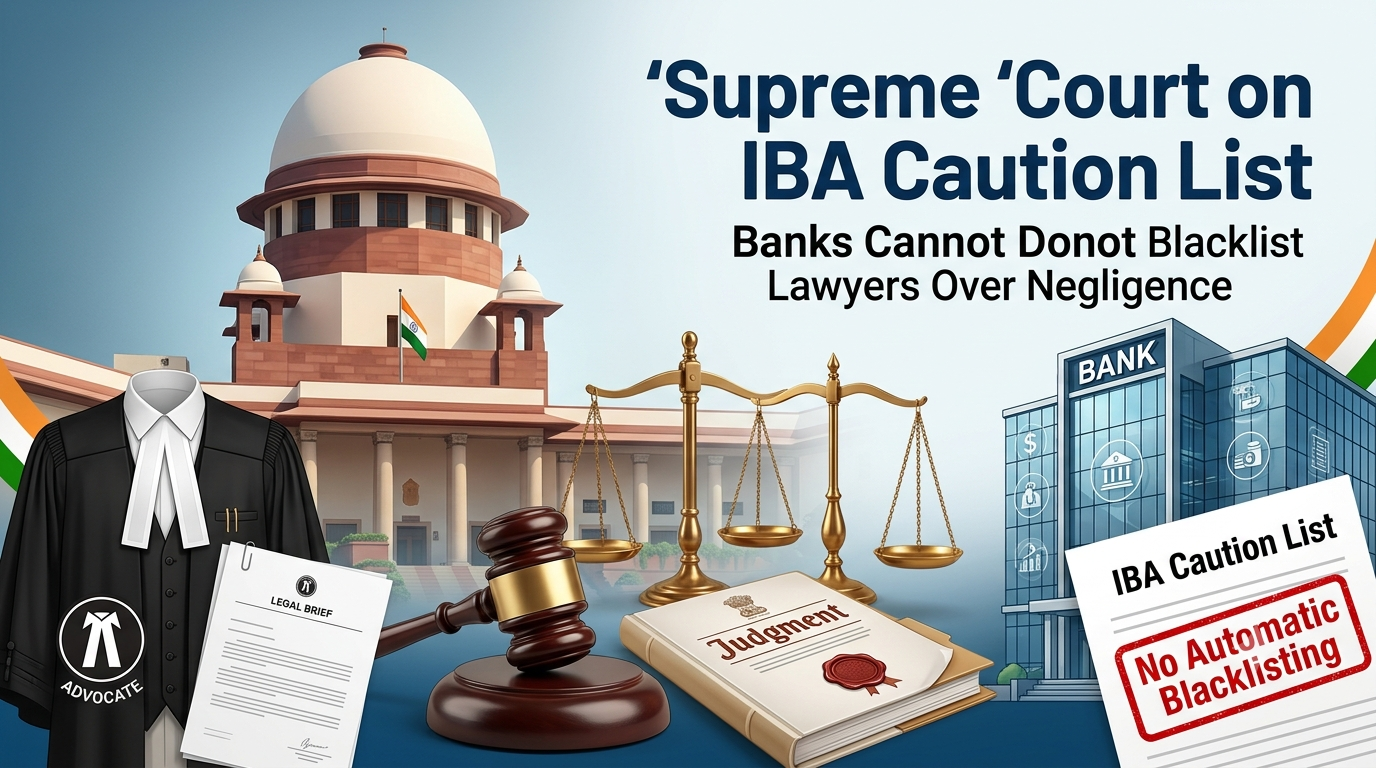
A Bench of Justice P.S. Narasimha and Justice Alok Aradhe ruled that the IBA cannot put a panel advocate on its caution list — and thereby blacklist him across the banking sector — simply because a bank has accused him of negligence. The Court observed that such an action strikes directly at an advocate’s profession and reputation, and that these consequences are too serious to flow from an internal listing made without proper safeguards.
The Court made clear that questions of an advocate’s professional conduct fall within a specific statutory framework, and a private association of banks cannot bypass that framework to punish a lawyer.
What Is the IBA Caution List?
The Indian Banks’ Association is an umbrella body of banks and financial institutions in India. Banks routinely engage panel advocates to carry out legal work such as title searches, property verification, documentation, and recovery. To warn its member banks about professionals they consider risky, the IBA maintains a caution list. Once a lawyer’s name appears on it, banks across the country tend to stop assigning work and remove the person from their panels.
In practice, a caution-list entry works like a blacklist. It does not merely caution one bank; it silently shuts the door at many. That is why the Supreme Court treated the listing as far more damaging than a routine administrative note.
Background of the Case
The dispute reached the Supreme Court through a Special Leave Petition (SLP) filed by an advocate. He had earlier approached the Allahabad High Court, which declined to entertain his petition, and he then challenged that refusal before the top court.
The trouble began with a property transaction. Syndicate Bank (now Canara Bank) alleged that its panel advocate had been negligent while preparing a search and title report for a property. According to the bank, the advocate failed to disclose that a part of the property had already been sold. The bank claimed this lapse helped the borrower commit fraud and exposed the bank to financial risk.
Acting on this allegation, the IBA added the advocate’s name to a caution list issued on 5 February 2020. The advocate argued that this was done without any prior notice, without an opportunity to be heard, and without a proper inquiry. The fallout was immediate and severe. Several banks and financial institutions removed him from their panels, causing him both financial loss and lasting damage to his professional standing.
The Core Legal Question
The heart of the case was a question of jurisdiction: who has the authority to act against an advocate for alleged professional misconduct?
Assisting the Court as amicus curiae, Senior Advocate Maninder Singh argued that only the Bar Council of India (BCI) and the relevant State Bar Councils are empowered to deal with the professional conduct of advocates. This power flows from the Advocates Act, 1961, which sets up the disciplinary machinery for the legal profession. Significantly, both the BCI and the Central Government supported this position, agreeing that a banks’ association cannot assume a role reserved for the statutory regulators of the Bar.
Why the Bar Council Holds This Power
Under the Advocates Act, 1961, the conduct and discipline of advocates is entrusted to the Bar Councils. When a complaint of professional or other misconduct is made, it is the State Bar Council — and, on appeal or transfer, the Bar Council of India — that inquires into it through a disciplinary committee. That process gives the advocate a notice, a hearing, and a fair chance to defend himself before any penalty such as suspension or removal from the rolls is imposed.
The IBA has no such statutory role. It is an association of banks, not a regulator of lawyers. When it places an advocate on a caution list on the strength of a single bank’s allegation, it effectively imposes a professional penalty without any of the safeguards the law demands. The Supreme Court’s ruling restores the correct order: allegations of a lawyer’s misconduct must travel through the Bar Councils, not through a private blacklist.
The Natural Justice Angle
The case also raised a basic principle of fairness known as audi alteram partem — no one should be condemned unheard. The advocate’s central grievance was that his name was listed without notice, without a hearing, and without inquiry. Any action that carries serious civil consequences, such as the loss of one’s livelihood and reputation, must follow a fair procedure.
The right to practise a profession is also protected under Article 19(1)(g) of the Constitution. A blanket blacklist that quietly ends a lawyer’s engagements across the banking sector interferes with that right, and it cannot stand when imposed by a body that owes the advocate neither notice nor a hearing.
A Push for Continuing Legal Education
The Supreme Court did not stop at protecting the advocate. It used the occasion to strengthen the profession as a whole. The Court directed the Bar Council of India to take steps to establish a National Legal Academy for advocates, on the lines of the National Judicial Academy that trains judges.
The aim is to build an institutional system of Continuing Legal Education (CLE) — ongoing, structured training that keeps lawyers updated on evolving laws and standards of practice. Better training reduces the very kind of professional lapses that led to this dispute, and it raises the overall quality and accountability of the Bar. The detailed judgment, which is awaited, is expected to elaborate on this direction.
Why This Ruling Matters
For advocates, the decision is a strong shield. A single client’s complaint can no longer be converted into an industry-wide blacklist that ends a career overnight. If a bank believes its panel lawyer was negligent, it must pursue the proper route — a complaint before the Bar Council, or a civil claim — where the lawyer gets a fair hearing.
For banks and the IBA, the ruling draws a clear boundary. They remain free to choose their panel advocates and to manage genuine risk, but they cannot act as a disciplinary authority over the legal profession. Risk management cannot become punishment imposed without due process.
For the wider justice system, the judgment reaffirms the independence of the Bar. Lawyers must be able to work without the fear that a powerful institution can silently destroy their practice. At the same time, the direction to set up a National Legal Academy signals that independence must be matched by competence and continuous learning.
Frequently Asked Questions (FAQs)
1. What did the Supreme Court decide about the IBA caution list? It held that the IBA cannot effectively blacklist a panel advocate by placing him on a caution list merely on allegations of negligence in a fraud.
2. Who decided the case? A Bench of Justice P.S. Narasimha and Justice Alok Aradhe delivered the ruling on 7 July 2026.
3. What is a panel advocate? A lawyer empanelled by a bank to handle legal work such as title searches, property verification, documentation, and recovery matters.
4. Who can take action against an advocate for misconduct? Only the Bar Council of India and the State Bar Councils, under the Advocates Act, 1961, have that power.
5. Why was the caution list seen as a blacklist? Once a lawyer’s name appears on it, banks across the sector tend to drop him from their panels, causing a broad loss of work and reputation.
6. What was wrong with how the advocate was listed? He was placed on the list without prior notice, without a hearing, and without any proper inquiry, violating the principles of natural justice.
7. What direction did the Court give to the Bar Council of India? To take steps to set up a National Legal Academy, on the lines of the National Judicial Academy, for the continuing legal education of advocates.
Conclusion
The Supreme Court’s decision on the IBA caution list is a meaningful safeguard for the legal profession. It confirms that a lawyer’s professional conduct is answerable to the Bar Councils under the Advocates Act, 1961 — not to a private association acting without notice or hearing. By protecting advocates from arbitrary blacklisting and, at the same time, calling for stronger continuing education, the Court has balanced independence with accountability. The detailed judgment is awaited and will offer fuller guidance on both fronts.