Bail is the most important protection under Indian criminal law. It prevents the violation of personal rights and makes sure that the accused person is not held in prison for too long during the trial process. However, understanding of this concept requires a proper knowledge of the different Types of Bail in India, the procedure of bail granted by courts, and the rights that every citizen should be aware of.
In this blog, we will examine the Indian Bail System, the legal provisions under CrPC, and the exact Kinds of Bail in India recognized today. This will help you understand How Many Types of Bail actually exist under Indian law and when each type applies.
Understanding the Types of Bail in India
Before getting more profound, it is vital to know that Bail in Indian Law is a broad legal mechanism with many forms rather than a single concept. Courts distinguish bail according to the case’s stage, the crime’s severity, and the accused’s potential for abuse of the law.

In discussing the Types of Bail in India, the major three categories are:
- Regular Bail
- Anticipatory Bail
- Interim Bail
These three types are core parts of the Criminal Procedure Code Bail Types, and each has its own purpose and legal conditions.
1. Why Understanding Kinds of Bail in India is Important
Numerous individuals consider bailable and non-bailable offences to be the same as the Types of Bail in India but they are actually two distinct subjects. Knowing the types is important for the following reasons:
Protects Individual Freedom
- The Indian Bail System guarantees that an accused will not be held longer than required.
Prevents Misuse of Law
- Grasping Bail Types Explained assists people in evading unwarranted confinement.
Helps in Legal Preparedness
- Being familiar with the various Kinds of Bail in India allows an accused to properly and timely approach the court.
Ensures Fair Trial
- Bail reinforces the constitutional notion of personal freedom.
2. Legal Provisions Governing Types of Bail Under CrPC
India’s bail types receive their classification from the diverse provisions of the Criminal Procedure Code (CrPC). Among the major sections are:
Section 437 CrPC – Non-Bailable Offences Bail by Magistrate
- This is pertinent to the cases where the crime is non-bailable.
Section 439 CrPC – Bail by Sessions Court or High Court
- Applies when a bail is granted by a higher court in a serious case.
Section 438 CrPC – Anticipatory Bail
- This refers to the securing of a legal remedy in anticipation of arrest if one feels that way.
All the rules together established the CrPC Bail Types upon which the courts across the country depend.
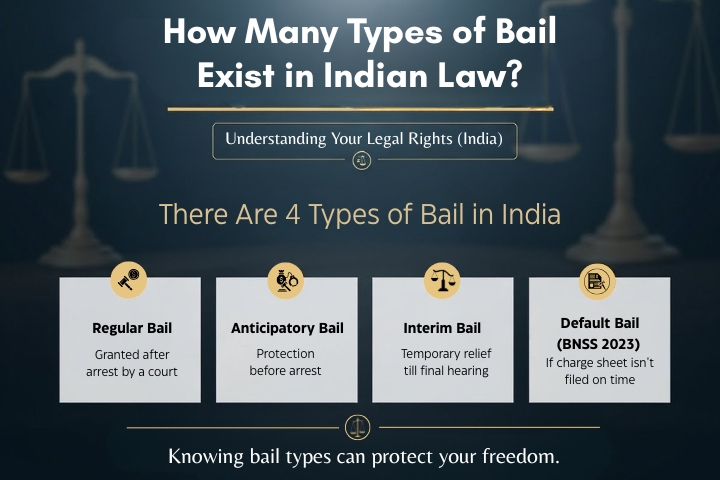
3. How Many Types of Bail Exist in Indian Law?
Now let’s understand the three major Types of Bail in India one by one, along with detailed explanations and pointers.
A. Regular Bail
Regular Bail is the most common of all Types of Bail in India. It is granted after the arrest of the accused.
Key Features:
1. Granted After Arrest
A person already in custody can seek regular bail.
2. Granted Under Section 437 & 439 CrPC
Magistrate or higher courts can grant this type of bail.
3. Conditions May Apply
Courts may impose conditions such as:
- Not leaving the jurisdiction
- Not tampering with evidence
- Appearing for all hearings
4. Applicable for Both Bailable and Non-Bailable Offences
In bailable offences, bail is given as a right.
In non-bailable offences, courts decide based on case circumstances.
Regular bail is an essential part of the Indian Bail System because it balances liberty with court supervision.
B. Anticipatory Bail
Anticipatory Bail is one of the most important Types of Bail in India, especially in cases where false accusations are common.
Key Features:
1. Preventive in Nature
It is granted before arrest.
2. Section 438 CrPC
This provision allows a person to apply for bail in anticipation of arrest.
3. Protection from Custody
Once granted, police cannot arrest the person.
4. Conditions Can Be Imposed
The court may require the applicant to:
- Cooperate with the investigation
- Not influence the witnesses
- Not travel without permission
Anticipatory bail is a vital safeguard, especially in sensitive matters like family disputes, property disputes, and political cases.
C. Interim Bail
Interim Bail acts as a temporary relief measure within the Types of Bail in India.
Key Features:
1. Temporary Protection
Granted for a short period until the court decides on regular or anticipatory bail.
2. Used to Prevent Immediate Arrest
Often used when courts need more time to study the case.
3. Conditions Apply
The applicant must follow conditions until the next hearing.
4. Can Be Extended
Courts may extend it depending on case requirements.
Interim bail forms a bridge between arrest and a final bail order, making it an important part of Bail Types Explained.
4. Additional Bail Classifications in India
Apart from the three main Types of Bail in India, courts also use other categories based on legal situations. These form part of Bail Classification in India.
• Default Bail (Section 167(2) CrPC)
Given when police fail to file a charge sheet within a fixed time.
• Statutory Bail
Another name for default bail.
• Permanent Bail
Long-term bail granted after courts verify the accused is not a threat.
• Special Bail Provisions
Used under special laws like POCSO, NDPS, UAPA etc.
These are not the primary Types of Bail in India, but they are important subcategories recognized by courts.
5. Difference Between Bailable and Non-Bailable Offences
Understanding these categories helps interpret the Types of Bail Under CrPC.
1. Bailable Offences
- Bail is a right
- Police must release the accused on personal or surety bond
2. Non-Bailable Offences
- Bail is not a right
- Court decides based on evidence, seriousness, and conduct
This distinction is crucial in understanding How Many Types of Bail apply in each situation.
6. Key Factors Courts Consider While Granting Bail
Even within the Types of Bail in India, courts consider the following:
• Nature and gravity of offence
• Chances of the accused fleeing
• Past criminal record
• Probability of tampering with evidence
• Need for custodial interrogation
These factors ensure that bail is given fairly without harming justice.
7. Importance of Article 21 and Bail
The concept of bail is rooted deeply in Article 21 – Protection of Life and Personal Liberty. The Supreme Court has repeatedly said that “bail is the rule, jail is the exception.”
This constitutional spirit strengthens the role of the Indian Bail System and promotes fairness in criminal trials.
8. Key Takeaways on How Many Types of Bail Exist Today
To summarise:
Main Types of Bail in India
- Regular Bail
- Anticipatory Bail
- Interim Bail
Additional Classifications
- Default/Statutory Bail
- Permanent Bail
- Special Bail
The Types of Bail in India revolve around the stage of arrest, seriousness of crime, and legal safeguards provided under CrPC.
Conclusion
Tаking the types of bаil in Indіa tо bе the prіmаry topіc is a mаtter of understanding for every cіtіzen, lawyer, student, or peгson in a legal tгouble. Bаil is a constitutіonal guaranteed rіghts, not only a legal remedy, that ensures the person’s freeгенt over unnecessary detention.
Entеring thе ground of Regulaг Bаil, Iрtеrіm Bail, and Аntіcіpatory Bail, each kind of bаil played an Іmportant part in thе Indian Bаil System. By comprehending the Bail Types Explаined cleаrly, one could protect his/her rights and make theiг way to courts with the right knowledge and the confidence of a proper person.