Bail is a very powerful weapon within the Indian criminal law system. It acts as a shield for personal liberty and prevents the situation where the accused is incarcerated for a long time unnecessarily just because the case is not over yet. To digest it better, we should look deeply into the Types of Bail in India, the rules CrPC laid down, and the fresh changes made under BNSS 2023.
This guide goes through all the kinds of bail, the process of courts granting bail, and the impact of BNSS 2023 on the system.
Understanding the Types of Bail in India
Bail is not a single concept—it has multiple types depending on:
- The stage of the case
- Nature of the offence
- Whether the accused has been arrested
- Court discretion
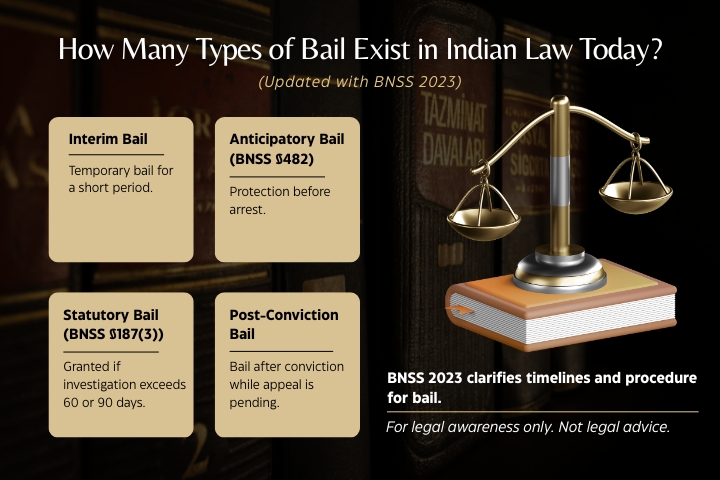
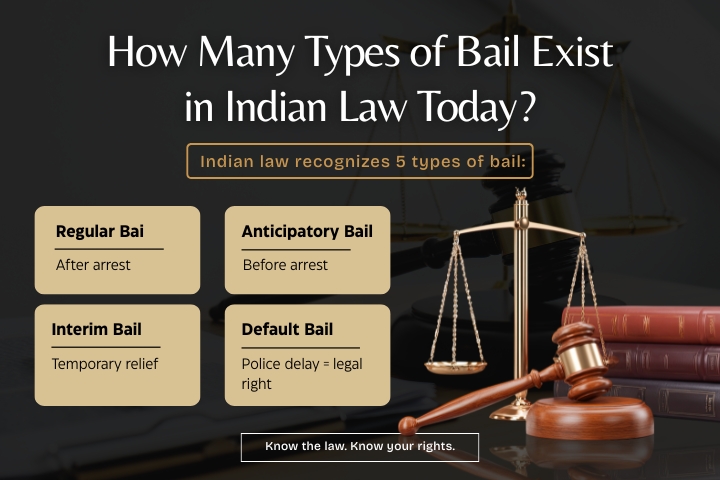
In Indian criminal law, the three primary Types of Bail are:
- Regular Bail
- Anticipatory Bail
- Interim Bail
Default bail, statutory bail, permanent bail, and exceptional bail provisions are other types of bail recognised by courts.
1. Why Understanding Kinds of Bail in India is Important
Bailable and non-bailable offences are often mistaken for types of bail, but they are actually separate concepts. Understanding the types of bail provides several advantages:
Safeguards Individual Freedom
- Stops needless imprisonment and the absolute rights of the person concerned.
Aids in Misuse Prevention
- Knowledge of the situation prevents people from being harassed or arrested improperly.
Guarantees Legal Readiness
- Understanding the correct type of bail enables an accused to go to the proper court at the appropriate time.
Contributes to Just Trial
- Bail allows the coexistence of freedom and fairness in the judicial process.
2. Legal Provisions Governing Types of Bail Under CrPC
In India, the major rules outlining bail are:
| Section | Provision | Explanation |
| Section 437 CrPC | Bail by Magistrate | Bail granted in non-bailable offences by a Magistrate; court checks seriousness, evidence, and risk factors. |
| Section 439 CrPC | Bail by Sessions Court / High Court | Higher courts have wider powers to grant bail in non-bailable offences. |
| Section 438 CrPC | Anticipatory Bail | Protection before arrest when a person fears being arrested on false or motivated allegations. |
They create the legal basis for the different Bail Types of the Code of Criminal Procedure.
3. How Many Types of Bail Exist in Indian Law?
The three major types of bail are:
A. Regular Bail
Regular bail is the most common type.
Key Features
- Applied After Arrest
Once a person is taken into custody. - Sections 437 & 439 CrPC
Granted by Magistrate, Sessions Court, or High Court. - Conditions May Apply
Courts may restrict travel, prevent evidence tampering, etc. - Applicable to Both Bailable & Non-bailable Offences
- In bailable offences → bail is a right
- In non-bailable offences → court decides
Regular bail protects liberty while keeping court supervision intact.
B. Anticipatory Bail
Anticipatory bail is preventive and protects against arrest.
Key Features
- Applied Before Arrest
When a person fears arrest on false or motivated allegations. - Section 438 CrPC
Special provision for pre-arrest protection. - Prevents Police Custody
Police cannot arrest once anticipatory bail is granted. - Conditions Apply
Applicants must cooperate, avoid influencing witnesses, etc.
This is widely used in family disputes, business matters, and cases of false implication.
C. Interim Bail
Interim bail is temporary protection.
Key Features
- Short-term Relief
Granted till the court decides regular or anticipatory bail. - Prevents Immediate Arrest
Useful when courts need more time to hear full arguments. - Strict Conditions
Valid only till the next hearing. - Can Be Extended
If necessary.
Interim bail acts as a “bridge” until the main bail hearing.
4. Additional Bail Classifications
Apart from the main categories, Indian courts also issue:
• Default/Statutory Bail (Section 167(2) CrPC)
- Bail granted when police fail to file chargesheet in time.
• Permanent Bail
- Long-term bail granted after confirming no risk.
• Special Bail Provisions
- Used under laws like POCSO, NDPS, UAPA, etc.
- These are not primary types but are legally important.
5. Bailable vs Non-Bailable Offences
These terms help determine when and how bail is granted.
1. Bailable Offences
- Bail is a right
- Police must grant bail at the police station
2. Non-Bailable Offences
- Bail is not a right
- Court decides based on facts
Understanding this distinction helps determine which type of bail applies.
6. How Courts Decide Bail
Courts consider:
- Gravity of the offence
- Chances of the accused fleeing
- Past criminal record
- Probability of evidence tampering
- Need for custodial interrogation
This ensures fairness to both the accused and the justice system.
7. Constitutional Importance — Article 21
The foundation of the Indian bail system lies in Article 21: Right to Life & Personal Liberty.
The Supreme Court repeatedly says:
“Bail is the rule, jail is the exception.”
This principle ensures that personal liberty is not sacrificed unnecessarily.
8. BNSS 2023: New Bail System Explained — Updated Rules, Arrest, Notice & Default Bail
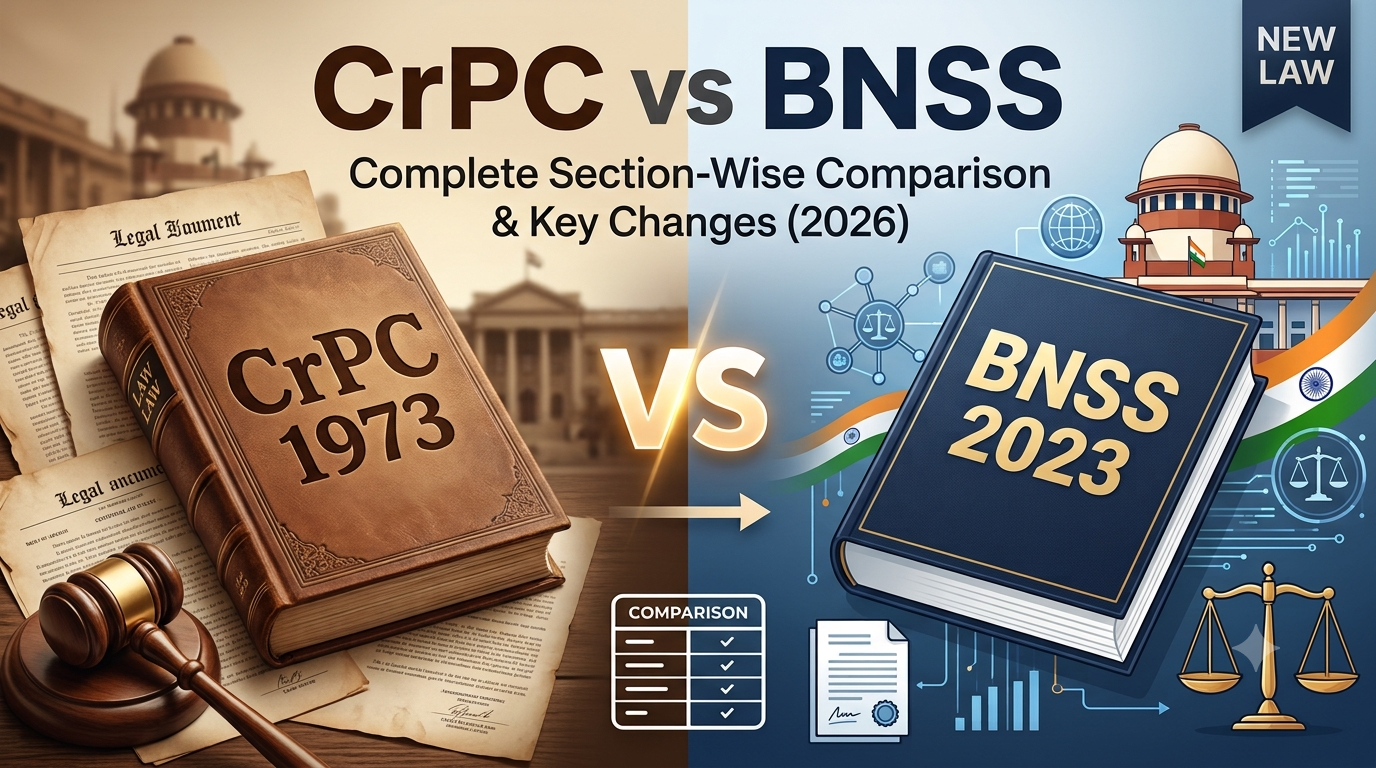
In 2023, the BNSS replaced the CrPC and modernized India’s criminal justice system — especially bail.
Here are the key changes that affect bail:
A. Arrest Becomes the Last Option (BNSS Section 35)
Police must record written reasons before arrest.
Arrest is allowed only if:
- Evidence may be destroyed
- Accused may abscond
- Witnesses might be influenced
- Crime is serious
- Accused is not cooperating
This reduces unnecessary arrests and increases fairness.
B. Notice of Appearance — A Major Reform
Instead of arrest, police can now issue a Notice of Appearance instructing the accused to appear before the IO.
Impact
✔ Reduces need for regular bail
✔ Prevents harassment
✔ Gives accused time to prepare
✔ Promotes transparency
C. Default/Statutory Bail Stronger Under BNSS
BNSS imposes strict deadlines on investigation.
If police fail to file the charge sheet on time → Default Bail becomes mandatory.
This is one of the strongest rights in the new system.
D. Victim Participation Mandated
In serious offences:
- Victim must be informed of bail hearing
- Court must hear victim’s objections
This increases transparency and fairness.
E. Police Accountability
Police must write:
- Why arrest was necessary
- Why notice was not enough
- What risk existed
This prevents misuse of power.
9. BNSS Bail System vs CrPC — Quick Table
| Old CrPC | BNSS 2023 |
| Arrest used frequently | Arrest is last resort |
| No notice requirement | Mandatory Notice of Appearance |
| Vague bail conditions | Clear, structured conditions |
| Slow investigations | Strict timelines |
| Weak default bail | Strong default bail |
| Victim rarely involved | Victim must be notified |
| Police discretion wide | Written justification required |
Conclusion
Today, Indian law recognises three primary Types of Bail:
- Regular Bail
- Anticipatory Bail
- Interim Bail
PAnd others like Default Bail, Statutory Bail, and Permanent Bail come along with it.
The BNSS 2023 bill has not only brought significant changes to the bail system but also prevented a large number of arrests, provided more openness, empowered the victims, and above all, faster investigation.
The new system ensures:
“First notice, then investigation, and arrest only when absolutely necessary.”
And it reinforces India’s constitutional philosophy: