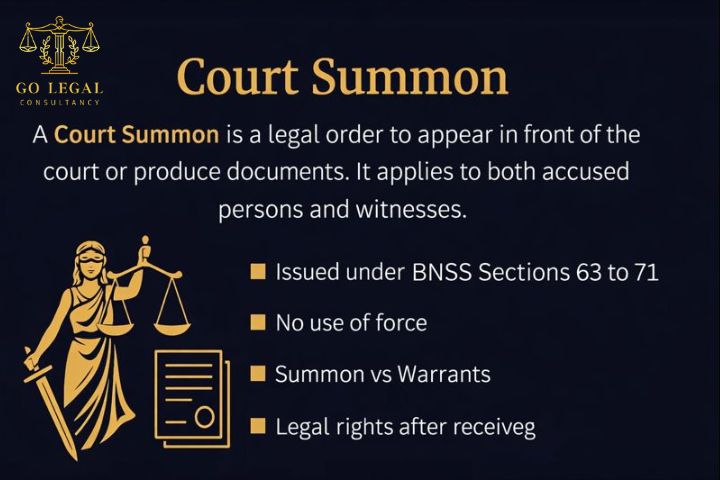
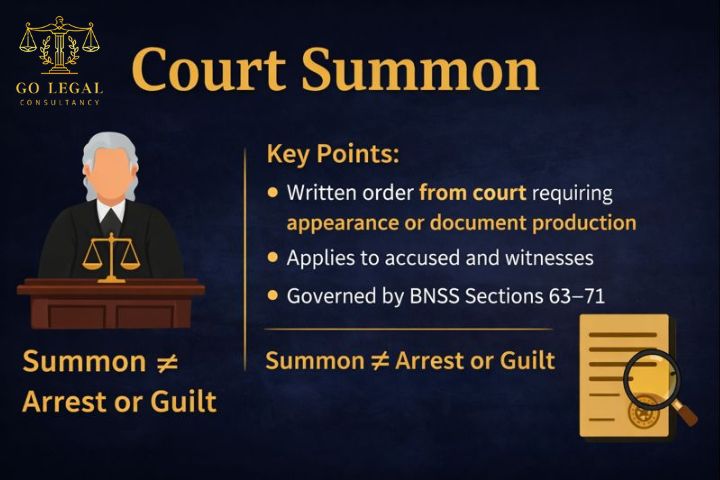
A Court Summon serves as a basic legal document which enables India to operate its criminal justice system. The document establishes formal contact between a court and a person whom the court requires to present themselves or their documents. The public experiences fear when they hear the term “summon” because they wrongly believe it leads to their arrest and punishment. A Court Summon functions as a legal document that requires people to appear in court without declaring their guilt. The Bharatiya Nagarik Suraksha Sanhita 2023 BNSS law establishes new regulations which describe how summons should be handled according to updated legal standards. Every citizen must acquire knowledge about the meaning of a Court Summon its reasons for being issued and the appropriate procedures for responding..
Meaning and Legal Concept of Court Summon
A Court Summon is a written order issued by a court requiring a person to:
- Appear before the court on a specified date and time, or
- Produce documents or evidence relevant to a legal proceeding
A Court Summon does not involve force and is issued when the court believes that the presence of a person can be secured without coercive measures. It applies to both accused persons and witnesses.
Court Summon Under Criminal Procedure Laws in India
Summon under CrPC / BNSS
Earlier, summons were governed by Sections 61 to 69 of the Criminal Procedure Code, 1973. With the enforcement of BNSS 2023, summons are now governed by:
Summon under BNSS 2023 – Sections 63 to 71
These provisions regulate:
- Form of summons
- Mode of service
- Compliance requirements
- Legal consequences of non-appearance
BNSS retains the core principles of CrPC while improving procedural clarity and accountability.
Court Summon Under BNSS 2023: Section-wise Explanation
Section 63 BNSS – Form of Summons
- A Court Summon must be in writing
- It must bear the seal of the court
- It must be signed by the presiding judicial officer
An unsigned or improperly issued summon has no legal validity.
Section 64–66 BNSS – Service of Summons
- Summons may be served personally
- It may be served to an adult family member if the person is unavailable
- In certain cases, electronic service is permitted
Section 67 BNSS – Service on Government Servants
- Service may be done through the head of the department
Section 69–71 BNSS – Proof and Compliance
- Proof of service is mandatory
- Court records compliance before proceeding further
These sections collectively ensure that a Court Summon is issued and served fairly.
Court Notice vs Summon: Key Differences
Many people confuse court notices with summons. The difference is crucial:
- Court notice: Informational or procedural communication
- Court Summon: Mandatory legal direction requiring compliance
Ignoring a notice may not always attract consequences, but ignoring a Court Summon can lead to legal action.
Summon Issued to Accused: What It Means
A summon issued to accused indicates that:
- The court has taken cognizance of an offence
- The accused’s presence is required to answer charges
Important points:
- It is not an arrest
- Bail is usually available
- Appearance is mandatory
The Court Summon allows the accused to participate in the legal process without immediate custody.
Summon Issued to Witness: Legal Duty to Cooperate
A summon issued to witness is issued when:
- The court believes the witness has material knowledge
- Testimony or documents are required
Witnesses are legally bound to comply with a Court Summon, and failure can attract penalties.
What to Do If Court Summon Received
If you receive a Court Summon, you should:
- Read the summon carefully
- Note the date, time, and court details
- Consult a legal professional immediately
- Appear before the court on the scheduled date
- Carry required documents
Never ignore a Court Summon, even if you believe it was issued mistakenly.
Legal Rights After Receiving Summon
Every person receiving a Court Summon has legal protections:
- Right to legal representation
- Right to seek exemption from personal appearance
- Right to receive a copy of the complaint or charge
- Right against self-incrimination
These legal rights after receiving a summon ensure procedural fairness.
Consequences of Ignoring Court Summon
Failure to comply with a Court Summon can result in serious consequences:
- Issuance of bailable or non-bailable warrant
- Monetary fines
- Proceedings under contempt of court
- Adverse inference by the court
The consequences of ignoring court summon are avoidable if timely compliance is ensured.
Importance of Court Summon in Criminal Justice
The Court Summon plays a vital role by:
- Ensuring participation without unnecessary arrest
- Protecting individual liberty
- Maintaining procedural discipline
- Preventing misuse of coercive powers
It reflects the balance between state authority and personal freedom.
Important Case Laws on Court Summon
| S. No. | Case Name & Year | Key Principle | Court Observation | Legal Significance |
| 1 | Pepsi Foods Ltd. v. Special Judicial Magistrate (1998) | Issuance of Court Summon is a serious judicial act | Magistrate must apply judicial mind; summoning cannot be routine or casual | Magistrate must examine complaint and evidence; mechanical summons illegal; protects individuals from unnecessary trials |
| 2 | Sunil Bharti Mittal v. CBI (2015) | Court Summon cannot be issued merely due to position or status | Criminal liability requires direct involvement or clear material | Personal role must be shown; prevents misuse of summoning power; ensures judicial accountability |
| 3 | Bhushan Kumar v. State (NCT of Delhi) (2012) | Summon can be issued if prima facie material exists | Court does not conduct a full trial at summoning stage | Limited inquiry required; detailed reasoning not mandatory; balances fairness and efficiency |
| 4 | Mehmood Ul Rehman v. Khazir Mohammad Tunda (2015) | Application of mind must reflect in summoning order | Summoning order must show consideration of material on record | Cryptic orders invalid; judicial reasoning mandatory; strengthens due process |
| 5 | Adalat Prasad v. Rooplal Jindal (2004) | Magistrate cannot recall summon once issued | Magistrate becomes functus officio after issuing summon | Remedy lies before higher courts; ensures procedural finality; prevents abuse |
| 6 | Mohd. Yousuf v. Afaq Jahan (2006) | Police investigation not mandatory before issuing summon | Summon can be issued on private complaint itself | Enhances judicial discretion; protects complainant rights; clarifies Magistrate’s authority |
| 7 | Inder Mohan Goswami v. State of Uttaranchal (2007) | Summon preferred over warrants | Coercive measures should be avoided unless necessary | Protects personal liberty; establishes proportionality; aligns with BNSS principles |
| 8 | Kewal Krishan v. Suraj Bhan (1980) | Summon without evidence is illegal | Issuing summon without material is abuse of process | Evidence must support summon; prevents harassment through false litigation |
Conclusion
A Court Summon is not a threat but a lawful call to participate in the justice system. Under Summon under BNSS 2023, especially Sections 63 to 71, the law clearly defines how summons are issued, served, and enforced. Whether it is a summon issued to accused or a summon issued to witness, compliance is a legal duty, supported by defined rights and safeguards.