The Bharatiya Nagarik Suraksha Sanhita (BNSS) 2023 has brought significant reforms in India’s criminal justice system. The Affidavit under BNSS functions as an essential legal document that provides transparency and accountability to judicial and administrative processes while maintaining its legal standing.
An affidavit is no longer just a formal document; it is a legally binding declaration that carries consequences for false statements, making it central to BNSS procedures. This article examines the Affidavit under BNSS as a legal document which establishes its importance for legal procedures and its application to both criminal and civil court cases..
Understanding Affidavit Under BNSS
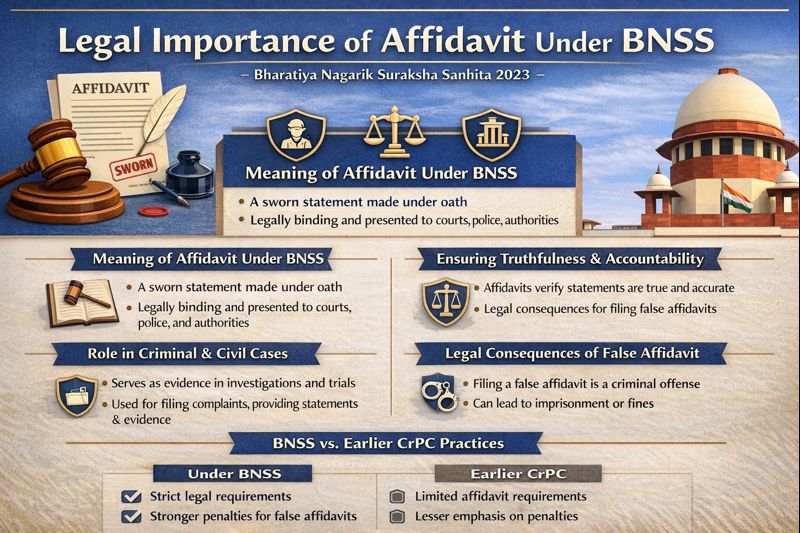
An affidavit under BNSS is a written declaration made under oath before a competent authority such as a judicial officer or notary. The declarant uses this document to declare that all information provided is true according to their best understanding.
Key aspects of Affidavit under BNSS include:
- Submission of truthful statements in judicial or administrative proceedings
- Verification of facts for legal authenticity
- Enforcement of accountability through legal consequences for false declarations
Legal Importance of Affidavit Under BNSS
The BNSS affidavit rules codify the necessity of affidavits in various stages of legal proceedings. The legal importance can be summarized as follows:
- Verification of Facts
A legal affidavit BNSS ensures that all statements presented are verified. This prevents disputes regarding authenticity and serves as evidence in court. - Judicial Accountability
Not only does the BNSS require statements to be made under oath, this assures that individuals, including witnesses and complainants, are legally accountable to the accuracy of their comments. - Deterrence Against False Claims
Filing a false affidavit is considered a criminal offense. This applies specifically to BNSS criminal case affidavits which can lead to serious consequences when false information is presented. - Court Evidence
Affidavits serve as acceptable evidence for all types of judicial trials which include civil cases and criminal cases and administrative matters. The BNSS court affidavit establishes essential proof that reinforces legal claims which support the ongoing petitions.
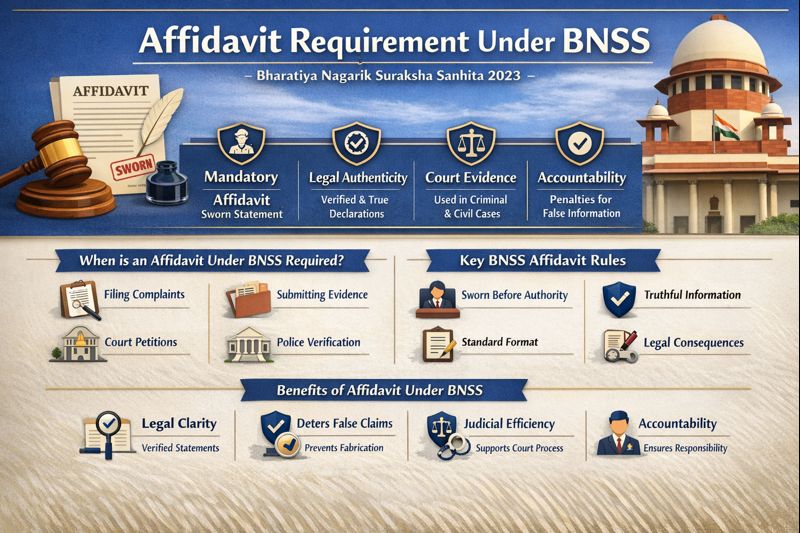
When is an Affidavit Required Under BNSS?
The Affidavit under BNSS is required in several legal situations:
- Filing Complaints: Guests need to have the license when booking a shuttle service.
- Submission of Evidence: In most cases, an affidavit BNS must be filed with the witness statements, expert opinions, and documentary proofs.
- Court Proceedings: In criminal or civil court, petitions, applications, or motions filed require a sworn affidavit in compliance with BNSS to proceed.
- Police Verification: The flow of affidavits goes in the light of confirming the statements or other things that a person witnesses or voices.
Mandatory Affidavit BNSS: Core Principles
The Mandatory affidavit BNSS is designed to ensure reliability and accountability. Key principles include:
- Truthfulness and Accuracy
It is declared by being under oath that all the statements given are correct, complete, and truthful. Any forgeries could be prosecuted. - Proper Jurisdiction
Affidavits must be submitted before competent authorities, such as judicial magistrates or notaries, in compliance with BNSS procedural requirements. - Standard Format
BNSS specifies a uniform format, including declarant details, facts, oath affirmation, signature, and date. - Legal Consequences
One can face imprisonment or a hefty fine in case of submitting bogus or fabricated affidavit BNSS or perjury.
How to Prepare an Affidavit Under BNSS
Preparing a valid affidavit under BNSS involves multiple steps:
- Step 1: Draft the Statement
The statement requires specific details which must be presented in an unambiguous manner. - Step 2: Include Declarant Details
The complete name, current age, full residential address, and relationship to the case must be provided. - Step 3: Swearing or Affirmation
The affidavit becomes legally valid when the person takes the oath before a judicial officer or notary. - Step 4: Sign and Date
The affidavit needs a signature and date from the signer who must also add a stamp if BNSS regulations require it - Step 5: Submission
The affidavit needs to be submitted to the correct court or authority for official recording purposes.
Role of Judicial Affidavit BNSS in Court
The judicial affidavit BNSS is essential in both criminal and civil cases:
- Criminal Cases
The BNSS affidavit serves as a verification tool for witness statements and complainant declarations and supporting evidence during both pretrial and trial proceedings in criminal cases. - Civil and Administrative Cases
The court affidavit BNSS functions as a tool to authenticate petitions, applications and claims because it establishes their legal validity.
BNSS Procedural Requirement and Compliance
Compliance with BNSS procedural requirement is crucial:
- The affidavit requirement must be followed because its violation will result in case delays and case dismissals.
- The act of submitting unverified statements creates liability for the declarant while it damages their credibility
- Courts rely on Mandatory affidavit BNSS to streamline processes and maintain legal authenticity.
Benefits of Affidavit Requirement BNSS
- Legal Clarity
Affidavits provide formal, verified documentation of statements and claims. - Deterrence Against Frivolous Claims
The legal requirement discourages false complaints or fabricated evidence. - Judicial Efficiency
Verified affidavits simplify proceedings by reducing disputes over authenticity. - Accountability and Transparency
Declarants are legally responsible for statements made under BNSS affidavit rules, ensuring transparency in legal proceedings.
Conclusion
The Affidavit under BNSS functions as an essential component of contemporary Indian legal systems. The requirement of judicial affidavit BNSS and affidavit for criminal cases BNSS mandates all parties to maintain honest conduct while meeting their.
The Mandatory affidavit BNSS and BNSS procedural requirements need to be understood and followed by citizens and legal professionals and governmental bodies. The Bharatiya Nagarik Suraksha Sanhita establishes processes which enable proper affidavit preparation and submission and verification to maintain efficient and fair and transparent legal operations.