The question of bail in sexual offence cases is one of the most sensitive and complex areas of Indian criminal law. The courts need to establish a specific balance which will protect both defendant rights and victim safety and dignity and legal rights. The alleged victim’s status as a minor makes this situation more difficult to manage.
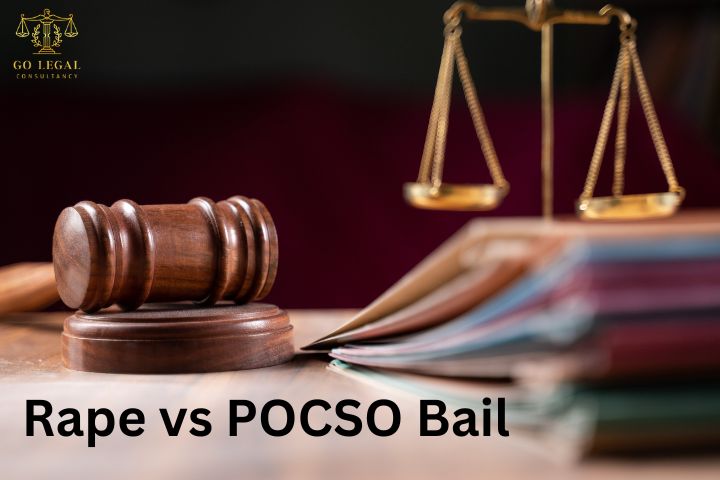
Bail outcomes get determined by the legal differences between rape cases and cases that fall under Protection of Children from Sexual Offences Act 2012 (POCSO). This article provides an extensive examination of Rape vs POCSO Bail through which it describes the legal requirements and judicial rules and security measures and the different ways that courts handle bail between these two legal systems.
Understanding the Concept of Bail in Sexual Offence Cases
Bail functions as a temporary release that permits an accused person to leave until their trial ends. The courts apply stricter examination standards which they use to assess sexual offence cases because of their severe nature.
Key considerations include:
- Gravity of the offence
- Nature of evidence
- Possibility of witness intimidation
- Protection of the victim
In Rape vs POCSO Bail, the presence of a minor victim drastically alters the legal threshold for bail.
Legal Framework: Rape and POCSO Offences
Rape under IPC / BNS
Rape is defined under Section 376 IPC / BNS Rape Offences. It criminalizes sexual acts committed without consent and prescribes severe punishments.
Key aspects:
- Consent plays a central role
- Adult victim cases allow factual examination of consent
- Punishment varies based on circumstances
POCSO Act
The POCSO Act creates a separate and stricter regime for sexual offences against children.
Key aspects:
- Victim must be below 18 years
- Consent is legally irrelevant
- Mandatory child-friendly procedures
This foundational difference is crucial in Rape vs POCSO Bail.
Consent as a Deciding Factor
Consent under POCSO Act
Under POCSO, consent has no legal value if the victim is a minor.
- Even voluntary participation does not dilute criminal liability
- Courts cannot assess consent as a mitigating factor
- This leads to Minor Victim Bail Restrictions
Rape Cases Involving Adults
In contrast:
- Consent can be examined
- Courts may assess contradictions, prior relationship, or conduct
- This sometimes affects bail outcomes
This is a major dividing line in Rape vs POCSO Bail jurisprudence.
Presumption of Guilt and Burden of Proof
Presumption of Guilt under POCSO
POCSO introduces a reverse burden of proof, meaning:
- Court presumes the accused is guilty
- Accused must disprove allegations during trial
This presumption significantly restricts bail.
Rape Cases
In rape cases:
- Presumption of innocence applies
- Prosecution must establish guilt
- Bail is evaluated on conventional criminal law principles
This distinction strongly impacts Rape vs POCSO Bail outcomes.
Criminal Procedure Differences
Criminal Procedure for POCSO Cases
POCSO mandates special procedures:
- Special Courts under POCSO Act
- In-camera trials
- Child-friendly testimony
- Time-bound investigation and trial
Procedure in Rape Cases
Rape cases follow general criminal procedure with certain safeguards, but without the mandatory rigidity of POCSO.
Stringency of Bail Conditions
Stringent Bail Conditions POCSO
Courts impose strict conditions such as:
- No contact with the victim or family
- Mandatory police reporting
- Travel restrictions
- Prohibition from entering victim’s locality
Rape Cases
Conditions may be comparatively flexible depending on facts.
This difference again reinforces why Rape vs POCSO Bail cannot be treated uniformly.
Role of Higher Judiciary
High Court Bail in POCSO Cases
High Courts exercise extreme caution:
- Bail is granted only in exceptional cases
- Delay in trial alone is insufficient
- Protection of child victim remains paramount
Rape Cases Before High Courts
High Courts may grant bail after evaluating:
- Medical evidence
- Statement inconsistencies
- Period of incarceration
Rights of Accused and Victim Protection
Rights of Accused in Rape Cases
Accused persons retain constitutional protections:
- Right to fair trial
- Right against arbitrary detention
- Right to legal representation
Victim Protection under POCSO Act
POCSO prioritizes:
- Psychological safety of child
- Identity protection
- Non-exposure to accused
Courts consciously tilt in favor of child protection while deciding Rape vs POCSO Bail.
Comparison Table: Rape vs POCSO Bail
| Aspect | Rape Bail | POCSO Bail |
| Victim Age | Usually adult | Minor below 18 |
| Consent | Legally relevant | Legally irrelevant |
| Presumption | Innocence | Reverse presumption |
| Courts | Regular criminal courts | Special Courts |
| Bail Threshold | Moderate to strict | Extremely strict |
| Victim Protection | Important | Paramount |
| Burden of Proof | Prosecution | Accused |
Judicial Approach in Practice
Courts consistently hold that:
- POCSO is a special statute
- Child protection overrides personal liberty
- Bail must not expose victim to trauma
This judicial philosophy dominates Rape vs POCSO Bail adjudication.
Case Law References
- State of Madhya Pradesh v. Madanlal (2015)
Supreme Court emphasized zero tolerance in sexual offences involving minors. - Satish v. State of Maharashtra (2021)
Clarified interpretation of sexual intent and victim protection. - X v. State of Telangana (2018)
Reaffirmed strict approach to bail in POCSO cases. - Mahipal v. Rajesh Kumar (2020)
Set principles governing appellate scrutiny of bail orders.
FAQs on Rape vs POCSO Bail
1. What is the core difference in Rape vs POCSO Bail?
The presence of a minor victim and statutory presumption under POCSO makes bail significantly stricter.
2. Can consent reduce liability under POCSO?
No. Consent under POCSO Act has no legal recognition.
3. Is bail completely barred under POCSO?
No, but it is granted only in rare and exceptional circumstances.
4. Are Special Courts mandatory in POCSO cases?
Yes, Special Courts under POCSO Act are compulsory.
5. Do accused persons lose all rights under POCSO?
No. Fundamental rights remain, but are balanced against child protection.
Conclusion
The legal distinction between Rape vs POCSO Bail shows more than technical differences because it demonstrates how legislators and judges try to defend minors against sexual exploitation. Judicial systems in rape cases assess both consent and actual situation details whereas POCSO cases follow strict rules that protect children above all other considerations.
People need to comprehend these distinctions because they matter for lawyers, students and citizens. Society uses bail procedures in sexual offence cases to demonstrate its commitment to both justice and human dignity which it considers essential moral and constitutional duties.