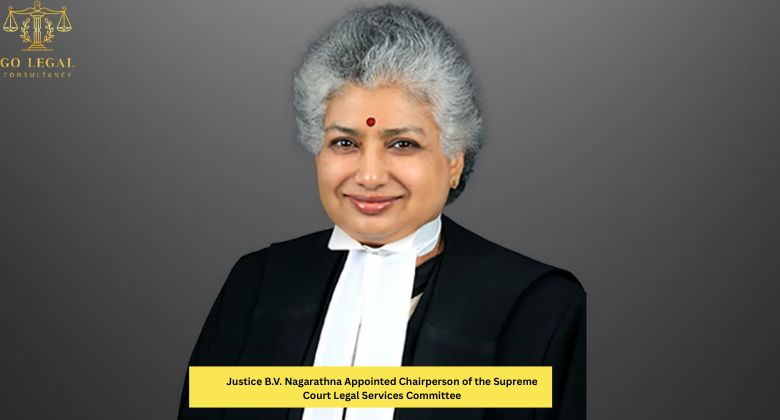
In a development that carries both symbolic weight and practical significance for access to justice in India, the Chief Justice of India (CJI) has nominated Justice Bangalore Venkataramiah (B.V.) Nagarathna, a sitting judge of the Supreme Court, as the Chairperson of the Supreme Court Legal Services Committee (SCLSC). The appointment takes effect from 29 June 2026 and comes in the wake of the retirement of Justice J.K. Maheshwari, who previously headed the Committee. The move reaffirms a well-established convention in the Indian judiciary and simultaneously places one of the country’s most closely watched judges at the helm of the institution charged with delivering free legal aid at the apex court.
With Justice B.V. Nagarathna appointed Chairperson of the Supreme Court Legal Services Committee (SCLSC), the apex legal aid institution enters a new phase of leadership focused on strengthening access to justice and ensuring free legal representation for eligible citizens before the Supreme Court.
Why Justice B.V. Nagarathna’s Appointment as SCLSC Chairperson Matters
The chairpersonship of the SCLSC is not an ordinary administrative posting. By long-standing tradition, the third most senior judge of the Supreme Court is nominated to lead the Committee. Justice Nagarathna’s elevation to this role therefore reflects her position in the Court’s order of seniority as much as it recognises her stature as a jurist. Her tenure at the head of the Committee links her directly to the constitutional promise contained in Article 39A of the Constitution, which directs the State to ensure that the legal system promotes justice on a basis of equal opportunity and that no citizen is denied access to justice because of economic or other disabilities.
The timing of the appointment is also notable. Justice Nagarathna is on a trajectory that is expected to make her the first woman Chief Justice of India in 2027. Her nomination as SCLSC Chairperson adds another significant institutional responsibility to her portfolio at a moment when she is increasingly seen as a defining figure of the contemporary Supreme Court.
Who Is Justice B.V. Nagarathna
Justice Nagarathna was born on 30 October 1962. She belongs to a family with deep judicial roots: her father, Justice E.S. Venkataramiah, served as the Chief Justice of India in 1989. She began her legal practice in 1987 and moved to independent practice in 1994, building expertise across constitutional, administrative, commercial and family law. Her judicial career began in 2008 with her appointment as an additional judge of the Karnataka High Court, where she was made a permanent judge in 2010. She was elevated to the Supreme Court of India on 31 August 2021.
During her time on the Supreme Court, Justice Nagarathna has participated in several Constitution Bench matters and has earned a reputation for independent reasoning and thoughtful, sometimes solitary, dissents. She is widely projected to become the 55th Chief Justice of India, and the first woman to hold that office, with a tenure expected in the latter part of 2027. Against this backdrop, her stewardship of the SCLSC is being read as an important chapter in a career that already carries considerable historical significance.
Justice B.V. Nagarathna: Career Timeline
| Year | Milestone |
| 1987 | Began legal practice |
| 1994 | Started independent legal practice |
| 2008 | Appointed Additional Judge of Karnataka High Court |
| 2010 | Became Permanent Judge of Karnataka High Court |
| 31 August 2021 | Elevated to the Supreme Court of India |
| 29 June 2026 | Appointed Chairperson of the Supreme Court Legal Services Committee |
| 2027 (Expected) | Likely to become India’s first woman Chief Justice |
What Is the Supreme Court Legal Services Committee (SCLSC)?
The Supreme Court Legal Services Committee operates under the framework of the Legal Services Authorities Act, 1987. The Committee was constituted under Section 3A of that Act, which provides that the National Legal Services Authority (NALSA) shall establish a committee for the Supreme Court. Its core mandate is to provide free and competent legal services to eligible persons in matters that fall within the jurisdiction of the Supreme Court.
In practical terms, the Committee receives and processes applications for legal aid, assesses eligibility, and appoints legal services advocates to represent beneficiaries in deserving cases. For a litigant who wishes to approach the highest court but lacks the financial means to engage a lawyer, the SCLSC is often the single most important gateway. It ensures that the right to be heard before the Supreme Court is not effectively reserved for those who can afford it.
Functions of the Supreme Court Legal Services Committee
The Supreme Court Legal Services Committee performs several important functions. It receives applications for free legal aid, verifies the eligibility of applicants under the Legal Services Authorities Act, 1987, appoints advocates to represent eligible litigants before the Supreme Court, and ensures that economically weaker and disadvantaged sections receive effective legal assistance. Through these responsibilities, the Committee helps fulfil the constitutional mandate of equal access to justice under Article 39A. With Justice B.V. Nagarathna as Chairperson of the Supreme Court Legal Services Committee, these functions are now carried forward under the guidance of a judge known for her strong commitment to constitutional values.
Composition of the Committee
The SCLSC is chaired by a sitting judge of the Supreme Court, who is nominated by the Chief Justice of India. Alongside the Chairperson, the Committee includes members who possess the experience and qualifications prescribed by the Central Government, and these members are also nominated by the CJI. Rule 10 of the NALSA Rules, 1995 sets out the number of members and the experience and qualifications they must hold. The CJI is empowered to appoint the Secretary of the Committee, and the Committee may in turn appoint officers and other employees in the manner prescribed, in consultation with the CJI. This structure keeps the Committee firmly within the supervisory reach of the Court’s leadership while allowing it to function as a dedicated legal-aid body.
The Broader Legal Aid Architecture
The SCLSC does not operate in isolation. It sits at the apex of a nationwide legal services network established by the 1987 Act. At the top is NALSA, headed by the sitting senior-most judge of the Supreme Court after the CJI, who serves as its Executive Chairman, while the CJI is the Patron-in-Chief. Below NALSA are the State Legal Services Authorities, District Legal Services Authorities, and Taluk Legal Services Committees, each mirroring the goal of taking legal aid to the grassroots. High Court Legal Services Committees perform a role at the High Court level that parallels what the SCLSC does at the Supreme Court. Together, this pyramid of institutions gives concrete shape to Article 39A and to the statutory objective of ensuring that justice is not denied on account of poverty or disadvantage.
Why This Appointment Matters
Free legal aid is frequently described as one of the quieter but most consequential functions of the Indian judicial system. Millions of citizens are unaware of their entitlements or lack the resources to pursue them, and the SCLSC is one of the mechanisms that translates constitutional guarantees into real representation before the highest court. The choice of who leads it therefore shapes the tone, priorities and responsiveness of legal aid at the apex level.
The naming of Justice B.V. Nagarathna as Chairperson of the Supreme Court Legal Services Committee carries several layers of significance. First, it maintains institutional continuity: by adhering to the convention that the third senior-most judge heads the Committee, the judiciary preserves a predictable and merit-linked succession. Second, her known emphasis on constitutional values and equal access aligns naturally with the SCLSC’s mission. Third, the appointment of a judge widely expected to become the first woman CJI to lead the country’s premier legal-aid committee sends an encouraging signal about representation and about the priority placed on access to justice.
For litigants, the practical takeaway is continuity of service. The Committee will continue to receive applications, evaluate eligibility and appoint advocates, now under the guidance of a Chairperson with a strong record on constitutional questions. For the wider legal community, the appointment is a reminder that legal aid remains an integral part of the Court’s institutional identity, not a peripheral concern.
Legal Basis of the Supreme Court Legal Services Committee
The Supreme Court Legal Services Committee functions under Section 3A of the Legal Services Authorities Act, 1987, which authorises the National Legal Services Authority (NALSA) to constitute a dedicated legal services committee for the Supreme Court. The Committee operates in furtherance of Article 39A of the Constitution of India, ensuring that access to justice is not denied because of financial or social disadvantages.
Looking Ahead
The appointment of Justice B.V. Nagarathna as Chairperson of the Supreme Court Legal Services Committee reflects the judiciary’s continued commitment to strengthening access to justice in India. As the SCLSC continues to provide free legal aid to eligible litigants before the Supreme Court, Justice Nagarathna’s leadership is expected to reinforce the Committee’s constitutional mission under Article 39A. With her widely anticipated elevation as the first woman Chief Justice of India in 2027, this appointment marks another significant milestone in her distinguished judicial career and in India’s legal aid framework.
Frequently Asked Questions (FAQs)
Q1. Who has been appointed Chairperson of the Supreme Court Legal Services Committee? Justice B.V. Nagarathna has been appointed Chairperson of the Supreme Court Legal Services Committee (SCLSC). She is a sitting judge of the Supreme Court of India and assumed the position with effect from 29 June 2026.
Q2. From when is the appointment effective? The appointment takes effect from 29 June 2026.
Q3. Why did this vacancy arise? The position became vacant following the retirement of Justice J.K. Maheshwari, who previously headed the Committee.
Q4. Who appoints the Chairperson of the SCLSC? The Chairperson is nominated by the Chief Justice of India. By convention, the third most senior judge of the Supreme Court heads the Committee.
Q5. Under which law does the SCLSC function? The SCLSC operates under the Legal Services Authorities Act, 1987, and was constituted under Section 3A of that Act by the National Legal Services Authority (NALSA).
Q6. What is the main function of the SCLSC? It provides free and competent legal services to eligible persons in cases before the Supreme Court, processes legal-aid applications, and appoints advocates for deserving beneficiaries.
Q7. Who is Justice B.V. Nagarathna? Born on 30 October 1962, she was elevated to the Supreme Court on 31 August 2021 after serving on the Karnataka High Court. Her father, Justice E.S. Venkataramiah, was Chief Justice of India in 1989.
Q8. Why is her appointment considered historic? Justice Nagarathna is widely projected to become the first woman Chief Justice of India in 2027, making her leadership of the country’s apex legal-aid committee especially significant.
Q9. How does the SCLSC fit into India’s legal aid system? It sits at the top of a nationwide network that includes NALSA, State and District Legal Services Authorities, Taluk Legal Services Committees, and High Court Legal Services Committees, all working to fulfil the mandate of Article 39A.
Q10. Who can benefit from the SCLSC’s services? Persons who are eligible under the Legal Services Authorities Act, 1987 — including those from weaker and economically disadvantaged sections — can seek free legal representation in Supreme Court matters.