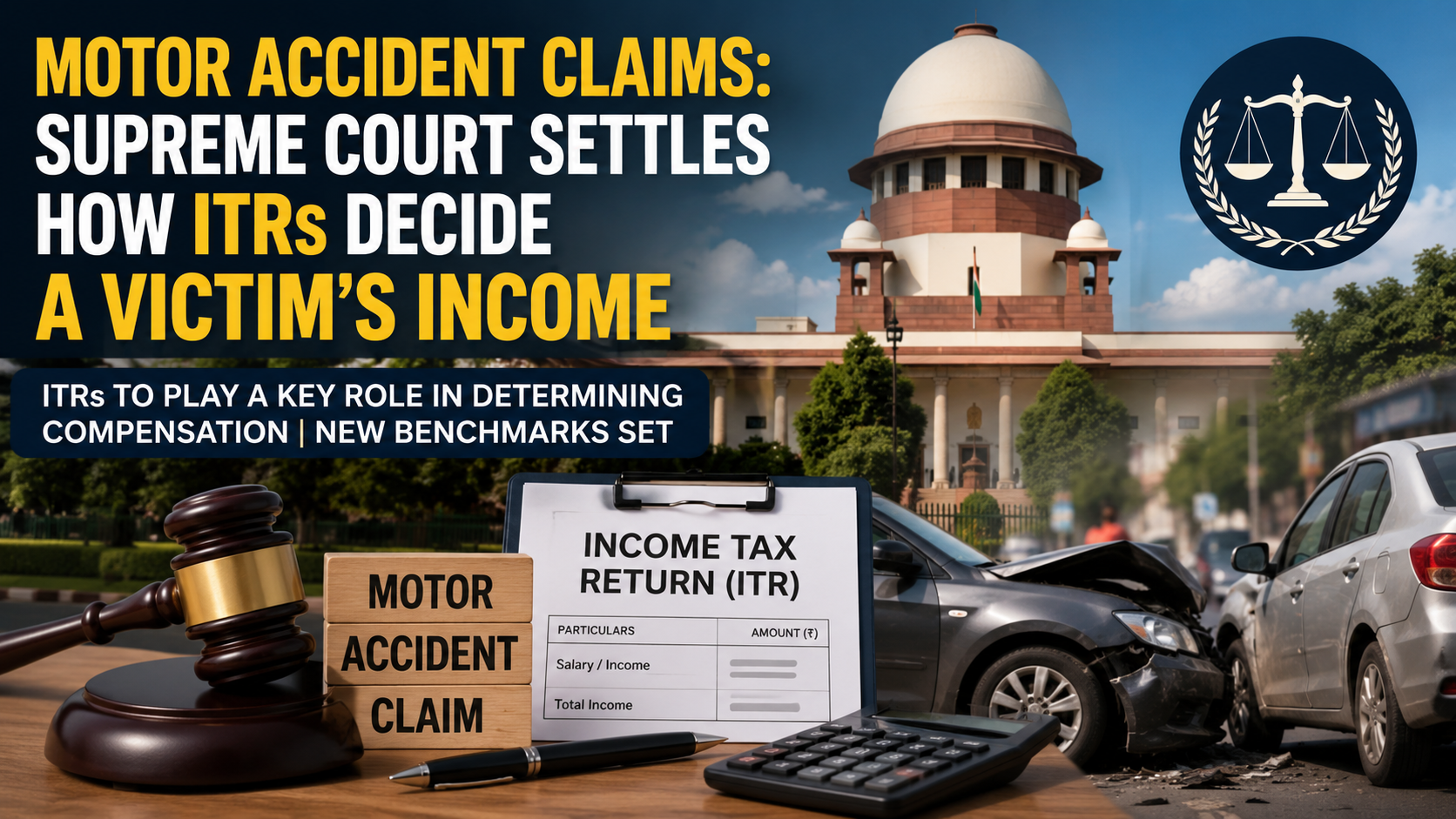
Deciding how much compensation a motor accident victim’s family deserves always turns on one hard question — how much did the person actually earn? For years, tribunals across India answered that question in different ways, especially when income tax returns (ITRs) were on record. Some relied on the latest return, some averaged several years, and some ignored the returns altogether. The result was uneven awards for similar losses.
The Supreme Court has now closed that gap. In Rashmirekha Tripathy & Anr. v. The Branch Manager (Legal Claims), Shriram General Insurance Company Limited & Ors., a Bench of Justice Sanjay Karol and Justice Nongmeikapam Kotiswar Singh laid down clear guidelines on using ITRs to assess a victim’s annual income. The core idea is simple but important: a salaried worker and a self-employed businessperson cannot be judged by the same yardstick.
Why the Court Stepped In
Under the Motor Vehicles Act, 1988, compensation in a fatal accident case depends heavily on the deceased’s annual income. Once that figure is fixed, the tribunal applies deductions for personal expenses, adds a percentage for future prospects, and multiplies the balance using an age-based multiplier. Everything flows from the starting number. If the income figure is wrong, the entire award is wrong.
The problem was consistency. When ITRs were available, tribunals had no settled rule on which year to trust. A family with three years of returns might see their claim decided on the weakest year. A businessperson who filed a single loss-making return might be treated as though they earned almost nothing. The Court wanted to remove this guesswork and bring uniformity to income calculation.
To do that, it accepted the assistance of two amici curiae — Senior Advocate J.R. Midha and Advocate Salil Paul — who recommended separate methods for the two categories of earners. The Bench agreed and built its guidelines around that distinction.
The Rule for Salaried Employees
For a person drawing a salary, the Court held that the income tax return of the immediately preceding assessment year should ordinarily be treated as the correct measure of annual income.
The reasoning is practical. A salaried person’s earnings usually move in one direction — upward. Promotions, increments, and revised pay all show up in the most recent return. By the time of the accident, the latest ITR captures the salary the person was actually drawing, along with the financial effect of any recent promotion. Looking further back would understate what the family truly lost.
In the Court’s words, only the last year needs to be considered because “the monetary effect of a promotion is quite significant and can be reflected only in the ITR of that year.” A single recent return therefore paints the most accurate picture of earning capacity for a salaried worker.
The Bench also anticipated a common gap. Sometimes a person is promoted shortly before the accident and has not yet completed a full year on the new post, or has not filed a return covering that period. In such cases, the tribunal is not left helpless. It can rely on the promotion letter and other supporting financial statements to establish the higher income the person had begun to earn. The absence of a return for the latest period does not force the court to fall back on outdated figures.
The Rule for Self-Employed Persons and Business Owners
The Court was clear that the salaried formula cannot fit those who run their own business or profession. Their income rarely follows a straight line. Market conditions, business cycles, and investment decisions push earnings up and down from year to year. A single return, good or bad, can be misleading.
For this group, the Bench held that the tribunal should ordinarily take the average of the income declared in the ITRs of the last three years as the reference point. Averaging smooths out the natural fluctuation and produces a fairer estimate of what the person consistently earned. The Court added that the facts of each case must still be weighed, so the three-year average is a strong starting rule rather than a rigid ceiling.
When Only One or Two Returns Exist
Many self-employed people file returns for only a year or two before an accident, which makes averaging impossible. The Court addressed this directly. Where the record is thin, the tribunal must look at the surrounding circumstances of the business before fixing income. The Bench listed the factors to examine:
- Nature of the business, including its geographical location and category.
- The way the business was growing, and the impact the person’s death had on it.
- The potential for future growth, since some ventures are capital-heavy at the start but become highly profitable at scale or over time.
- Negative income, because certain businesses record losses in their early years that do not reflect the person’s true financial standing.
- Any other relevant factor connected to the business.
This list matters most for young entrepreneurs and start-up owners. Without it, an early loss or a modest first return could wrongly brand a promising business as worthless. By directing tribunals to study the trajectory of the venture rather than a single figure, the Court protects families who lost a breadwinner still in the building phase of their enterprise.
How the Guidelines Fit the Larger Compensation Framework
These guidelines do not replace the established method of calculating motor accident compensation; they sharpen its first step. Once the annual income is fixed using the ITR rules above, the tribunal continues with the settled process laid down in earlier Constitution Bench and larger Bench rulings.
The income figure is first raised by a percentage for future prospects, recognising that earnings would likely have grown had the person lived. A deduction for personal and living expenses is then made, based on the number of dependants. The remaining annual dependency is multiplied by an age-based multiplier to arrive at the loss of dependency. Finally, fixed conventional heads such as loss of estate, loss of consortium, and funeral expenses are added.
By standardising how the base income is drawn from ITRs, the judgment makes this entire chain more predictable. Two families who suffered similar losses are now far more likely to receive similar awards, regardless of which tribunal hears the claim.
Why This Judgment Matters
The ruling carries real weight for accident victims and their families. It removes the uncertainty that once hung over income calculation and replaces it with a transparent, reasoned method. Salaried families gain from the latest-year rule, which reflects promotions and raises. Business families gain from the three-year average and the circumstance-based approach, which shields them from being judged on a single bad year.
For insurers, the guidelines bring discipline and reduce arbitrary claims. For tribunals, they offer a clear roadmap that cuts down on litigation over the basic income figure. And for the justice system as a whole, they advance the goal that has always driven motor accident law — awarding just and fair compensation rather than a number that changes from courtroom to courtroom.
The decision reflects a careful balance. It trusts ITRs as reliable evidence of income, yet it refuses to let a rigid reading of a single return defeat a genuine claim. In doing so, the Court has given families, lawyers, and insurers a settled answer to a question that troubled motor accident litigation for far too long.
Frequently Asked Questions (FAQs)
1. Which ITR is used to assess a salaried victim’s income? The income tax return of the immediately preceding assessment year, because it reflects the latest salary, promotions, and increments.
2. How is a self-employed person’s income calculated? By averaging the income shown in the ITRs of the last three years, while considering the facts of each case.
3. What if a promoted employee had no ITR for the new post? The tribunal can rely on the promotion letter and other supporting financial statements to fix the higher income.
4. What happens if only one or two ITRs are available for a businessperson? The tribunal must look at surrounding circumstances, such as the nature of the business, its growth, its future potential, and any early losses.
5. Who decided this case? A Supreme Court Bench of Justice Sanjay Karol and Justice Nongmeikapam Kotiswar Singh, in Rashmirekha Tripathy & Anr. v. Shriram General Insurance Company Ltd. & Ors.
6. Does this change how the final compensation is calculated? No. It only standardises the starting income figure. Future prospects, personal-expense deductions, and the multiplier method still apply as before.
7. Why did the Court treat salaried and self-employed persons differently? Salaried income rises steadily and shows fully in the latest return, while self-employed income fluctuates, so an average gives a fairer picture.