
The Bharatiya Nagarik Suraksha Sanhita, 2023 (BNSS), which came into effect by annulment of the Criminal Procedure Code (CrPC), has made the biggest change in India’s arrest laws. Among them, the most remarkable change is that without this warrant, there is still limited arrest which creates the area of arrest where the public often gets confused and the power is easily misused.
This article will break down the BNSS rules of arrest for you, mainly talking about the scenarios under which the police can arrest without warrant, the protective measures that the law provides, and the things that every citizen should know.
Why Arrest Laws Needed Change
Under the old CrPC, arrests were often made even when not necessary. The Supreme Court repeatedly criticized unnecessary arrests, especially in minor offences.
BNSS 2023 now focuses on:
✔ Reducing unnecessary arrests
✔ Protecting personal liberty
✔ Increasing accountability
✔ Ensuring transparency in police procedures
BNSS Sections on Arrest Without Warrant
| BNSS Section | What It Deals With |
| Section 35 | When police can arrest without warrant |
| Section 36 | Procedure of arrest (rights + duties) |
| Section 37 | Notice of appearance instead of arrest |
| Section 173 | Obligations after arrest (medical exam, custody) |
| Section 176 | Rights of arrested person + information to family |
1. Section 35 BNSS — Arrest Without Warrant (Most Important Section)
Section 35 is the heart of the arrest rules under BNSS.
It defines when the police can arrest a person without needing a court warrant.
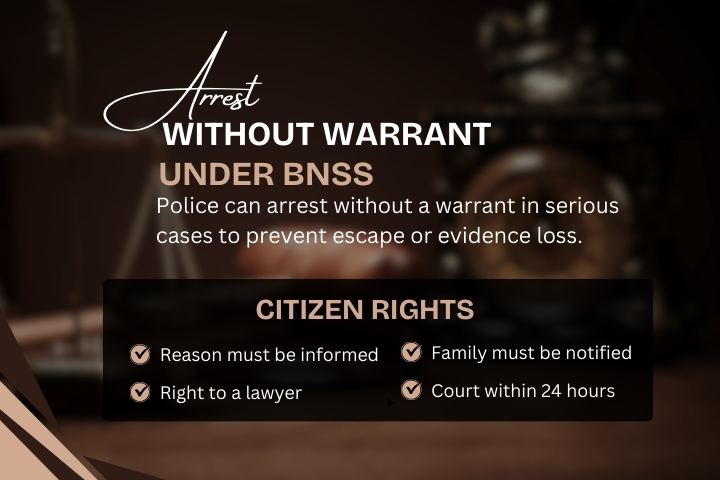
Police can arrest without warrant in these situations:
A. Arrest for Cognizable Offences
If a person is accused of a cognizable offence, the police can arrest without warrant.
⮞ Cognizable offences include:
- Murder
- Rape
- Dowry death
- Kidnapping
- Serious fraud
- Serious assaults
- Cyber offences causing major loss
But BNSS adds extra safeguards even in these cases.
B. Police Must Record Written Reasons for Arrest
Under BNSS, arrest cannot be made automatically.
The officer must write:
✔ why arrest is necessary
✔ why notice (Section 37) cannot be used
✔ why detention is required for investigation
⚠ Without written reasons → arrest becomes illegal.
C. Police Must Consider Less Intrusive Options
Before arresting, police must consider:
- issuing notice
- asking for cooperation
- checking if the person is likely to escape
- verifying criminal history
- likelihood of destroying evidence
This prevents “casual arrests.”
D. Mandatory Arrest in Serious Crimes
Arrest becomes mandatory if:
- offence is punishable with 7+ years imprisonment
- suspect tries to escape
- suspect threatens witnesses
- suspect refuses to cooperate
2. Section 37 BNSS — Notice of Appearance (Major Reform)
Instead of arrest, police must issue a Notice of Appearance for offences punishable up to 3 years.
✔ This is a written notice ordering the person to visit the police station at a fixed time.
✔ If the person cooperates, no arrest can be made.
✔ If the person refuses to cooperate, THEN police may arrest.
This protects citizens from unnecessary arrests in minor offences like:
- simple hurt
- defamation
- minor fraud
- small property disputes
When Police Must Use Notice Instead of Arrest
| Offence Punishment | Can Police Arrest? | Rule |
| Up to 3 years | No | Section 37 notice must be issued |
| 3–7 years | Yes (with written reasons) | Section 35 + written justification |
| 7+ years | Mandatory | Serious offences → arrest required |
3. Section 36 BNSS — Procedure During Arrest
BNSS ensures the arrest is done legally, safely, and transparently.
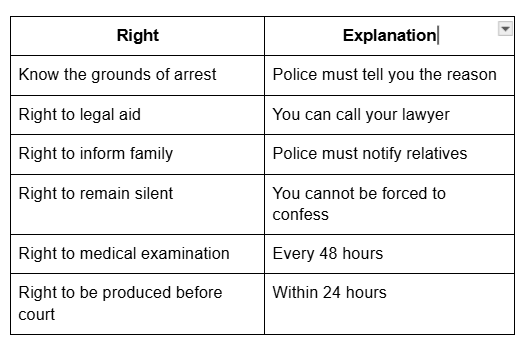
Police must:
✔ Identify themselves (name & badge)
✔ Inform the accused of the reason for arrest
✔ Inform family/relatives within 12 hours
✔ Prepare an arrest memo signed by:
- accused
- one witness
- police officer
✔ Conduct medical examination every 48 hours
✔ Produce accused before Magistrate within 24 hours
Failure to follow these → illegal arrest.
4. Major Changes in Arrest Rules Under BNSS
| Topic | Old CrPC | New BNSS |
| Notice of appearance | Optional | Mandatory for offences ≤3 years |
| Written reasons for arrest | Not strictly enforced | Compulsory |
| Accountability | Low | High – Reasons must be recorded |
| Protection of rights | Limited | More rights + information to family |
| Focus | Arrest first | Investigation first, arrest only if needed |
5. New Protections for Citizens Under BNSS
✔ No arrest for minor offences
- Police CANNOT arrest for offences under 3 years punishment unless absolutely necessary.
✔ Arrest only as a last resort
- BNSS promotes liberty, not arrest.
✔ Mandatory family notification
- The family must be informed within 12 hours.
✔ Arrest cannot be hidden
- All arrest details must be uploaded to the digital system.
✔ Safeguard against misuse in matrimonial disputes
Police must evaluate:
- intent
- cooperation
- risk factors
- before arrest.
6. When Police CAN Arrest You Without a Warrant
Police can arrest without warrant if:
- You are caught committing a cognizable offence
- You are likely to run away
- You threaten witnesses
- You destroy or hide evidence
- You refuse to follow a Section 37 notice
- Offence is punishable with more than 7 years
7. When Police CANNOT Arrest You Without Warrant
Police cannot arrest you if:
- Offence punishable ≤ 3 years
- You follow the notice & cooperate
- No written reasons justifying arrest
- It is a civil dispute (business, property, cheque disagreements)
- They need a warrant (non-cognizable offences)
Citizen Rights During Arrest
8. What To Do If You Face Illegal Arrest
If arrested illegally:
✔ Ask for the written reason for arrest
✔ Ask for copy of the arrest memo
✔ Inform family immediately
✔ Demand immediate presentation before Magistrate
✔ Apply for bail based on the offence category
✔ File complaint to:
- Magistrate
- Police Superintendent
- Human Rights Commission
FAQs
1. Is it possible that the police make arrests without a warrant according to BNSS?
In that case, yes, however, only in the case of cognizable offences, and with very strict conditions which are provided in Section 35.
2. Which section of BNSS relates to warrantless arrests?
It is Section 35.
3. Is it mandatory to provide notice prior to an arrest?
Yes! It requires that misdemeanors be the maximum penalty abducted with only three years (Section 37).
4. What will be the consequences if I ignore the notice?
You will be arrested by the police.
5. Are the police allowed to make arrests after dark?
Sure, but with certain safeguards especially in the case of women.
6. Is it a must to have a lawyer during the arrest?
Sure, you have the privilege of calling a lawyer right away.