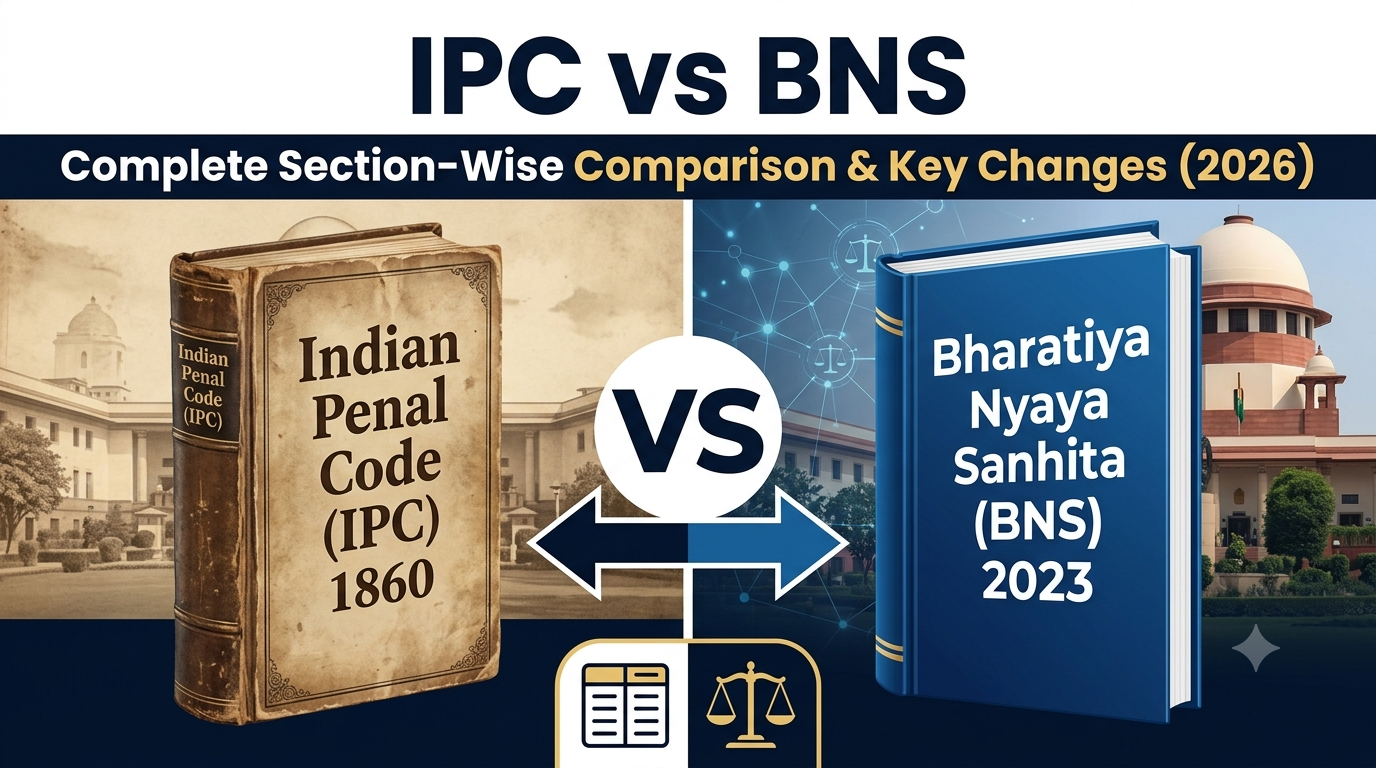
For over 160 years, the Indian Penal Code, 1860 (IPC) served as the backbone of criminal law in India. On 1 July 2024, it was replaced by the Bharatiya Nyaya Sanhita, 2023 (BNS). Since then, one question comes up again and again from students, lawyers, and ordinary citizens alike — what changed, and where did my old IPC section go? This IPC vs BNS guide answers both, with a clear section-wise mapping table and a simple breakdown of the key changes.
IPC vs BNS: What Actually Changed?
The IPC had 511 sections. The BNS trims and reorganises the law into 358 sections. Most offences remain the same in substance — murder is still murder, theft is still theft — but the section numbers have changed, some provisions were merged, a few were dropped, and several new offences were added.
Three shifts stand out in the IPC vs BNS comparison:
- New offences added — the BNS introduces specific provisions for organised crime, terrorism, and mob lynching, which the IPC never covered directly.
- Sedition reframed — the old sedition offence (Section 124A IPC) is gone. In its place, Section 152 BNS punishes acts that endanger the sovereignty, unity, and integrity of India.
- Community service introduced — for the first time, community service is recognised as a form of punishment for certain minor offences.
IPC vs BNS Section Mapping Table
The table below maps the most searched and most important IPC sections to their new BNS equivalents. Keep it handy as a quick reference.
| Offence | Old Law (IPC 1860) | New Law (BNS 2023) |
| Common intention | Section 34 | Section 3(5) |
| Criminal conspiracy | Section 120A / 120B | Section 61 |
| Acts endangering sovereignty (old sedition) | Section 124A | Section 152 |
| Promoting enmity between groups | Section 153A | Section 196 |
| Culpable homicide | Section 299 | Section 100 |
| Murder (definition) | Section 300 | Section 101 |
| Punishment for murder | Section 302 | Section 103 |
| Culpable homicide not amounting to murder | Section 304 | Section 105 |
| Death by negligence | Section 304A | Section 106 |
| Dowry death | Section 304B | Section 80 |
| Abetment of suicide | Section 306 | Section 108 |
| Attempt to murder | Section 307 | Section 109 |
| Voluntarily causing hurt | Section 323 | Section 115 |
| Grievous hurt by dangerous weapons | Section 326 | Section 118 |
| Assault on a woman (outraging modesty) | Section 354 | Section 74 |
| Kidnapping | Section 363 | Section 137 |
| Rape (definition) | Section 375 | Section 63 |
| Punishment for rape | Section 376 | Section 64 |
| Cruelty by husband or relatives | Section 498A | Section 85 |
| Theft | Section 379 | Section 303 |
| Robbery | Section 392 | Section 309 |
| Dacoity | Section 395 | Section 310 |
| Criminal breach of trust | Section 406 | Section 316 |
| Cheating | Section 420 | Section 318 |
| Mischief | Section 425 | Section 324 |
| Criminal trespass | Section 441 | Section 329 |
| Defamation | Section 500 | Section 356 |
| Criminal intimidation | Section 506 | Section 351 |
Note: The BNS reorganises the entire code, so a single IPC section may map to more than one BNS sub-section. Always read the full provision for exact wording.
Key Differences Between IPC and BNS
1. Structure and Numbering
The IPC was arranged in a specific order built up over decades of amendments. The BNS regroups offences more logically — for example, crimes against women and children are brought together earlier in the code. This is why familiar numbers like 302 and 420 now sit at 103 and 318.
2. Crimes Against Women and Children
The BNS gives these offences priority placement and adds tougher provisions in several areas. Gang rape of a minor and certain sexual offences carry stricter punishment, and the section on cruelty by a husband or his relatives continues under Section 85 BNS.
3. New-Age and Organised Crime
The IPC had no dedicated section for organised crime or terrorism; these were handled through special laws. The BNS brings them into the main criminal code through Sections 111 and 113, and it also creates a specific provision punishing mob lynching.
4. Sedition Replaced
Perhaps the most debated change in the IPC vs BNS shift is the removal of the word “sedition.” Section 124A IPC is gone. Section 152 BNS instead targets acts that threaten the sovereignty, unity, and integrity of the nation, with the language redrawn to focus on genuine threats to the State.
5. Community Service as Punishment
The BNS formally recognises community service as a punishment for minor offences such as petty theft or public misconduct. This is a first for Indian criminal law and reflects a move toward reformative justice.
Does the IPC Still Apply in 2026?
Yes, but only to old cases. Any offence committed before 1 July 2024 is still tried under the IPC, because criminal law is not applied retrospectively. Every offence committed on or after 1 July 2024 falls under the BNS. This is why courts, police, and lawyers currently work with both codes side by side, and why understanding the IPC vs BNS mapping remains essential for years to come.
Why This Comparison Matters
For a law student, the mapping is exam-critical. For a practising advocate, quoting the correct BNS section is now a daily requirement. For an ordinary citizen, knowing that “Section 420” is now “Section 318” helps in reading an FIR or understanding a case. The IPC vs BNS transition is not just a change of numbers — it is a modernisation of India’s criminal justice framework, and staying updated is the safest way to protect your rights.
Frequently Asked Questions (FAQs)
1. When did the BNS replace the IPC? The Bharatiya Nyaya Sanhita, 2023 came into force on 1 July 2024, replacing the Indian Penal Code, 1860.
2. How many sections does the BNS have compared to the IPC? The IPC had 511 sections; the BNS has 358 sections.
3. What is Section 302 IPC in BNS? The punishment for murder, earlier under Section 302 IPC, is now under Section 103 BNS.
4. What is Section 420 IPC in BNS? Cheating, earlier under Section 420 IPC, is now covered by Section 318 BNS.
5. Is sedition still an offence under the BNS? The word “sedition” has been removed. Section 152 BNS now punishes acts endangering the sovereignty, unity, and integrity of India.
6. Does the IPC still apply after 1 July 2024? Yes, but only to offences committed before that date. New offences are tried under the BNS.
7. What new offences did the BNS add? The BNS added specific provisions for organised crime, terrorism, and mob lynching, and introduced community service as a punishment.
Conclusion
The move from IPC to BNS marks the biggest overhaul of Indian criminal law in more than a century. Most offences carry forward in substance, but the numbering, structure, and a few key rules have changed. Bookmark this IPC vs BNS comparison and mapping table so you can always find the new section behind any old one.