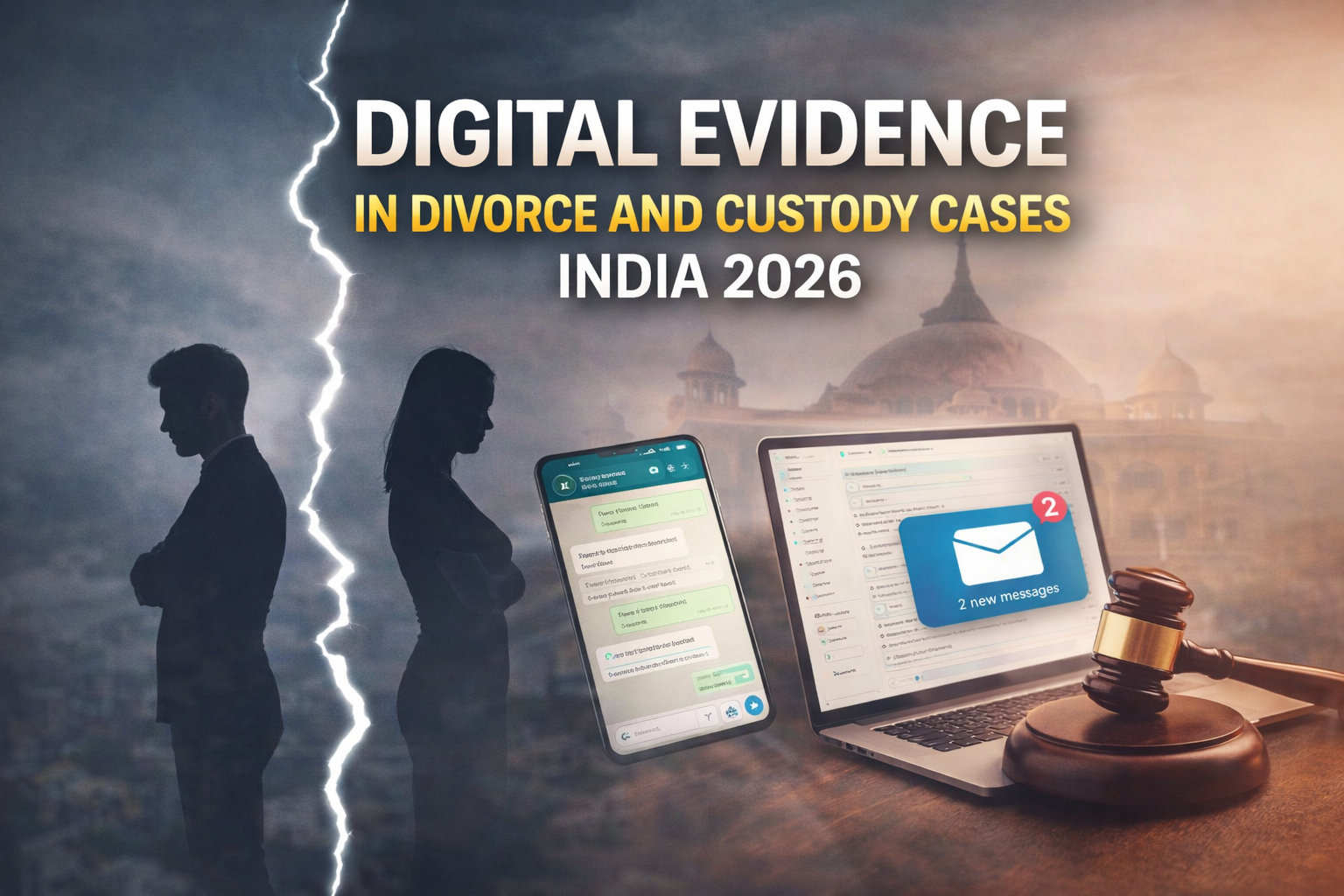
Today’s marriages live online. Every fight, every suspicious message, every secret location ping — they all leave a digital trail. Indian courts have started taking this trail very seriously, and 2026 is a landmark year. Digital Evidence in Divorce India 2026 is no longer a niche legal concept — it is the single most powerful weapon in matrimonial litigation. Whether you are fighting for justice in a divorce case or battling for your child’s custody, understanding how digital evidence works under India’s new Bharatiya Sakshya Adhiniyam (BSA) 2023 can make or break your case.
The old Indian Evidence Act of 1872 had limited provisions for electronic evidence. Sections 65A and 65B tried to keep up with technology — but barely. BSA 2023 is responsible for a complete overhaul of these rules. If one is involved in a disputing divorce or custody battle, this guide is what one can follow.
BSA 2023 vs Indian Evidence Act: What Changed for Digital Evidence?
The shift from the Indian Evidence Act (IEA) 1872 to BSA 2023 vs Indian Evidence Act digital rules is massive. The old law treated electronic records as secondary evidence — valid only if accompanied by a certificate under Section 65B. On a technicality, many real digital evidence have ended up thrown out by courts that included the certification lacking or otherwise defective.
Key Changes Under BSA 2023
Section 61 — Parity Clause: Under Section 61 BSA 2023 Parity Clause, electronic records now carry the same evidentiary weight as paper documents. A WhatsApp screenshot carries the same legal standing as a written letter — if properly certified.
Section 62 — Admissibility of Electronic Records: Any information generated, stored, or transmitted in electronic form is admissible as evidence, including emails, texts, social media posts, and call recordings.
Section 63 — Expert Certification: FThe certification process for digital records BSA 2023 requires a qualified digital forensic expert to authenticate electronic records. The new system replaces the previous 65B certificate requirement with a more advanced verification process.
Section 64 — Primary Evidence Expansion: Digital records stored in a server or cloud now qualify as primary evidence directly, without needing printed copies.
In simple terms, BSA 2023 makes digital evidence much easier to present in court — but also much harder to fake. Courts now expect proper chain of custody, hash value and metadata for legal evidence India, and expert verification.
How Digital Evidence in Divorce India 2026 Actually Works in Court
The process begins when you present Digital Evidence in Divorce India 2026 to either a Family Court or a District Court or a High Court. The step-by-step process needs to be explained to the audience.
Step 1 — Collect and Preserve the Evidence
- To prevent screenshots from being edited, make sure you include the timestamps of these chats, emails, social media posts-and carry them out immediately.
- Do not alter, crop, or edit the content because courts require hash value and metadata to establish legal evidence in India which demonstrates that the file remained unchanged.
- The unaltered device must be used to create copies or the original device needs to be submitted for forensic examination.
Step 2 — Get Expert Certification
- The certified digital forensic analyst needs to produce an expert-certified report which confirms the authenticity of digital records according to BSA 2023 standards.
- The analyst verifies the metadata — timestamps, device ID, IP address — and issues a certificate.
- The court will reject the evidence according to Section 63 of BSA 2023 without this certificate.
Step 3 — File the Evidence with the Court
- You need to submit certified copies of digital records together with the forensic expert’s certificate as part of your case documents.
- Family Court requires you to submit evidence together with the appropriate petition which you need to file under the Hindu Marriage Act 1955 or the Special Marriage Act 1954.
- In divorce cases which involve cruelty or adultery the digital evidence gets submitted through the Written Statement or through a separate Application for Additional Evidence.
Step 4 — Cross-Examination
- The opposing party’s advocate can cross-examine the forensic expert.
- The courts analyze the evidence collection methods to determine whether they meet legal standards. Evidence which has been obtained through hacking or unauthorized access will be completely rejected by the court.
How to Prove Adultery with Digital Evidence in India
The most searched legal question during 2026 asked how people in India prove adultery using digital evidence. The Supreme Court decriminalized adultery in Joseph Shine v. Union of India (2018) but Section 13(1)(i) of the Hindu Marriage Act permits yet sexual infidelity to serve as grounds for divorce.
The petitioner must prove an adulterous relationship through circumstantial evidence in order to demonstrate adultery for the divorce case. Digital evidence plays a decisive role here.
- WhatsApp / Signal / Telegram Chats: Romantic or sexually explicit messages exchanged with a third party serve as strong circumstantial evidence of adultery.
- Email Correspondence: Love letters or explicit emails from a partner’s account to a third party do not conform to the definition of a spousal communication or relationship under applicable privacy laws (Section 62, Act 20 of 1923).
- Hotel Booking Confirmations: Digital receipts, Uber invoices, or OYO/MakeMyTrip booking history has been greatly altered or simply erased to display the presence of someone illegally involved with the transgressor.
- GPS Location Data: Shared location history or GPS location data as evidence in custody battles and adultery cases is now accepted by courts when supported by forensic certification.
- Social Media Evidence: Tagged photos, direct messages, and timeline posts —social media evidence in Indian matrimonial cases has been accepted by multiple High Courts as circumstantial proof of an extramarital relationship.
Can Call Recordings Be Used in Divorce Court India?
Can call recordings be used in divorce court India? — Yes, they can, but with strict conditions.
- The recording you made of your conversation with your spouse is admissible in court because you participated in the call according to BSA 2023.
- The recording of another person’s call without their consent will be treated as an illegal intercept according to the Indian Telegraph Act 1885 and the Information Technology Act 2000. A forensic expert must confirm that the recording remains unaltered through editing or splicing or any other form of manipulation.
- The audio file must maintain matching hash value and metadata as its original version to serve as legal proof in India.
- The process requires transcription of all call recordings which must then be submitted together with the audio recording.
In Rakesh Kumar v. State of Rajasthan (2021), the Rajasthan High Court upheld a call recording as valid evidence in a matrimonial cruelty case because the petitioner was a direct party to the call and the recording was forensically verified.
GPS Location Data and Social Media in Custody Battles
Indian courts use the ‘best interest of the child’ standard to decide child custody cases. GPS location data as evidence in custody battles has emerged as a powerful tool to either prove or disprove a parent’s claims.
How GPS Evidence Works in Custody Cases
- The evidence shows that a parent can create Google Maps or Apple Maps timeline records to prove which locations their child visited when left unsupervised.
- The location evidence shows a parent visiting their bar and gambling den and third party residence during times of custody which creates strong evidence against them.
- The device’s location log needs to provide GPS data which requires verification from a forensic expert.
Social Media Evidence in Custody Disputes
- Family courts now maintain standard procedures for evaluating social media proof during Indian matrimonial disputes.
- Instagram and Facebook posts by parents which show their dangerous activities and drug abuse and their abandonment of the child will impact custody decisions.
- Social media private messages become admissible evidence when law enforcement agencies obtain them through court orders or when users choose to share their content.
- Courts have accepted parenting group chat screenshots as evidence because one spouse admitted to both neglect and abuse.
Real Case Studies: Digital Evidence in Divorce India 2026
Case 1 — Shilpa Sharma v. Rajat Sharma (Delhi High Court, 2023)
The spouse filed for a dissolution decree from the spouse on grounds of cruelty and adultery applying for both sections of Section 13(1)(ia) and 13(1)(i) of the Hindu Marriage Act, 1955.
- Evidence used: The evidence consists of WhatsApp messages which include intimate dialogues between the husband and a third person, hotel booking confirmations which were obtained from the husband’s email through the use of a shared device, and Google Maps location history that shows the husband visiting the third party’s home multiple times.
- Section applicable: The Indian Evidence Act (old) Section 65B remains in effect as the current Section 61-63 of BSA 2023. The evidence was supported by a certificate from a CERT-In empanelled forensic examiner.
- Process: The wife’s advocate filed a forensically certified USB drive containing the extracted data along with a 12-page expert affidavit. The husband’s counsel challenged the admissibility, but the court upheld it, noting that the chain of custody was unbroken and the hash values matched.
- Outcome: In the matter of claim and counterclaim for restitution of conjugal rights, the petitioners and respondents allegedly were married in 1991; the 25 years age gap led to a medical, economic, and financial dependence on the husband from the wife’s end, and unwanted pregnancies and abortions were alleged to ensue.
Case 2 — Priya Menon v. Anil Menon (Kerala High Court, 2024)
This was a bitter custody battle following a contested divorce. The mother alleged that the father was an alcohol-dependent individual unfit to exercise joint custody.
- Evidence used:The evidence includes Instagram stories and Facebook posts which show the father attending late-night parties and GPS data from the father’s connected car application which proves that the child was present in the car during his late-night high-speed driving and the father made threats to the mother during their recorded phone conversations which she participated in.
- Section applicable: Section 62 and 63 BSA 2023 for digital records; the call recordings were admitted under the one-party consent principle confirmed by the Kerala High Court.
- Process: The forensic expert showed how to analyze metadata through a practical demonstration which he performed in court. The court commissioned a court-commissioner to conduct an independent examination of the vehicle manufacturer’s server data about GPS information.
- Outcome: The court awarded sole custody to the mother. The court established that social media evidence from Indian matrimonial cases together with verified GPS data created an unbreakable pattern of behavior.
Case 3 — Vikram Rathore v. Sunita Rathore (Rajasthan High Court, 2025)
In rebuttal, she accused him of squandering the household funds on meaningless things and explained the pro thief stance taken by the latter in a defamation lawsuit.
Evidence used:The evidence presents three types of proof which include WhatsApp voice notes that display the husband using abusive language together with threatening statements and emails which the husband sent to his brother in which he confessed to committing physical violence and the husband’s Truecaller call logs which record his continuous harassment calls.
Section applicable: Section 61 BSA 2023 Parity Clause — the court treated the WhatsApp voice notes on par with oral testimony. The emails were admitted under Section 64 BSA 2023 as primary electronic documents.
Process: The wife filed a Domestic Violence complaint under Section 3 of the Protection of Women from Domestic Violence Act, 2005, alongside the divorce proceedings. The digital evidence was presented in both legal cases through cross-filing.
Outcome: The Rajasthan High Court dismissed the husband’s divorce petition which required him to provide interim maintenance and residential rights to his wife. The judge described the digital evidence as both essential proof and authentic verification of the case.
Why Hash Value and Metadata Matter in Indian Courts
If you have heard lawyers mention hash value and metadata for legal evidence India, here is what it means in plain language.
- Hash Value: A hash creates a distinct digital fingerprint which identifies a complete file through an algorithm-generated string of letters and numbers (SHA-256). The hash of a file changes entirely when any part of the image or text file content gets modified. Courts use hash verification to confirm that the evidence has not been altered since it was collected.
- Metadata: Metadata exists as concealed information within digital files which reveals the details of its creation including the creator’s identity, the creation time, and the device used for creation, and the creator’s IP address. The metadata of a WhatsApp screenshot reveals the exact time and device used to capture the screenshot. Courts utilize this method to detect fake screenshots.
- Why It Matters: The Bombay High Court eliminated WhatsApp screenshots from a matrimonial case in 2024 because the metadata showed the screenshots were captured two months after the supposed time of the chats. The opposing side had clearly backdated the screenshots — and the hash analysis caught it.
Conclusion: Digital Evidence in Divorce India 2026 — Know Your Rights
Digital Evidence in Divorce India 2026 is a field that rewards the well-prepared. The new BSA 2023 framework levels the playing field — it makes genuine evidence stronger and exposes fabricated evidence faster. The case benefits from a well-documented digital evidence trail which includes certified evidence that has been hash-verified and forensically analyzed to support the proof requirements of adultery, cruelty, desertion, and unfit behavior for custody.
Courts across India — from Family Courts in Udaipur and Jodhpur to the High Courts in Delhi, Bombay, and Kerala — are now comfortable accepting and acting upon Digital Evidence in Divorce India 2026. The key factors for authentication process need to establish both custody procedures and expert assessment credentials.
The system can obtain digital evidence through its existing capabilities because you need to prove your case through this evidence. The digital evidence requires urgent action because its permanent deletion will occur after 14 days.