The property laws of India underwent substantial alterations during the first months of 2026. The two states of Gujarat and Rajasthan which are governed by the BJP established important laws that determine property transactions for people who wish to sell or purchase land in specific restricted areas. These regulations operate at the intersection between two areas of real estate law and two types of historical records and constitutional protection rights. The rules must be understood by you because they apply to your property ownership your home buying activities and your real estate work in both states.
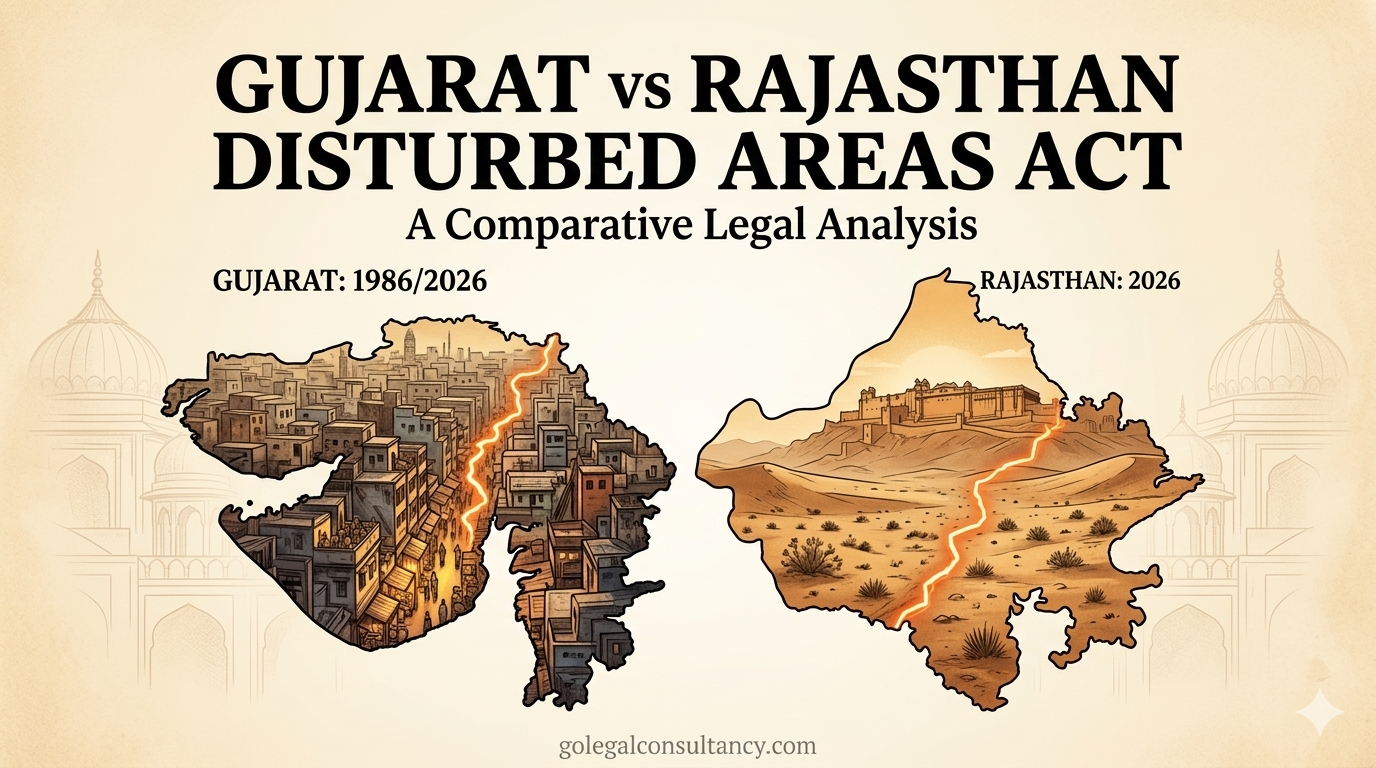
The blog provides a detailed analysis of the Gujarat vs Rajasthan Disturbed Areas Act by explaining its main differences and showing its legal development through time while detailing all modifications made to the law.
What Is the Disturbed Areas Act? Origins and Purpose
The Disturbed Areas Act Gujarat explained best begins in the mid-1980s. Ahmedabad was torn apart by repeated communal riots. Minority communities — particularly Muslims — began selling their properties at prices far below market value out of fear. The term “distress sale” describes this situation. The Gujarat government created a law in 1986 through an ordinance to prevent people from panicking and to safeguard property owners from forced departure.
Key milestone dates in Gujarat’s law:
- 1986 — The original Disturbed Areas Act introduced as an ordinance in Ahmedabad following communal violence
- 1991 — The Gujarat Prohibition of Transfer of Immovable Property and Provision for Protection of Tenants from Eviction from Premises in Disturbed Areas Act, 1991 (Gujarat Act No. 12 of 1991) received its official enactment through this process.
- 2010 — First set of amendments passed to widen coverage
- 2019 / 2020 — Major amendments passed. The Gujarat Assembly approved an important amendment in July 2019 which received Presidential approval and became effective in 2020. The amendment granted District Collectors extensive new powers.
- March 25, 2026 — The Gujarat Assembly approved the Disturbed Areas (Amendment) Bill 2026 which changed the term “disturbed areas” to “specified areas” while giving Collectors expanded authority.
The law’s stated goal was always to prevent involuntary or coerced property sales in communally sensitive areas. However, over 34 years of enforcement, critics argue that the Gujarat real estate law changes have created the very segregation they claimed to prevent.
How the Gujarat Disturbed Areas Act Works: Core Mechanics
Under the Gujarat Disturbed Areas Act explained, here is how the law operates on the ground:
1. Notification of a “Disturbed” or “Specified” Area
The District Collector identifies and officially notifies a neighbourhood as a “disturbed area” (now called a “specified area” after the 2026 amendment). This notification triggers all the property transfer restrictions under the Act. As of 2018, the law covered over 770 localities across cities including Ahmedabad, Vadodara, Surat, Himmatnagar, Godhra, Kapadvanj, and Bharuch. No area has ever been de-notified since the law came into force.
2. Mandatory Collector Permission for Property Transfer
Under Gujarat property transfer rules, once an area receives a “specified area” tag, no sale, gift, exchange, or lease of immovable property can happen without the prior written permission of the District Collector. This applies specifically to the Hindu-Muslim property transfer law Gujarat scenario — meaning transfers between members of different religious communities face the highest scrutiny. Every registration of property in a disturbed area requires the Collector’s sanction before the sub-registrar processes the documents.
3. Role of the Collector Under the 2020 and 2026 Amendments
The 2020 amendment (arising from the 2019 bill) significantly strengthened the collector permission property Gujarat framework. New powers included:
- Formation of a Special Investigation Team (SIT) comprising the Collector, Police Commissioner, and Municipal Commissioner
- Authority to assess whether a transfer might cause “polarisation” or “improper clustering”
- Power to check for “demographic equilibrium” disturbances
The Disturbed Areas Act amendment Gujarat of March 2026 went even further:
- Renamed “disturbed areas” to “specified areas” to reduce stigma — but expanded coverage criteria
- Expanded “aggrieved party” — now any resident of a specified area can approach the Collector to object to a property transfer, not just the buyer or seller
- Suo motu powers — the Collector can now investigate property transactions on their own initiative, without waiting for a complaint
- Possession authority — if a transfer is found “objectionable,” the Collector has the power to take physical possession of that property
- Monitoring and Advisory Committee — a new body advises the government on areas with potential for communal disturbance
- Mortgage allowed — the 2026 amendment introduced a new right: property owners in specified areas can now mortgage their property to financial institutions to obtain loans. This was not permitted earlier
4. Penal Provisions
Under real estate restrictions Gujarat Act, violations carry serious punishment:
- Pre-2020: Six months imprisonment
- Post-2020 amendment: Three to five years imprisonment, plus a fine of ₹1 lakh or 10% of the property’s value, whichever is higher
Gujarat High Court and Constitutional Challenges
The Gujarat vs Rajasthan Disturbed Areas Act legal debate traces heavily through judicial history. Courts have played a major role in defining the boundaries of this law.
Two petitions challenging the Act’s constitutional validity — filed in January 2021 and August 2022 — are pending before the Gujarat High Court benches led by the Chief Justice. One petition by Jamiat Ulama-e-Hind Gujarat sought an interim stay in 2024 alleging harassment of citizens, but the High Court refused.
However, petitioners succeeded on one front: the Gujarat High Court stayed the operation of the expanded “demographic equilibrium” and “proper clustering” provisions introduced by the 2020 amendment in January 2021, finding those terms too vague and granting excessive discretionary power.
Courts have consistently held that the Collector’s role under these laws must be limited to two checks only:
- Whether the sale reflects free and voluntary consent
- Whether the price reflects fair market value
The Gujarat High Court has ruled that law and order grounds alone cannot justify blocking a property transfer — a point made crystal clear in a March 2020 case involving a Hindu seller and Muslim buyers in Vadodara, where the court quashed the Collector’s refusal that was based on police reports about possible communal tensions.
The Rajasthan Disturbed Areas Act, 2026: A New Player Enters
Background and Timeline
Rajasthan became the second state in India to adopt a Disturbed Areas law. Here is the timeline:
- January 21, 2026 — The Rajasthan Cabinet approved the Bill
- January 28, 2026 — Bill introduced during the Budget Session of the State Assembly
- March 6, 2026 — The Rajasthan Prohibition of Transfer of Immovable Property and Provisions for Protection of Tenants from Eviction from the Premises in Disturbed Areas Bill, 2026 was passed by the Rajasthan Vidhan Sabha with a voice vote after a five-hour debate
- The Bill passed despite strong Opposition protests from Congress MLAs who demanded it be sent to a Select Committee for review
Core Provisions of the Rajasthan Act
The Rajasthan Disturbed Areas Act comparison with Gujarat reveals both similarities and critical differences:
Similarities with Gujarat:
- State government can declare any area “disturbed” based on communal violence, riots, or mob unrest
- Property transfer restrictions Rajasthan — all transfers in notified areas require prior permission from the competent authority (District Collector / District Magistrate)
- Any transfer made without this permission is null and void
- Violations are cognisable and non-bailable offences
- Punishment: Three to five years imprisonment plus a fine
- Declaration is valid for one year, extendable periodically
- Tenants in disturbed areas cannot be evicted without due process
Key Differences from Gujarat:
| Feature | Gujarat Act (1991 + 2026 Amendment) | Rajasthan Act (2026) |
| Origin Year | 1986 / 1991 | 2026 |
| Stated Purpose | Prevent distress sales from communal riots | Prevent “demographic imbalance” and “improper clustering” |
| Naming | Now called “Specified Areas” | Called “Disturbed Areas” |
| Collector’s Scope | Evolved through amendments and court rulings | Explicitly includes demographic concerns from day one |
| Judicial History | 34 years of High Court scrutiny and rulings | No judicial history yet — likely to face immediate challenges |
| Mortgage Provision | Allowed from 2026 onward | Not specified in initial Bill |
| Area Denotification | Never done in 35+ years | Unknown — no precedent |
Gujarat vs Rajasthan Disturbed Areas Act: The Critical Differences
When you compare the Gujarat vs Rajasthan Disturbed Areas Act side by side, the most important difference is in intent and language:
- Gujarat’s law — even after all its amendments — still uses the original language of protecting “distress sales” and preventing coercion. The law frames itself as protecting the seller from being forced out. Courts have repeatedly anchored the Collector’s role to this narrow definition.
- Rajasthan’s law — in contrast — is more explicit. Its preamble and ministerial statements frame the law around “safeguarding the demographic equilibrium and social harmony of Rajasthan” against “increasing population of a particular community.” Critics from the People’s Union for Civil Liberties (PUCL) and legal experts argue this crosses a constitutional line because it targets community identity rather than coercion.
The property law differences Gujarat vs Rajasthan are also visible in how each law came about:
- Gujarat’s law emerged from actual communal riots that had already caused documented distress sales in specific neighbourhoods
- Rajasthan’s law was introduced in a state not traditionally associated with large-scale communal violence of the Gujarat type, raising questions about the proportionality of the measure
Congress has already promised to repeal the Rajasthan Act if the party returns to power in 2028.
Impact on Real Estate: What Buyers and Sellers Must Know
For Gujarat Property Owners
Under Gujarat housing law update 2026, if you own property in a “specified area”:
- You cannot sell, gift, lease, or exchange your property without Collector approval
- You can now mortgage your property to banks or financial institutions for loans — this is a new right introduced by the 2026 amendment
- Third parties can object to your sale. Any resident of the specified area can file a complaint with the Collector
- The Collector can investigate your transaction without any complaint being filed
- If the Collector finds your transfer “objectionable,” the government can take possession of your property
For anyone investing in urban property laws Gujarat, these rules directly affect property liquidity, pricing, and investment risk in covered localities.
Real Estate Compliance Gujarat: Practical Steps
If you are buying or selling in a Gujarat “specified area,” follow this process:
- Verify the area’s status — check with the District Collector’s office whether the property falls under a notified specified area
- File an application with the District Collector seeking prior permission before executing any sale deed
- Submit supporting documents — title papers, identity, valuation report, and declaration of free consent
- Await Collector’s order — the law does not specify a fixed timeline, which has caused months-long delays in practice
- Ensure registration — the sub-registrar will not register the sale without the Collector’s prior sanction certificate
Property Sale Rules in Disturbed Areas — Rajasthan
Under the new Rajasthan Act, the process mirrors Gujarat’s but with key notes:
- The competent authority must satisfy itself that the transfer does not contribute to “improper clustering”
- Violation makes the sale agreement null and void from the beginning — you lose both the property and your money if you skip permissions
- Criminal liability attaches immediately — buyers and sellers can both face arrest under a non-bailable provision
Constitutional Concerns and Ongoing Legal Debate
Both the Gujarat vs Rajasthan Disturbed Areas Act frameworks face serious constitutional scrutiny. Legal experts cite three primary areas of concern:
Article 19(1)(f) / Right to Property — While property is no longer a fundamental right after the 44th Amendment (1978), the right to trade freely in property connects to Article 19(1)(g) (freedom to practice any occupation or trade) and Article 300A (protection from arbitrary deprivation of property).
Article 14 — Equality Before Law — Critics argue that the law applies differently in practice to Hindu-Muslim transactions compared to same-community transactions, violating the equality guarantee.
Article 19(1)(e) — Right to Reside — PUCL argues that creating permanent “disturbed” zones that restrict who can live where violates every citizen’s constitutional right to settle anywhere in India.
The land transfer rules India comparison shows that Gujarat and Rajasthan stand alone — no other Indian state has adopted similar property transfer restriction legislation based on communal composition of neighbourhoods.
Gujarat vs Rajasthan Disturbed Areas Act: A Summary Comparison Table
| Aspect | Gujarat | Rajasthan |
| Full Name | Gujarat Prohibition of Transfer of Immovable Property… Act, 1991 (Amended 2026) | Rajasthan Prohibition of Transfer of Immovable Property… Bill, 2026 |
| Effective Since | 1986 (ordinance) / 1991 (Act) | March 2026 |
| Areas Covered | 770+ localities in 7 cities | Yet to be notified |
| Area Name | “Specified Areas” (from 2026) | “Disturbed Areas” |
| Collector Powers | Expanded significantly via 2020 and 2026 amendments | Broad from inception |
| Mortgage Allowed | Yes (from 2026) | Not specified |
| Judicial Scrutiny | 34+ years of case law | None yet |
| Imprisonment | 3–5 years | 3–5 years |
| Fine | ₹1 lakh or 10% of property value | Specified in Act |
| Area Denotification | Never done | No precedent |
What These Laws Mean for India’s Real Estate Sector
The growing adoption of Disturbed Areas Act type legislation creates important signals for real estate compliance Gujarat and now Rajasthan:
- Property values in notified zones tend to stagnate because restricted liquidity reduces buyer interest
- Investors avoid specified areas due to legal uncertainty and the risk of Collector refusals
- Mortgage availability — the 2026 Gujarat amendment’s mortgage provision addresses a longstanding grievance of residents who could not use their biggest asset as collateral
- Developers and redevelopers must seek Collector permission before bringing new occupants to redeveloped properties in specified areas
- Legal due diligence costs rise significantly for any transaction in covered areas
Final Thoughts
The Gujarat vs Rajasthan Disturbed Areas Act debate is not just about property law — it cuts to the heart of how India balances community protection with individual rights. Gujarat’s model, built over 35 years through legislative amendments and High Court judgments, has moved far from its original narrow purpose of stopping distress sales. Rajasthan has now adopted a version that states its demographic goals even more explicitly.
For property owners, buyers, real estate professionals, and legal practitioners, understanding the detailed mechanics of property transfer restrictions Gujarat and Rajasthan’s new Act is not optional — it is essential. Both laws carry criminal penalties, void sales made without permission, and create administrative layers that directly affect your rights over your own property.
As courts take up constitutional challenges to the Rajasthan Act — and continue examining the Gujarat law — the Gujarat vs Rajasthan Disturbed Areas Act story will continue to unfold. Stay informed, consult legal counsel before any transaction in covered areas, and keep a close watch on High Court and Supreme Court developments in this space.