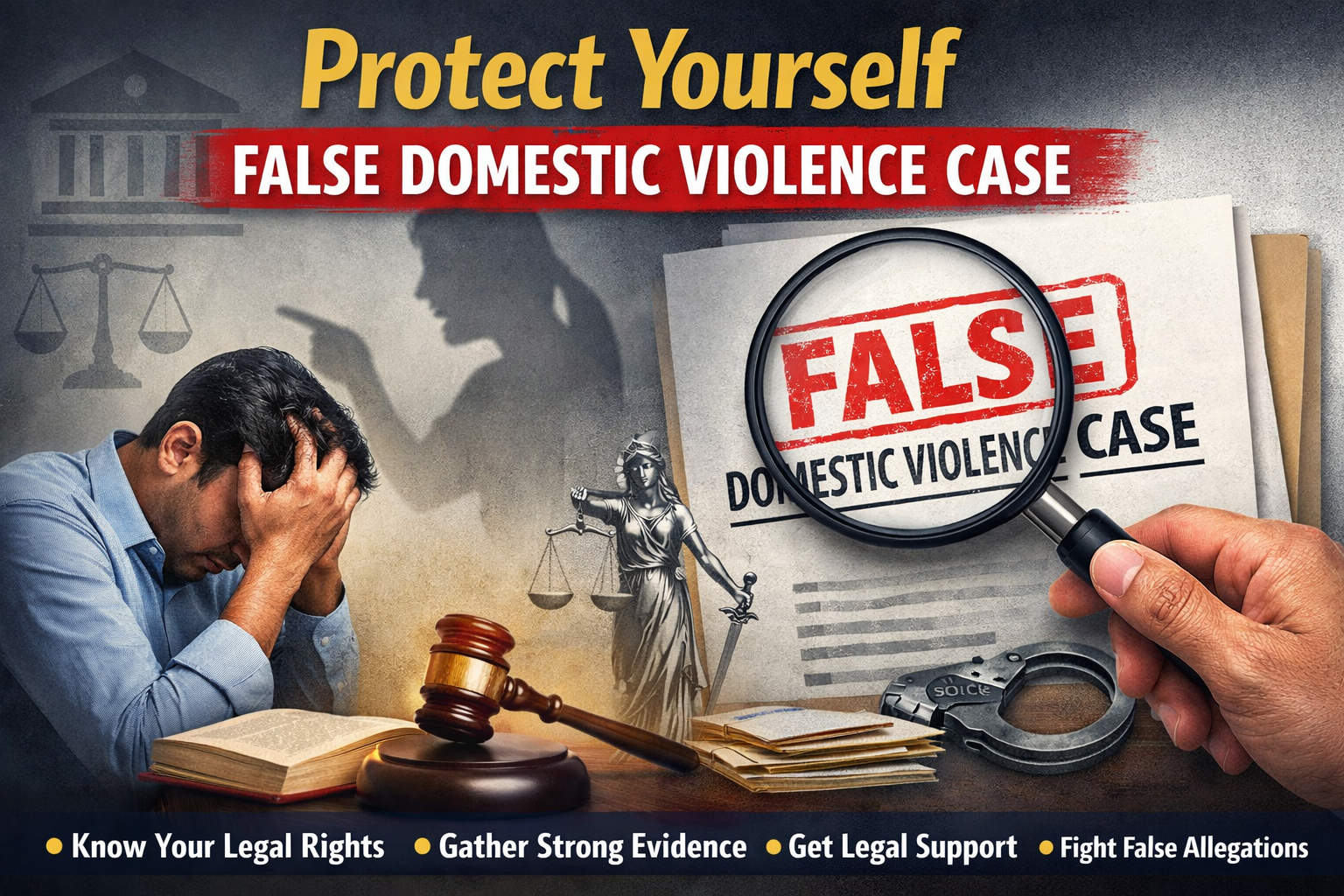
The Indian government established domestic violence laws to protect women from domestic violence attacks. The courts in India have recognized that people misuse these laws for their own purposes. The False Domestic Violence Case leads to serious damage because it takes away personal freedom and respect and job opportunities and psychological well-being of the accused person. The process starts with an arrest which results in financial expenses and social judgment and extended court battles which continue until the actual facts of the case are known.
The implementation of new criminal laws through the Bharatiya Nyaya Sanhita (BNS) and Bharatiya Nagarik Suraksha Sanhita (BNSS) laws which became effective in 2023 requires people to learn their legal rights for protection against False Domestic Violence Case.
This article provides a comprehensive explanation of the legal system which includes court protocols and defendant rights and methods for presenting evidence and the latest updates to legal statutes.
Understanding a False Domestic Violence Case in India
A False Domestic Violence Case refers to a complaint filed under the Protection of Women from Domestic Violence Act, 2005 (PWDVA), which includes criminal charges for cruelty, because the complainant made false accusations through exaggerated claims and complete fabrications.
Indian courts have clarified that the mere filing of a complaint does not establish guilt. The sensitive nature of domestic violence laws requires that accused individuals face immediate legal penalties before their trial begins.
The misuse of domestic violence law in India has become a judicial concern that continues to grow.
Key Domestic Violence Laws Frequently Involved
Having an understanding of the legal framework is essential to help you to fight against a false domestic violence case.
- Cruelty by Husband or Relatives – Earlier under IPC Section 498A, now continued under the Bharatiya Nyaya Sanhita, 2023, with similar ingredients.
- Protection of Women from Domestic Violence Act 2005 PWDVA – functions as a civil law which grants women protection orders and residence rights and monetary relief and compensation.
- cruelty from a husband and his relatives- existed as an offense under IPC Section 498A which now continues under the Bharatiya Nyaya Sanhita 2023 with its original elements.
- criminal procedure system- used to follow CrPC but the legal system now uses Bharatiya Nagarik Suraksha Sanhita 2023 which controls arrest procedures and bail processes and investigation methods.
A False 498A and domestic violence case often results in simultaneous civil and criminal proceedings against the accused.
False Domestic Violence Case: Common Indicators of Misuse
Certain patterns frequently appear in a False Domestic Violence Case:
- The allegations lack specific dates and particular incidents.
- No medical or independent evidence of violence
- Being mean to oneself is quite damaging to the other, too.
- Going indulgent once opens up to plethora of negative impacts.
- Claims contradicted by messages, emails, or location records
Courts treat such factors seriously when evaluating credibility.
Legal Remedies for False Domestic Violence Case
Legal remedies for false domestic violence case are firmly recognized under Indian law.
Key Remedies Explained:
- Anticipatory Bail: Protection from arrest when false allegations are anticipated
- Quashing of Proceedings: High Courts can terminate cases lacking substance
- Challenge to Interim Orders: Maintenance and residence orders can be contested
- Discharge Applications: Seeking removal from criminal proceedings at an early stage
Courts have clarified that criminal law must not be used as a tool for harassment.
How to Prove Domestic Violence Case Is False
In the context of a False Domestic Violence Case discrimination strongly depends on evidence.
How to prove domestic violence case is false involves:
- Digital evidence – includes call logs and WhatsApp chats and emails and social media messages.
- Medical records- show that there are no injury reports which contradict the claims of assault.
- location data – includes travel records and GPS data and office attendance records.
- Witnesses include – neighbors and colleagues and family members who do not take sides.
- statement discrepancies – arise from the differences found between the FIR and DV complaint and the affidavits.
Courts increasingly rely on documentary and electronic evidence over oral claims.
Rights of Husband in False Domestic Violence Case
The Indian Constitution protects the accused against arbitrary action. The rights of husband in false domestic violence case include:
- Right to personal liberty under Article 21
- Right against automatic arrest
- Right to a fair and impartial investigation
- Right to challenge ex-parte protection orders
- Right to reputation and dignity
Courts have emphasized that marriage disputes cannot justify mechanical arrests.
Supreme Court Guidelines on False Domestic Violence Cases
The Supreme Court guidelines on false domestic violence cases form the backbone of judicial protection.
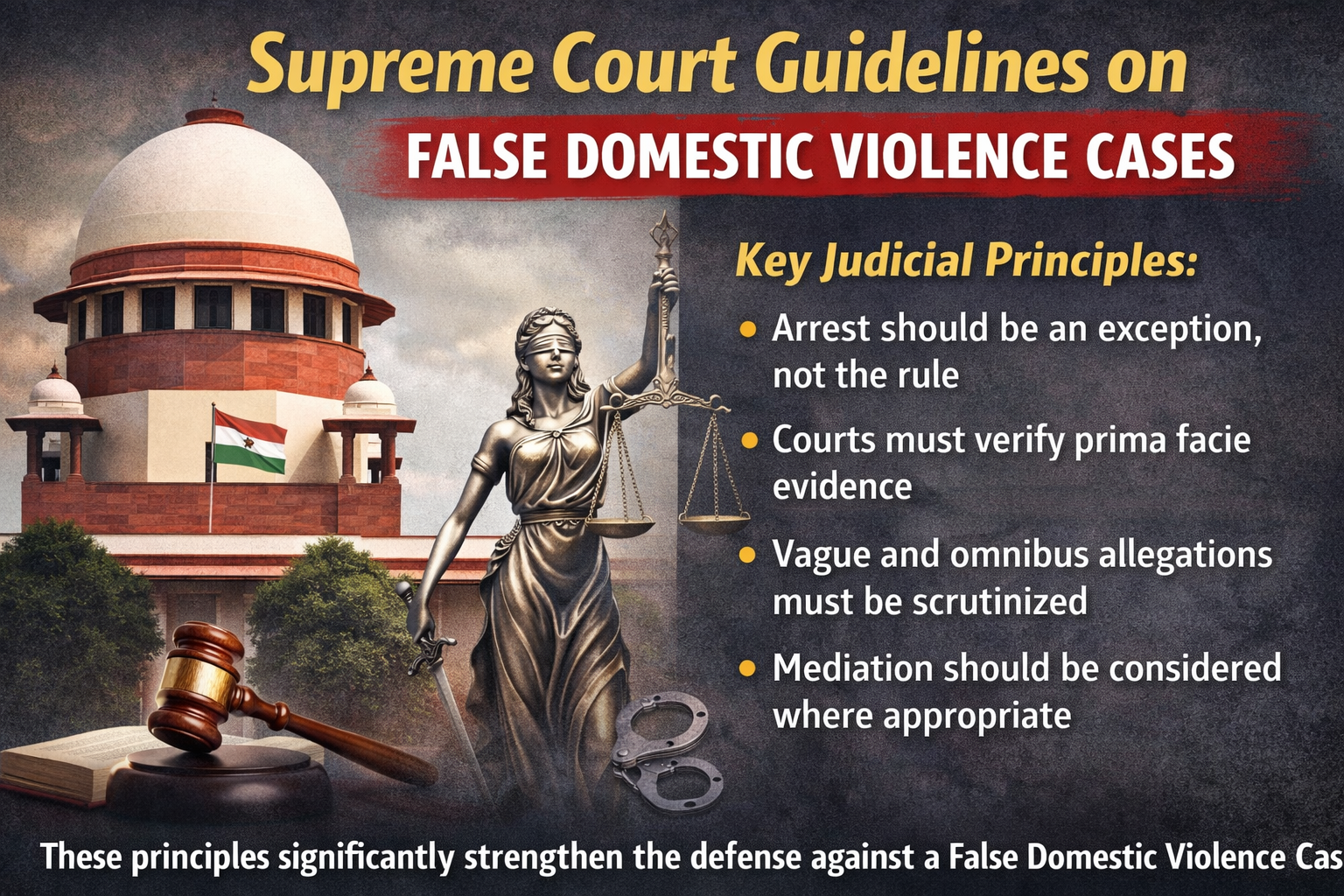
Key Judicial Principles:
- Arrest should be an exception, not the rule
- Courts must verify prima facie evidence
- Vague and omnibus allegations must be scrutinized
- Mediation should be considered where appropriate
- Misuse of matrimonial laws must be prevented
These principles significantly strengthen the defense against a False Domestic Violence Case.
Impact of New Criminal Laws 2023 (BNS & BNSS)
The 2023 legal reforms brought procedural clarity:
- Arrest procedures now emphasize written justification
- Investigation timelines are more structured
- Greater accountability on police officers
- Digital evidence recognition strengthened
- Safeguards against unnecessary detention reinforced
These changes help reduce abuse of process in a False Domestic Violence Case, especially during the initial stages.
Challenging Interim Maintenance and Residence Orders
Under PWDVA, courts may grant interim relief. In a False Domestic Violence Case, such orders can be challenged on grounds such as:
- Suppression of income details by complainant
- False claim of shared household
- Independent earning capacity of the complainant
- Absence of domestic relationship
Courts have clarified that interim relief must be based on verified facts.
Misuse of Domestic Violence Law in India: Judicial View
The misuse of domestic violence law in India has been openly acknowledged by High Courts and the Supreme Court.
Judicial observations highlight that:
- False cases dilute the seriousness of genuine complaints
- Law cannot become a means of extortion
- Balance between protection and fairness is essential
This evolving judicial mindset offers relief to those facing a False Domestic Violence Case.
Post-Case Remedies Against False Complaints
If a False Domestic Violence Case is quashed or ends in acquittal, legal action can be initiated against the complainant.
Available Actions:
- Defamation proceedings
- Action for giving false information to authorities
- Perjury for false statements under oath
- Civil compensation for mental harassment
Courts have upheld accountability for malicious prosecution.
Practical Do’s and Don’ts During a False Domestic Violence Case
Do’s:
- Preserve all evidence from day one
- Comply strictly with court orders
- Communicate only through legal counsel
- Maintain a detailed chronology of events
Don’ts:
- Avoid direct contact with the complainant
- Do not post case details online
- Do not ignore summons or notices
- Do not give statements without legal advice
Conclusion
The entire domestic life of an individual experiences disruption because of a False Domestic Violence Case, but Indian laws protect people through their existing legal safeguards when they pursue proper legal procedures. Justice requires people to understand legal solutions for false domestic violence cases and to know how to prove a domestic violence case as false and to learn about their rights as husbands facing false domestic violence accusations and to follow Supreme Court guidelines on false domestic violence cases.
Indian courts combine their current judicial interpretation with 2023 criminal law reforms to handle domestic violence law abuse while they still protect actual victims. Evidence, legal knowledge, and timely action remain the strongest defense against a False Domestic Violence Case.