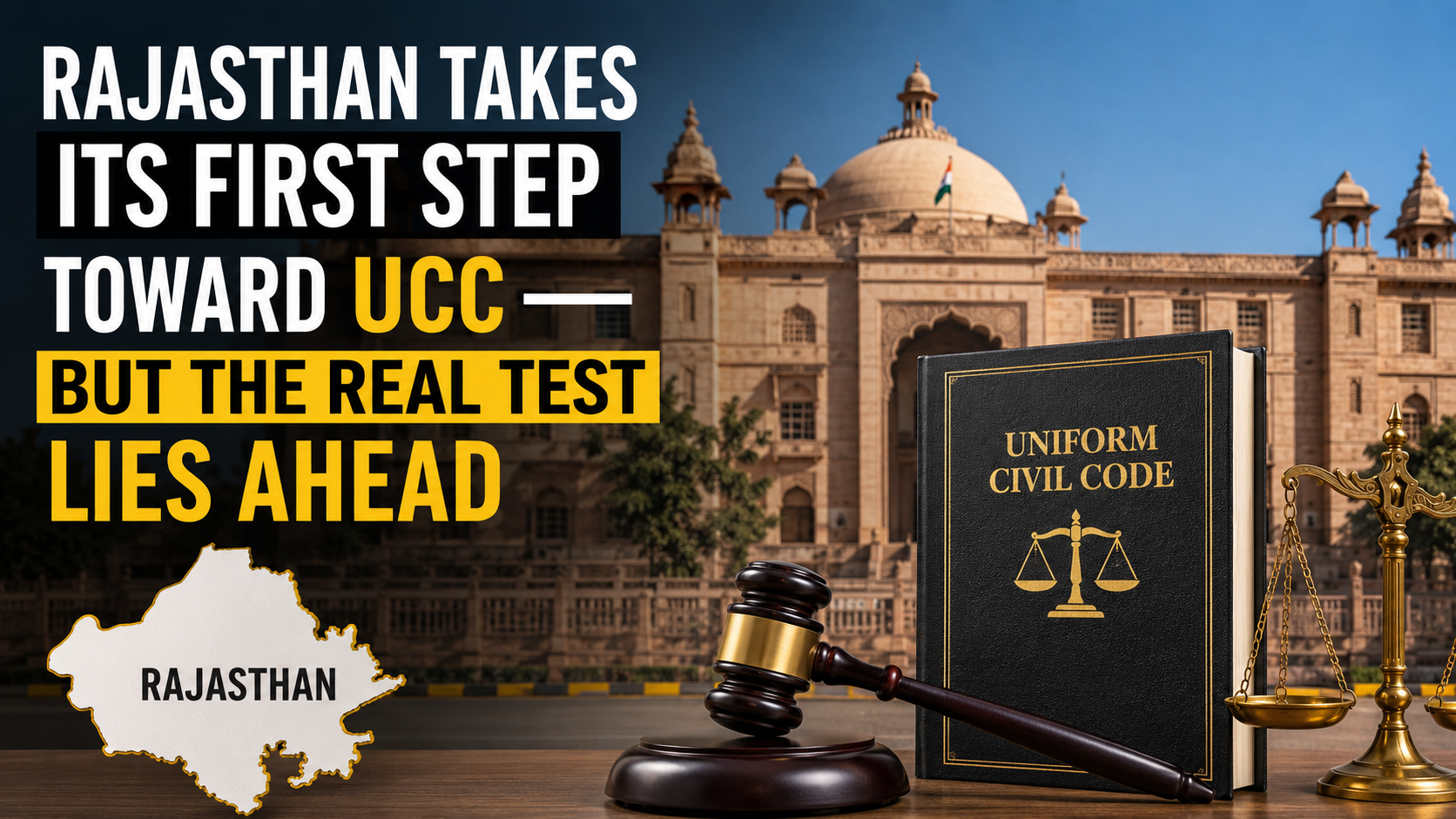
More than seven decades have passed. Since then, one question has echoed time and again — should every citizen of India be governed by the same law, regardless of their religion? The answer? It was always confined to political speeches. However, in June 2026, Rajasthan decided to change the narrative. They didn’t just talk; they constituted a committee.
The Rajasthan Uniform Civil Code, 2026 — or RUCC, as it is being called — is no longer just a distant dream. A high-powered expert panel has been set up to draft this legislation. And this is no ordinary panel. It is headed by former Supreme Court Justice, Ranjana Prakash Desai.
This is undoubtedly a massive stride. But the burning question remains — will it truly bring a monumental shift on the ground?
How and When the Decision Unfolded
On April 14, 2026, a pivotal meeting was held under the chairmanship of the Chief Minister of Rajasthan, where it was resolved that the state needed its own UCC. Following two months of meticulous groundwork, the official public announcement was made during a press conference on June 22, 2026, by Cabinet Minister Shri Jogaram Patel and Minister of State for Home, Shri Jawahar Singh Bedham.
Uttarakhand had already paved the way in 2024, becoming the first state in independent India to implement a UCC. Rajasthan has closely studied that model and is now carving its own path. The key distinction here is the deliberate approach — forming an expert panel first to curate the draft signals that the government is prioritizing legal soundness over political haste.
Five Members, One Massive Responsibility
The committee comprises five individuals from diverse professional backgrounds, showcasing the gravity with which the administration is treating this assignment.
Alongside Justice Desai is retired IAS officer Shri Shatrughan Singh, whose vast administrative experience will be crucial in translating legal theory into grassroots implementation. Representing the courtroom perspective is Basant Singh Chhaba, Additional Advocate General of the Rajasthan High Court, who knows exactly what will hold up under judicial scrutiny. The academic and scholarly depth is brought in by Shri Ramswroop Aggarwal, former Principal of Government Law College, Ganganagar, and Dr. Shuchi Chauhan. Additionally, the Additional Chief Secretary (Home) will serve as the Member-Secretary.
This diverse lineup indicates that the final draft will look beyond mere politics, balancing legal compliance with practical governance.
What Will the Law Actually Cover?
Now, let’s look at the core issue — what changes will the RUCC actually introduce?
- Uniform Marriage & Divorce Laws: Rules governing marriage and divorce will become identical for every citizen.
- Prohibition of Polygamy: A complete ban on polygamy will be enforced. This directly challenges existing Muslim personal laws, which currently permit it under specific religious tenets.
- Mandatory Registration of Live-in Relationships: This will provide solid legal protection to thousands of couples currently living in a legal “grey area”—especially safeguarding the rights of women.
- Equal Ancestral Property Rights: While the Hindu Succession Act was amended in 2005 to grant daughters equal coparcenary rights, it doesn’t apply uniformly across all communities. The RUCC aims to plug these systemic loopholes.
Public Consultation: The Ultimate Litmus Test
The committee has committed to a thoroughly democratic process. A dedicated online platform will be launched to gather feedback, suggestions, and grievances directly from the public.
Rajasthan is a mosaic of diverse tribal communities, distinct religious groups, and various OBC communities, each bound by centuries-old customs. If this public consultation turns into a mere paper-pushing exercise, the resulting law will be detached from ground realities. However, if executed authentically, it could set a historic precedent for how massive socio-legal reforms should be introduced.
Why Justice Ranjana Prakash Desai Matters
The choice of chairperson carries immense strategic weight. Justice Ranjana Prakash Desai is a highly respected legal mind. She has served as the first female chairperson of the Press Council of India and also headed the Delimitation Commission — a role demanding absolute institutional neutrality.
Her appointment sends a clear signal: the RUCC draft is intended to be a robust constitutional document rather than a political manifesto. Anyone wishing to oppose the draft will first have to challenge the unimpeachable credibility of Justice Desai, which will not be an easy task.
Article 44: A Long-Standing Promise
Back in 1950, Article 44 of the Indian Constitution envisioned that the State would endeavor to secure a Uniform Civil Code for its citizens. However, placed under the Directive Principles of State Policy, it remained non-justiciable — meaning it cannot be forcefully enforced by a court of law.
For decades, the Supreme Court nudged Parliament to act, but central leadership remained hesitant. Now, a new chapter of legal federalism is being written as individual states take matters into their own hands. First Uttarakhand, now Rajasthan — a trend is emerging where states choose not to wait indefinitely for national consensus.
The Road Ahead is Fraught with Challenges
To put it bluntly, this journey will be anything but smooth.
Muslim socio-religious organizations have historically opposed a UCC, viewing it as an infringement on the freedom of religion guaranteed under Article 25. Similarly, tribal communities — who enjoy distinct constitutional safeguards under the Fifth and Sixth Schedules — will likely require specific exemptions to protect their indigenous customary laws.
Perhaps the trickiest hurdle is the Concurrent List. Since personal laws fall under this domain, both the Center and the States have the power to legislate. This legal overlap is bound to trigger intense constitutional battles in the apex court.
The committee’s job is not just to write a progressive law; they must draft a piece of legislation that can survive the ultimate legal storm.
Frequently Asked Questions (FAQs)
Q1. What exactly is the Rajasthan Uniform Civil Code (RUCC) 2026?
It is a proposed state-level legislation aimed at creating a single, uniform set of laws governing personal matters like marriage, divorce, inheritance, and adoption for all citizens of Rajasthan, irrespective of their religion.
Q2. Who is heading the drafting committee?
The five-member committee is chaired by former Supreme Court Judge, Justice Ranjana Prakash Desai, who also holds the distinction of being the first female chairperson of the Press Council of India.
Q3. When was this decision made?
The administrative decision was finalized in a cabinet meeting on April 14, 2026, and the official public announcement was made on June 22, 2026.
Q4. What are the key focus areas of the RUCC?
The code will primarily focus on uniform marriage and divorce laws, a complete ban on polygamy, mandatory registration of live-in relationships, and ensuring equal gender rights in ancestral property.
Q5. Will ordinary citizens have a say in the drafting process?
Yes, the government will launch a dedicated online platform to invite suggestions, opinions, and feedback from the general public and stakeholders.
Q6. Who are the other members of this expert panel?
The panel includes retired IAS officer Shatrughan Singh, Rajasthan HC’s Additional Advocate General Basant Singh Chhaba, former Law College Principal Ramswroop Aggarwal, and Dr. Shuchi Chauhan. The Additional Chief Secretary (Home) is the Member-Secretary.
Q7. Is Rajasthan the first Indian state to introduce a UCC?
No. Uttarakhand became the first state in independent India to formally pass and implement a state-level Uniform Civil Code in 2024.
Q8. Is a state-level UCC constitutionally valid?
Since personal laws fall under the Concurrent List of the Indian Constitution, states possess the legislative competence to frame laws on these subjects. However, a final stamp of constitutional validity will ultimately depend on judicial review by the Supreme Court.